
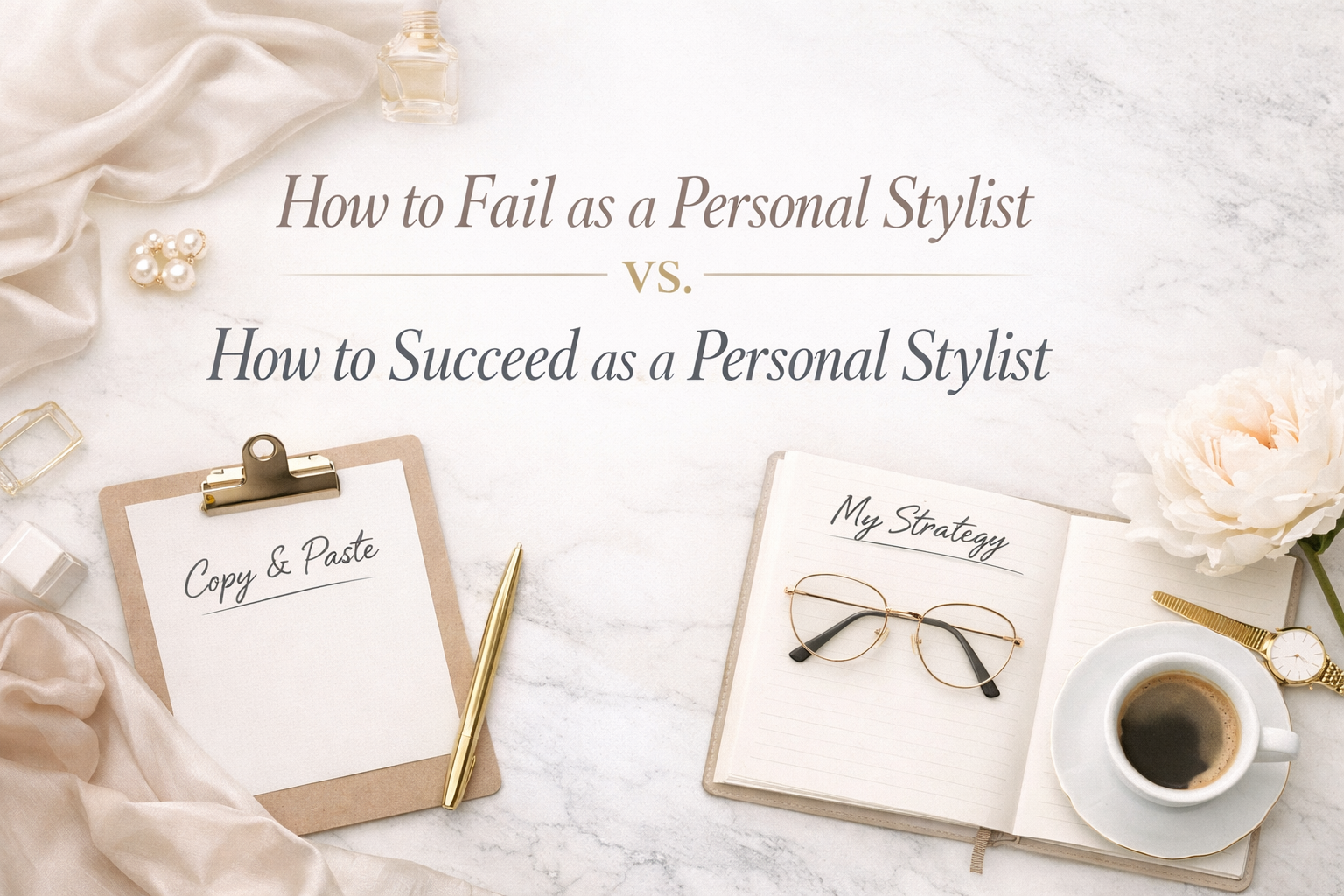
How to Fail as a Personal Stylist vs. How to Succeed as a Personal Stylist
Want to Know How to Fail as a Personal Stylist vs. How to Succeed as a Personal Stylist? The personal styling industry looks glamorous from the outside. Beautiful wardrobes. Luxury imagery. Social media followings. Photos from New York, Dubai, Paris. But behind the visuals, there’s a harsh truth:
Most personal stylists fail within their first few years.
Not because they lack taste.
Not because they lack ambition.
But because they build their careers on unstable foundations.
If you’re serious about learning how to succeed as a personal stylist, you need to understand what causes failure first.
There are two dominant models in this industry:
- The Mimic Model
- The Structured Authority Model
One produces short bursts of visibility.
The other builds long-term credibility and income.
Let’s examine both.
PART I: How to Fail as a Personal Stylist: The Mimic Model
How to Fail as a Personal Stylist Step 1. – Take a Course and Copy the Materials Instead of Developing Mastery
One of the fastest ways to fail as a personal stylist is to take a training program and replicate it word for word.
This often looks like:
- Repeating the instructor’s exact phrasing
- Reusing the same positioning language
- Mirroring service names
- Replicating pricing structures
Knowledge becomes memorized rather than embodied.
Clients can feel the difference between a stylist who understands their craft deeply and one who is reciting borrowed frameworks.
Surface-level imitation does not create authority.
How to Fail as a Personal Stylist Step 2. – Collect Certifications Instead of Building Competence
Another common failure pattern is stacking certifications without developing real-world skill.
Taking multiple classes and merging pieces of each into a loosely connected brand creates fragmentation.
When your business is built from copied fragments, it lacks coherence.
Stylists who succeed build intellectual structure.
Stylists who fail build collages.
How to Fail as a Personal Stylist Step 3. – Build a Brand Around Borrowed Authority
Imitation often shows up in branding:
- Similar bios
- Mirrored website positioning
- Echoed messaging
- Replicated service tier structures
- Matching tone and cadence
Here is the truth:
You cannot outperform the original.
Search engines reward original authority.
Clients recognize authenticity.
Markets eventually reject imitation.
A brand built on borrowed positioning collapses when comparison becomes obvious.
How to Fail as a Personal Stylist Step 4. – Confuse Aesthetic With Expertise
Beautiful imagery does not equal professional mastery.
Luxury backdrops and designer pieces may attract attention — but attention alone does not build a sustainable business.
Clients want:
- A clear styling process
- Defined deliverables
- Measurable outcomes
- Strategic wardrobe logic
Without a structured methodology, aesthetic branding eventually stalls.
How to Fail as a Personal Stylist Step 5. – Prioritize Visibility Over Infrastructure
Many stylists believe success equals:
- More followers
- More engagement
- More social media presence
But without:
- Clear contracts
- Defined service packages
- Strategic pricing
- Structured onboarding
- Business systems
Growth becomes chaotic.
And chaos does not scale.
The Result of the Mimic Model
Short-term spikes.
Inconsistent income.
Price resistance.
Constant rebranding.
Eventual burnout.
Now let’s explore the alternative.
PART II: How to Succeed as a Personal Stylist: The Structured Authority Model
If you truly want to understand how to succeed as a personal stylist, you must build what I call Structured Authority.
Structured Authority is not about volume. It is about clarity, coherence, and intellectual ownership.
How to Succeed as a Personal Stylist Step 1. – Develop a Proprietary Methodology
Success begins with system creation.
Ask yourself:
- What is my styling framework?
- What are my phases?
- What transformation do I deliver?
- How do I measure outcomes?
When you document your process clearly, you create intellectual property.
This makes you difficult to replicate.
How to Succeed as a Personal Stylist Step 2. – Position With Precision
Clear positioning answers:
- Who do I serve?
- What problem do I solve?
- What outcome do I provide?
- Why am I different?
Vague stylists compete on price.
Precise stylists compete on value.
Precision builds authority.
How to Succeed as a Personal Stylist Step 3. – Build a Real Business — Not Just a Social Media Presence
Authority-driven stylists build:
- Contracts
- Tiered service structures
- Professional pricing
- Client onboarding systems
- Repeatable processes
Talent without structure leads to instability.
Structure turns skill into income.
How to Succeed as a Personal Stylist Step 4. – Invest Deeply, Not Broadly
Instead of copying multiple mentors, master one discipline fully.
Practice consistently.
Refine through client experience.
Develop depth rather than dilution.
Depth creates confidence.
Confidence builds trust.
Trust converts.
How to Succeed as a Personal Stylist Step 5. – Build Long-Term Credibility
Authority compounds over time.
Successful stylists maintain:
- Consistent brand messaging
- Clear thought leadership
- Defined methodology
- Measurable client results
Real authority is structured, not reactive.
Mimic Model vs. Structured Authority Model
Below is a clear comparison between the two approaches.
| Mimic Model | Structured Authority Model |
|---|---|
| Copies mentor language | Develops proprietary methodology |
| Collects certifications | Masters one system deeply |
| Builds on borrowed positioning | Builds on intellectual property |
| Focuses on aesthetic visibility | Focuses on measurable outcomes |
| Competes on price | Competes on value |
| Short-term growth spikes | Long-term authority compounding |
| Reactive branding | Strategic positioning |
| Social proof dependent | System credibility driven |
| Easily replaced | Difficult to replicate |
| Burnout-prone | Infrastructure-supported |
Authority is built. Imitation is temporary.
Why Structured Authority Wins Long-Term
Search engines reward originality.
Clients reward clarity.
Markets reward structure.
Stylists who build intellectual property, systems, and professional infrastructure create careers that last 10–20 years — not just 12 months.
This is the difference between visibility and longevity.
Build a Styling Career That Cannot Be Replicated
If you are serious about learning how to succeed as a personal stylist — not just appear successful — structured training matters.
At Sterling Style Academy, we teach system-based styling, professional positioning, and real business architecture designed for long-term authority.
Explore professional personal stylist training here.
✔ Defined methodology
✔ Structured pricing tiers
✔ Professional contracts
✔ Long-term positioning strategy
Build your authority the right way.
Frequently Asked Questions
Why do most personal stylists fail?
Most personal stylists fail because they copy existing models instead of developing their own methodology. Without structured positioning, business systems, and intellectual ownership, their brand lacks long-term stability.
How long does it take to succeed as a personal stylist?
With structured training and consistent client application, many stylists begin earning within 6–12 months. But first you need to know how to become a personal stylist. Long-term authority typically develops over several years of strategic positioning and refinement.
What is the biggest mistake new personal stylists make?
The biggest mistake is imitation. Copying language, pricing, or branding from others prevents differentiation and weakens your authority, not theirs.
Is certification enough to become a successful stylist?
Certification is necessary but certification alone is not enough. Success depends on implementation, structured systems, professional positioning, and the ability to deliver repeatable client outcomes.
How do you build authority as a personal stylist?
Authority is built through:
- Developing a proprietary methodology
- Defining a niche
- Publishing good content
- Maintaining consistent professional positioning
- Delivering measurable results