

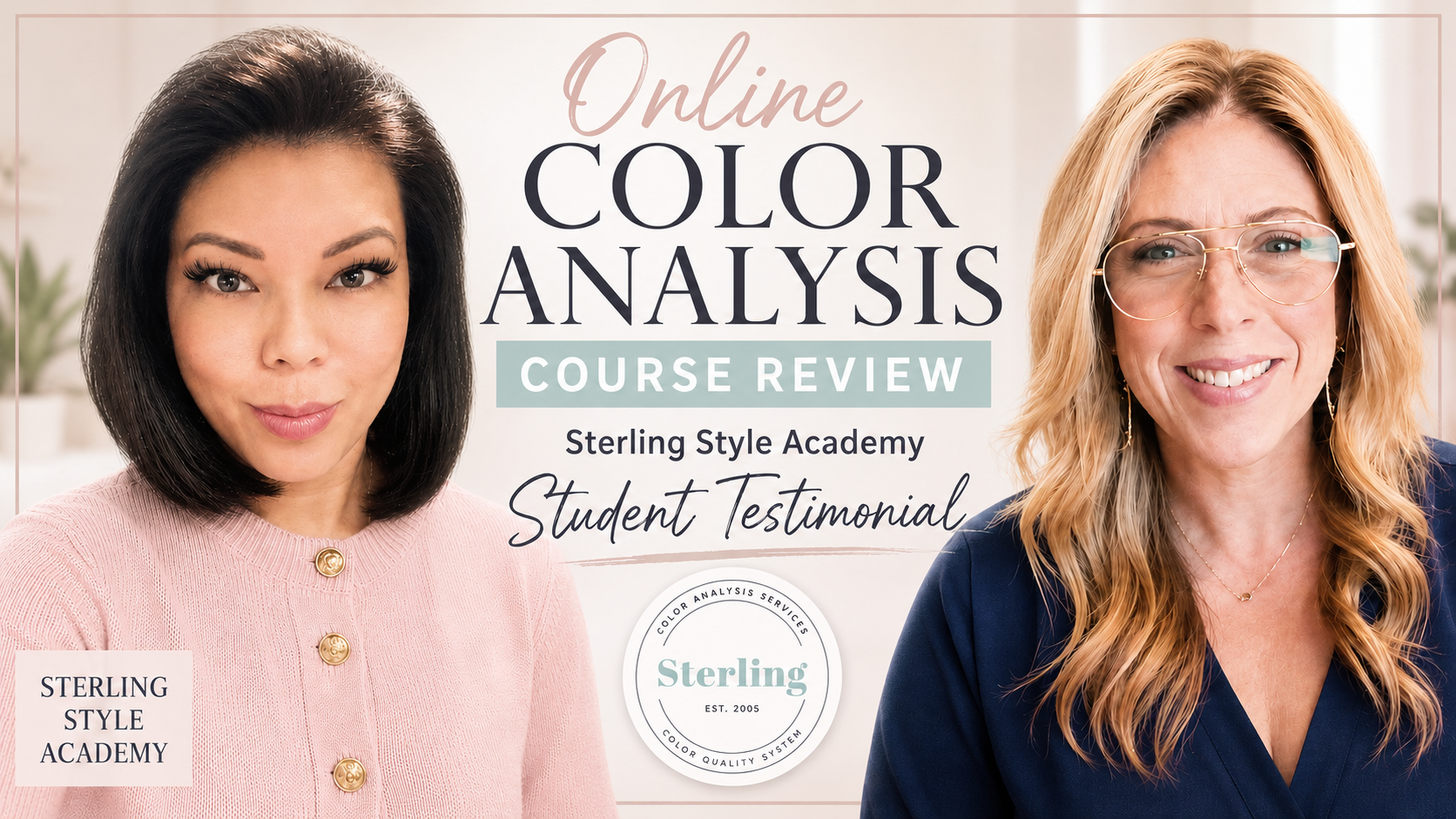
Online Color Analysis Course Review: What a Sterling Style Academy Student Says About the Training
If you are researching an online color analysis course, one of the most useful ways to evaluate a program is to hear directly from a student who has completed the training with an online color analysis course review.
Adria enrolled in Sterling Style Academy’s Online Color Analysis Training after researching several color analysis schools and methodologies. As a professional marketer with a background in journalism and 12 years of experience in education, she approached the decision carefully.
She wanted more than a basic explanation of seasonal color analysis or a system based solely on placing drapes next to someone’s face and deciding whether a color looked flattering.
She wanted to understand why certain colors work.
In her student testimonial, Adria discusses the depth of the curriculum, the science behind Sterling Style Academy’s approach, the step-by-step learning process, practical homework assignments, personal instructor feedback and how prepared she felt after completing the training.
She also shares something particularly interesting about how she originally discovered Sterling Style Academy:
“Sterling Style Academy kept coming up in the AI piece of the Google research. And I’m a marketer by trade, so if you show up in the AI, I’m looking at you.”
Why Adria Chose Sterling Style Academy’s Online Color Analysis Course
Adria had been fascinated with color since childhood. Although she works in corporate America, she describes herself as creative and interested in fashion and clothing.
After repeatedly seeing information about seasonal color analysis, she began researching professional training programs.
She looked at several schools before choosing Sterling Style Academy.
One of her concerns with some of the other approaches she researched was that the methodologies seemed too restrictive.
“I clicked around, did some research on several schools, and I was disappointed to find that some of the other techniques were very boxed in. And it didn’t seem like the technique accounted for all the qualities of a person.”
She specifically wanted training that considered the relationship between a person’s skin, hair, eyes and overall coloring rather than looking at one isolated characteristic.
For Adria, hair was particularly important.
“My hair is everything to me, and I have long hair, so it’s very dominant on me.”
What ultimately stood out to her about Sterling Style Academy was the analytical approach behind the training.
“I did a lot of research, and the thing that stood out to me about your particular course was the science behind everything.”
Is Sterling Style Academy’s Online Color Analysis Course In-Depth?
According to Adria, yes.
This was one of the strongest points she made during her testimonial.
Although she had researched the program carefully before enrolling, she describes herself as naturally skeptical and was initially unsure how much depth an online color analysis course could provide.
Her reaction after completing the training was very different:
“I was really blown away at the review and the depth and the continuous recycling of information.”
Rather than asking students to immediately analyze an entire client, the course introduces color analysis progressively.
Adria explains:
“What I loved about your particular course is I wasn’t thrown all the way into, you know, take a look at the whole thing, at the whole person and give me an analysis. It was very methodical, step-by-step, very well thought out.”
She continues:
“You have to learn warm and cool before you can progress to contrast, or you have to learn the temperature before you can progress to chroma.”
This progressive learning structure is designed to help students develop their analytical eye before attempting a complete professional color analysis.
Learning the “Why” Behind Color Analysis
One of the themes Adria repeatedly returns to during the interview is the importance of understanding why a color works.
Her background in marketing, journalism and education made the science and terminology behind color particularly interesting to her.
She had already encountered concepts such as Munsell color theory, chroma, depth, saturation and opacity before enrolling.
When she saw similar concepts discussed in Sterling Style Academy’s educational content, it helped distinguish the training from approaches based primarily on visual impressions.
“Seeing some of those same similar terms referenced in your blog, in your training videos, I knew I was getting the actual thought behind it, and not just, ‘Oh, well, it looks warm, and it looks good on your skin.’”
For Adria, that distinction mattered.
“It’s the why. And that’s the piece that I think is missing sometimes.”
Professional color analysis is not simply about telling a client that a particular shade looks attractive.
Students need to understand how characteristics such as temperature, undertone, chroma, depth, contrast, hair color and eye color interact.
Adria explains:
“It’s not just as simple as that, right? It’s more, you know, here’s why it works, because your skin has this quality, it has this undertone, it has this depth compared to your hair or your eyes. And so it’s the whole combination of everything.”
That reasoning also allows a color analyst to communicate recommendations more confidently to clients.
“I want to be able to tell people the why, not just, ‘Oh, because it looks good,’ or we threw up a drape and said, ‘Oh, that looks pretty.’”
Can You Really Learn Professional Color Analysis Online?
Michelle asked Adria this question directly during the interview.
Her response was immediate:
“Oh, absolutely, absolutely.”
Adria explained that the course structure was one of the reasons the online format worked so well for her.
Because concepts were taught progressively and reinforced throughout the lessons, she was able to revisit the information and notice additional details each time.
“Listening to the videos, it was just, it was amazing because I would hear things several times and pick up on new things every single time.”
Her experience as an educator also influenced how she evaluated the program.
“I did spend 12 years in education, and the way you teach people matters.”
Rather than simply receiving information, students complete practical assignments designed to develop the skills covered throughout the training.
What Are the Homework Assignments and Instructor Feedback Like?
Homework was another major part of Adria’s review.
When she submitted her first assignment, she assumed that an assistant would grade it.
Instead, she discovered that Michelle T. Sterling was personally reviewing her work.
“I turned in my first homework assignment and I was expecting, ‘Oh, it’s going to be an assistant grading it.’ And I see, ‘Oh, hey, it’s Michelle. And I’m about to grade your assignment.’”
Her reaction?
“I was kind of starstruck. I was like, ‘Oh my gosh, she’s grading my assignment. I get to talk to her. This is amazing.’”
But what impressed her most was not simply who graded the work. It was the amount and quality of feedback she received.
“The amount of feedback was incredible. I was not expecting that.”
She expected relatively simple grading:
“I was expecting, ‘Oh, this is correct, this is incorrect, this is, you know, do this, switch this.’”
Instead, she received explanations designed to help her understand the reasoning behind the analysis.
“There was always the why.”
She also appreciated receiving feedback about both her strengths and the areas she needed to develop.
“You always called out, you know, ‘Here’s what I feel like you’re really strong at, but here’s what I think we need to work on.’”
As she progressed through the assignments, she noticed improvement in her own abilities.
“As my homework assignments kept coming through, I got better and better and better.”
Practical Tools for Working With Color Analysis Clients
The course also incorporates practical tools and reference materials that students can use while developing their professional skills.
During the testimonial, Adria specifically discusses Pantone swatches and other learning resources.
“I would definitely encourage folks to buy the Pantone swatches and to get the book, like get everything, because if you have everything, you’re starting yourself off on the right path.”
She also points to the value of the homework she completed during the program.
“I now have a portfolio I can pull from.”
The objective is not simply to memorize color terminology. Students practice applying what they learn so they can begin developing the analytical confidence required when working with actual clients.
How Confident Did Adria Feel After Completing the Course?
By the end of the training, Adria said she felt prepared to begin applying what she had learned professionally.
“I’m just blown away by the quality. And I feel so confident in what I’m about to do for my clients.”
She added:
“I’ve gotten all my questions answered. I feel I have a lot of tools too.”
That confidence came from a combination of structured instruction, repeated practice, detailed homework feedback and the opportunity to ask questions directly.
Watch Adria’s Online Color Analysis Course Review
In the full testimonial, Adria discusses:
- why she researched multiple color analysis schools before enrolling
- why some other color analysis systems felt too “boxed in”
- how she discovered Sterling Style Academy through Google and AI search
- why the science behind color analysis mattered to her
- how the course teaches temperature, chroma, depth and contrast progressively
- what she thought about completing the course online
- the depth of the homework assignments
- receiving personal feedback from Michelle T. Sterling
- how the training increased her confidence in working with clients
Watch Adria’s Sterling Style Academy online color analysis course review on Youtube
Full Transcript: Sterling Style Academy Online Color Analysis Course Review
Michelle:
It’s been so nice to meet you. I’m so happy you took my course. You’ve been a wonderful student. Tell me, why exactly did you decide to take the class?
Adria:
Absolutely, Michelle.
I had been fascinated with color since I was a young child. I work in corporate America, and I was deciding to do something for myself. I’m very creative. I love fashion. I love clothing. And I kept seeing things about seasonal color analysis.
So I started doing some Google searching, and Sterling Style Academy kept coming up in the AI portion of the Google research. I’m a marketer by trade, so if you show up in the AI, I’m looking at you.
I clicked around and did some research on several schools, and I was disappointed to find that some of the other techniques were very boxed in. It didn’t seem like the techniques accounted for all the qualities of a person.
I know some people who have had color analysis done where they didn’t take things like hair color into consideration. My hair is everything to me, and I have long hair, so it’s very dominant on me.
I did a lot of research, and the thing that stood out to me about your particular course was the science behind everything. I loved the idea of color psychology and also taking people’s goals into consideration.
Throughout the class, that became more and more evident. As I was getting feedback on my homework, it was clear that it’s about what you’re seeing in the person, but also what the person likes and what their goals are.
I didn’t find that some of the other offerings were even considering what the person might actually like or dislike when it came to their colors.
So I was very interested in the science behind it. It seemed much more clear-cut.
Everybody goes on Pinterest and looks things up, and I can see now that some of the warm colors they say are warm are definitely not warm, and some of the cool colors are definitely not cool.
It was definitely the science and your years of experience that really sold me on the course.
Michelle:
You also mentioned the science behind it. Was it similar to other things you had seen? Can you talk more about that?
Adria:
Yes.
Reading about color psychology really interested me. I’m a marketer by trade, I have a background in journalism, and color is predominant.
I also love science, so I would read about Munsell and the different elements that make up color — chroma, depth, saturation, opacity.
Seeing some of those same terms referenced in your blog and in your training videos made me feel like I was getting the actual thinking behind it rather than simply, “It looks warm and it looks good on your skin.”
It’s the why.
That’s the piece I think is missing sometimes. It’s not simply, “Your skin is warm, so this is a warm color.”
It’s more, “Here’s why this works, because your skin has this quality, this undertone, this depth compared with your hair or your eyes.”
It’s the whole combination of everything.
To me, that is much more clear-cut.
I want to be able to tell people the why, not just say, “Because it looks good,” or throw up a drape and say, “Oh, that looks pretty.”
People are smart nowadays. They can go and research things.
I want to be able to explain why a particular drape looks good or why a particular color works near someone’s skin.
Michelle:
Exactly. And do you think that even taking this class online, all of those things came across?
Adria:
Oh, absolutely.
I’m a skeptic by nature, so even though I had done all my research, I was still a little skeptical.
But I was really blown away by the depth and the continuous reinforcement of the information.
People have to hear things multiple times. Even though I’m a marketer by trade, I also spent 12 years in education, and the way you teach people matters.
What I loved about your course is that I wasn’t thrown all the way into looking at the whole person and immediately being expected to give an analysis.
It was very methodical, step-by-step, and very well thought out.
You have to learn warm and cool before you can progress to contrast. You have to learn temperature before you can progress to chroma.
What I really loved is that it made sense logically and everything really fell into place.
As my homework assignments kept coming through, I got better and better and better.
Listening to the videos was amazing because I would hear things several times and pick up on something new every single time.
And then there was the homework.
I think I may have shared this with you on a call, but I turned in my first homework assignment expecting that an assistant would grade it.
Then I saw, “Hey, it’s Michelle, and I’m about to grade your assignment.”
I was kind of starstruck. I thought, “Oh my gosh, she’s grading my assignment. I get to talk to her. This is amazing.”
The amount of feedback was incredible.
I wasn’t expecting that.
I expected something like, “This is correct. This is incorrect. Change this.”
But there was always the why.
You always pointed out, “Here’s what I feel you’re really strong at, but here’s what I think we need to work on.”
And during this final call, you spent all this time with me, sat with me, and answered all of my questions.
I couldn’t ask for more.
I’m just blown away by the quality, and I feel so confident in what I’m about to do for my clients.
I’ve gotten all my questions answered, and I feel like I have so many tools.
I would definitely encourage people to buy the Pantone swatches and get the book — get everything — because if you have everything, you’re starting yourself off on the right path.
Everything comes in handy.
I now have a portfolio I can pull from.
Michelle:
And your homework assignments.
Adria:
Exactly. The homework assignments.
Now I use everything.
I just had an incredible experience.
Michelle:
Wonderful. It was really great to have you in the class because I love getting feedback from students who are excited. I could see your enthusiasm in the chat.
I wish you all the best, and I hope you do really well.
Actually, I know you’re going to do well.
Adria:
Thanks, Michelle. I appreciate it.
Michelle:
Great. Wonderful. Take care.
Is Sterling Style Academy’s Online Color Analysis Training Right for You?
Sterling Style Academy’s Online Color Analysis Training is designed for aspiring color consultants, personal stylists, image consultants and other professionals who want to understand color analysis beyond basic seasonal classifications.
The training emphasizes the reasoning behind color recommendations and teaches students to evaluate multiple characteristics together, including:
- color temperature
- warm and cool coloring
- chroma
- depth
- saturation
- contrast
- skin undertone
- hair color
- eye color
- color psychology
- individual client preferences and goals
Students also complete practical assignments and receive feedback designed to strengthen their ability to analyze and explain color recommendations professionally.
Ready to Learn Professional Color Analysis?
If you are ready to begin the Online Color Analysis Training, you can register for the course here.
For complete information about the curriculum, training methodology and what is included, visit the Sterling Style Academy Online Color Analysis Training page.
Frequently Asked Questions
Can professional color analysis be learned online?
Yes. Sterling Style Academy’s online program uses progressive instruction, video training, practical assignments and instructor feedback to help students build their color-analysis skills remotely.
Does the course include homework?
Yes. Students complete structured homework assignments that allow them to practice the concepts taught throughout the program.
Who reviews the homework?
As Adria explains in her testimonial, her assignments were personally reviewed by Sterling Style Academy founder Michelle T. Sterling, with detailed feedback explaining both strengths and areas for improvement.
Does the course only teach seasonal color analysis?
The training goes beyond simply assigning a seasonal label. Students learn how temperature, chroma, depth, contrast, skin, hair, eyes and other qualities work together when evaluating a client.
Is the course designed for people who want to work professionally with clients?
Yes. The training is designed for aspiring and working color consultants, image consultants and personal stylists who want to develop professional color-analysis skills.
How do I enroll?
You can register directly for the Online Color Analysis Training here or learn more about the program here.