
A Step-By-Step Guide on How to Become a Color Analyst
If you are wondering how to become a color analyst, you are probably interested in helping people discover the colors that make them look more confident, polished, and naturally harmonious.
A color analyst studies a client’s natural coloring and recommends the clothing, makeup, hair, and accessory colors that best support their appearance. This can include evaluating skin tone, undertone, hair color, eye color, contrast, color temperature, depth, brightness, and overall harmony.
Color analysis is one of the most valuable skills in personal styling, image consulting, beauty, and wardrobe consulting because it gives clients something practical: a clearer understanding of what colors actually work for them.
This guide walks you through the real steps to becoming a color analyst, from learning color theory to practicing consultations, building confidence, and offering color analysis as a professional service.
What Is a Color Analyst?
A color analyst is a trained professional who helps clients identify the colors that flatter their natural features. The goal is to create harmony between the client’s personal coloring and the colors they wear.
A color analyst may recommend:
- Clothing colors
- Wardrobe neutrals
- Makeup shades
- Lipstick and blush colors
- Hair color direction
- Jewelry metals
- Accessories
- Professional wardrobe colors
- Special event colors
- Personal branding colors
A color analyst does not simply choose favorite colors. The role requires understanding how color interacts with the client’s skin, hair, eyes, and overall contrast level.
When color analysis is done well, the right colors can make the client appear fresher, brighter, more rested, more polished, and more visually balanced.
Color Analyst vs Color Consultant: What Is the Difference?
The terms color analyst and color consultant are often used interchangeably, but there is a slight difference.
A color analyst usually focuses on analyzing a person’s natural coloring and identifying their most flattering colors.
A color consultant may do personal color analysis, but the title can also apply more broadly to professionals who advise on color for interiors, home staging, branding, retail, design, or visual presentation.
For example, a personal stylist may become a color analyst to help clients choose better clothing and makeup colors. A home stager or interior designer may study color consulting to better select paint colors, textiles, and décor palettes.
If your main goal is to offer professional personal color analysis, becoming a color analyst is the most relevant path.
If you want to understand the broader certification path, you can also read our guide on how to become a certified color analyst.
Why Become a Color Analyst?
Color analysis is popular because people want to make better style decisions. Many clients feel overwhelmed by shopping, trends, makeup choices, and wardrobe mistakes. They may own many clothes but still feel like nothing looks quite right.
A color analyst helps solve that problem.
Clients often want to know:
- What colors look best on me?
- Am I warm or cool?
- What is my color season?
- Why do some colors make me look tired?
- What makeup shades should I wear?
- What hair color suits me?
- What colors should I stop buying?
- How do I build a wardrobe around my best colors?
Color analysis gives clients clarity. It helps them stop guessing and start making more intentional choices.
For professionals, color analysis can be a powerful service because it can stand alone or be added to personal styling, image consulting, makeup artistry, hair styling, wardrobe consulting, or personal shopping.
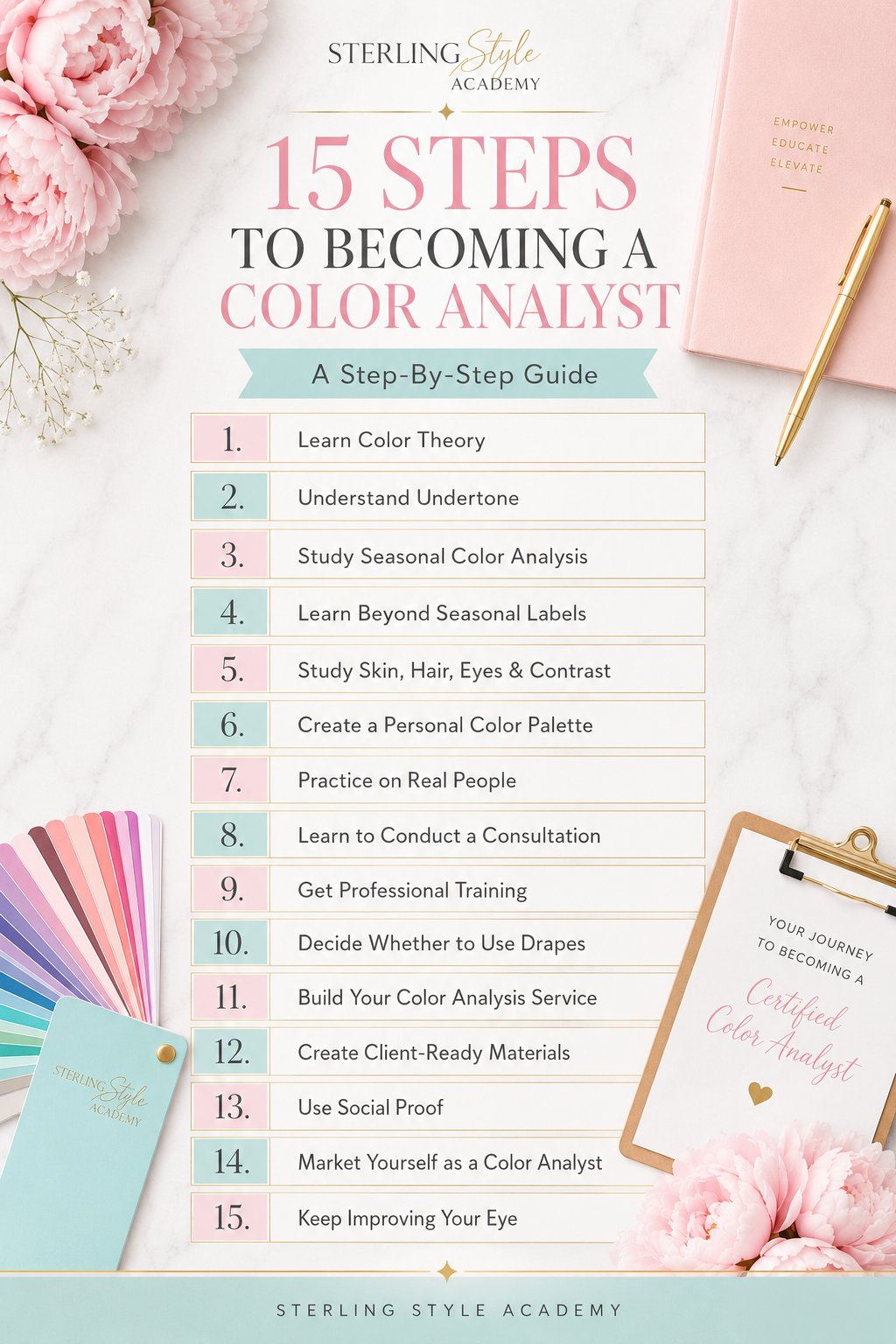
How to Become a Color Analyst Step 1: Learn the Foundations of Color Theory
The first step to becoming a color analyst is learning color theory. You need to understand how color works before you can confidently analyze clients.
Important color theory concepts include:
- Hue
- Value
- Chroma
- Undertone
- Saturation
- Contrast
- Temperature
- Harmony
- Color relationships
These concepts help you understand why one shade of pink may flatter a client while another shade of pink may look harsh, dull, or disconnected.
Color analysis is not about memorizing a list of “good” and “bad” colors. It is about understanding why certain colors create harmony with a client’s natural coloring.
For example, one client may look beautiful in soft rose, while another may need bright fuchsia. One client may glow in warm ivory, while another may look better in crisp white. One client may need muted earth tones, while another may need clear jewel tones.
A trained color analyst learns how to see these differences.
How to Become a Color Analyst Step 2: Understand Undertone
Undertone is one of the most important parts of color analysis, but it is also one of the most misunderstood.
A client’s undertone may be:
- Warm
- Cool
- Neutral
- Olive
- A blend of undertone qualities
Many people assume that fair skin is always cool or deeper skin is always warm. This is not true. People of every skin depth can have warm, cool, neutral, or olive undertones.
A color analyst must learn how to evaluate undertone carefully instead of relying on oversimplified rules.
For example:
- Yellow surface tone does not always mean warm undertone.
- Redness in the skin does not always mean cool undertone.
- Olive undertones can be complex and may not fit simple warm/cool categories.
- Dyed hair and makeup can distort the analysis.
- Lighting can change how undertone appears.
This is why professional training matters. A strong color analyst learns to look at the whole person and how they respond to color.
How to Become a Color Analyst Step 3: Study Seasonal Color Analysis
Seasonal color analysis is one of the most recognized color analysis systems. It organizes people into color palettes such as Spring, Summer, Autumn, and Winter.
The four traditional seasons are:
- Spring
- Summer
- Autumn
- Winter
Each season has different color qualities.
Spring colors are usually warm, clear, and fresh.
Summer colors are usually cool, soft, and refined.
Autumn colors are usually warm, rich, and earthy.
Winter colors are usually cool, clear, deep, or high contrast.
Many modern systems also use 12 seasons, such as Light Spring, Soft Autumn, True Summer, and Bright Winter.
As a color analyst, you should understand seasonal color analysis because many clients will ask about it. Even if your method is not limited to the seasonal system, you need to be able to explain how seasons work and where they can be helpful.
For a deeper explanation, read our guide on what seasonal color analysis is.
How to Become a Color Analyst Step 4: Learn Beyond Basic Seasonal Labels
Seasonal color analysis is useful, but real clients do not always fit neatly into one simple category. This is why a professional color analyst needs to understand the color qualities behind the seasons.
The most important qualities include:
- Warm vs cool
- Light vs deep
- Soft vs bright
- Muted vs clear
- Low contrast vs high contrast
- Neutral vs strongly warm or cool
This is where color analysis becomes more precise.
For example, two clients may both be considered “Autumn,” but one may need soft, muted colors while another needs deep, rich, dramatic colors. Two clients may both be “Winter,” but one may look best in bright icy colors while another needs darker, more intense shades.
A professional color analyst learns to identify these differences instead of giving every client a generic seasonal result.
How to Become a Color Analyst Step 5: Study Skin, Hair, Eyes, and Contrast
Color analysis should evaluate the full relationship between a client’s skin, hair, eyes, and contrast level.
A strong analysis may consider:
- Skin tone
- Undertone
- Hair color
- Eye color
- Natural contrast
- Depth
- Brightness
- Softness
- Overall harmony
Contrast is especially important. Some clients look best in high-contrast combinations, such as black and white or bold jewel tones. Others look better in softer, blended combinations with less sharp contrast.
A client with deep hair and bright eyes may need a different palette than a client with soft hair, soft eyes, and low contrast. A client with warm skin and golden hair may need different colors than a client with warm skin and deep brunette hair.
The goal is to study the whole person, not just one feature.
How to Become a Color Analyst Step 6: Learn How to Create a Personal Color Palette
A personal color palette gives the client a practical guide for shopping, styling, makeup, and wardrobe planning.
A good palette should help the client understand:
- Their best colors
- Their best neutrals
- Their best accent colors
- Their best makeup direction
- Their best hair color direction
- Which colors to avoid or soften
- How to combine colors in outfits
- How to shop more intentionally
The palette should feel useful, not overwhelming. Clients need to know how to apply the information in real life.
This is where a color analyst becomes more than a person who gives a label. You are helping the client make better decisions.
How to Become a Color Analyst Step 7: Practice on Real People
Color analysis skill improves with practice. You need to see how different colors affect different people.
Practice helps you understand:
- How undertones appear in real clients
- How lighting affects analysis
- How dyed hair can influence perception
- How contrast changes color recommendations
- How makeup can help or distort results
- How clients respond emotionally to color advice
- How to explain results clearly
Start by practicing with friends, family, or volunteer clients. Study their coloring, test your observations, and notice what makes them look clearer, brighter, softer, stronger, or more harmonious.
The more people you analyze, the more confident your eye becomes.
How to Become a Color Analyst Step 8: Learn How to Conduct a Professional Consultation
A color analyst needs more than technical knowledge. You also need consultation skills.
A professional color consultation should feel organized, clear, and helpful. Clients should understand what you are doing and why your recommendations make sense.
A consultation may include:
- Asking about the client’s goals
- Reviewing their current wardrobe challenges
- Evaluating their natural coloring
- Explaining undertone and contrast
- Identifying flattering color directions
- Discussing best neutrals and accent colors
- Recommending makeup and hair color direction
- Showing how to use the palette in real life
- Answering client questions
The consultation should not feel like a confusing lecture. It should feel like a personalized style solution.
How to Become a Color Analyst Step 9: Get Professional Color Analysis Training
You can learn basic color theory on your own, but professional training helps you move faster and avoid common mistakes.
A strong color analysis training program should teach:
- Color theory
- Undertone analysis
- Seasonal color analysis
- Tonal color analysis
- Contrast
- Client consultation structure
- Wardrobe color application
- Makeup color guidance
- Hair color direction
- How to explain results
- How to offer color analysis as a service
Sterling Style Academy offers an Online Color Analysis Certification for students who want flexible professional training from anywhere.
If you prefer hands-on classroom training, you can also explore our 2-Day Color Analysis Training In-Person.
How to Become a Color Analyst Step 10: Decide Whether You Want to Use Drapes
Some color analysis systems rely heavily on fabric drapes. Draping can be useful, especially in an in-person setting, because it allows the analyst and client to compare colors directly near the face.
However, drapes are not the only way to learn color analysis.
Sterling Style Academy teaches students how to evaluate skin tone, undertone, hair color, eye color, contrast, and overall harmony through a professional method that does not rely entirely on traditional draping.
If you are interested in this approach, read our guide on a color analysis course online without using drapes.
How to Become a Color Analyst Step 11: Build Your Color Analysis Service
Once you have training and practice, you can begin designing your color analysis service.
Your service may include:
- Online color analysis
- In-person color analysis
- Wardrobe color consultation
- Makeup color consultation
- Hair color direction
- Closet edit by color
- Personal shopping by palette
- Group color analysis workshop
- Color analysis party
- Color analysis add-on for styling packages
You can keep your offer simple at first. For example, you may begin with one online color analysis package or one in-person consultation. As you gain experience, you can add more detailed options.
How to Become a Color Analyst Step 12: Create Client-Ready Materials
Clients need something they can refer back to after the consultation. This may include a digital palette, written notes, a short report, shopping guidance, or a wardrobe color checklist.
Client-ready materials may include:
- Best colors
- Best neutrals
- Colors to avoid
- Makeup recommendations
- Hair color guidance
- Shopping tips
- Outfit color combinations
- Seasonal or tonal explanation
- Personal style notes
The goal is to make the result easy to use. A client should leave the consultation knowing what to look for when shopping and what to avoid buying again.
One of the best ways to understand a training program is to hear from students who have completed it.
How to Become a Color Analyst Step 13: Look for Student Reviews for Learning Color Analysis Online
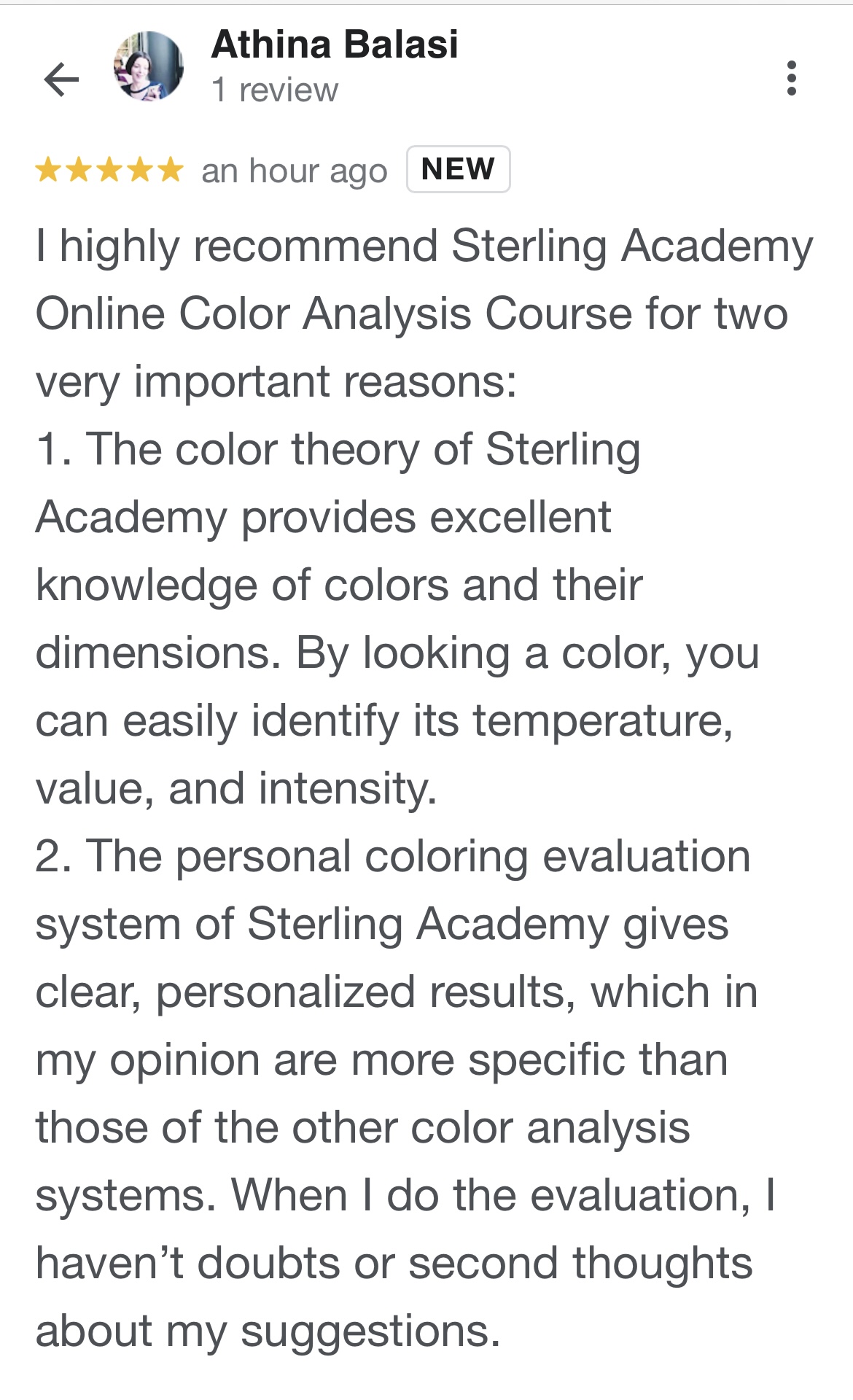
Sterling Style Academy has received student feedback from individuals who appreciated the flexibility of online color analysis training, the ability to study at their own pace, and the practical application of the method.
These types of student experiences help future students understand what the training feels like from a real learner’s perspective.
For anyone researching how to become a color analyst, social proof is important because it helps answer a practical question: “Can I actually learn this online and use it with clients?”
How to Become a Color Analyst Step 14: Market Yourself as a Color Analyst
After you learn color analysis, you need to help people understand what you offer.
You can market yourself through:
- TikTok
- YouTube
- Email marketing
- Local partnerships
- Beauty collaborations
- Styling packages
- Workshops
- Referral programs
Helpful content topics include:
- What is color analysis?
- How to know your color season
- Warm vs cool undertones
- Best colors for your skin tone
- Why certain colors wash you out
- How to choose lipstick for your undertone
- What colors make you look younger
- Can color analysis be done online?
- What happens in a color analysis consultation?
Educational content helps potential clients understand the value of your service before they book.
How to Become a Color Analyst Step 15: Keep Improving Your Eye
Becoming a strong color analyst takes ongoing practice. Certification and training give you the foundation, but your skill grows as you work with more clients.
Continue studying:
- Different skin tones
- Different undertones
- Olive undertones
- High contrast coloring
- Low contrast coloring
- Soft coloring
- Bright coloring
- Makeup application
- Hair color changes
- Lighting conditions
- Client feedback
The more examples you study, the better you become at recognizing patterns.
A strong color analyst keeps learning and refining their eye.
Can You Become a Color Analyst Online?
Yes. You can become a color analyst online if the training teaches a structured method and gives you the knowledge to practice with real clients.
Online learning is especially helpful if you need flexibility or cannot travel to an in-person class. You can study the material, review lessons, practice with examples, and build your confidence over time.
Online training may be a good fit if you:
- Want to study from anywhere
- Prefer flexible learning
- Want to add color analysis to an existing service
- Are starting a styling or image consulting business
- Want to offer online consultations
- Need a more accessible training option
Sterling Style Academy’s Online Color Analysis Certification is designed for students who want to learn professional color analysis remotely.
How Much Does It Cost to Become a Color Analyst?
The cost to become a color analyst depends on the type of training you choose. Some in-person color analysis programs cost more because they may include live instruction, physical tools, classroom time, and travel expenses.
Online training is often more accessible because you do not need to pay for flights, hotels, or travel.
Sterling Style Academy’s online color analysis training is priced at US$697, making it a flexible option for students who want professional training from anywhere.
You can compare training costs in our guide on how much color analysis training costs.
What Skills Do You Need to Become a Color Analyst?
To become a color analyst, you need both technical and interpersonal skills.
Important skills include:
- Strong eye for color
- Understanding of color theory
- Ability to analyze undertone
- Ability to identify contrast
- Knowledge of seasonal color analysis
- Ability to explain concepts clearly
- Listening skills
- Client consultation skills
- Styling or beauty awareness
- Confidence giving recommendations
A client may come to you feeling confused or insecure about their appearance. Your role is to give clear, supportive guidance that helps them make better decisions.
What Services Can a Color Analyst Offer?
A color analyst can offer several types of services depending on their training and business model.
Possible services include:
- Personal color analysis
- Online color analysis
- In-person color analysis
- Seasonal color analysis
- Makeup color consultation
- Hair color consultation
- Wardrobe color consultation
- Closet edit by color
- Personal shopping by palette
- Bridal color consultation
- Corporate image color consultation
- Group color workshops
Color analysis can be offered as a standalone service or combined with personal styling, image consulting, makeup artistry, hair styling, or wardrobe consulting.
Related Color Analysis Guides
If you are researching how to become a color analyst, these related guides can help you compare your options:
- How to Become a Certified Color Analyst
- Online Color Analysis Certification
- Best Color Analysis Courses: Top Color Analysis Certification & Training Programs in 2026
- Online vs In-Person Color Analysis Training: Which Is Better?
- How Much Does Color Analysis Training Cost?
- Color Analysis Course Online Without Using Drapes
- What Is Seasonal Color Analysis?
FAQs About How to Become a Color Analyst
How do I become a color analyst?
To become a color analyst, learn color theory, undertone analysis, seasonal color analysis, contrast, and client consultation skills. Then complete professional training, practice with real people, create client-ready materials, and begin offering color analysis services.
Do I need certification to become a color analyst?
Color analysis is not legally regulated in most places, so certification is usually not legally required. However, certification can help you build credibility, learn a professional method, and gain confidence working with clients.
Can I become a color analyst online?
Yes. You can learn color analysis online through a structured training program that teaches color theory, undertone, seasonal palettes, contrast, and client consultation skills.
What is the difference between a color analyst and a color consultant?
A color analyst usually focuses on personal coloring for wardrobe, makeup, hair, and style. A color consultant may apply color principles more broadly, including interiors, branding, home staging, retail, and visual presentation.
How long does it take to become a color analyst?
The timeline depends on your training program and practice schedule. Some students complete online training quickly, while others take more time to review lessons, practice, and build confidence before offering paid consultations.
How much does color analysis training cost?
Color analysis training costs vary by school and format. Online programs may be more affordable than in-person training because they do not require travel. Sterling Style Academy’s online color analysis training is priced at US$697.
Can I do color analysis without drapes?
Yes. Some methods do not rely entirely on traditional draping. Sterling Style Academy teaches students how to evaluate skin tone, undertone, hair color, eye color, contrast, and color harmony without relying only on fabric drapes.
What can I do after becoming a color analyst?
After becoming a color analyst, you can offer online or in-person color analysis consultations, wardrobe color guidance, makeup color recommendations, hair color direction, personal shopping by palette, closet edits, workshops, and styling packages.
Is color analysis a good service for personal stylists?
Yes. Color analysis is an excellent service for personal stylists because it helps clients understand which clothing colors, neutrals, makeup shades, and accessories flatter them most.
Final Thoughts: How to Become a Color Analyst
Becoming a color analyst is a practical path for anyone who wants to help clients make better color decisions. Whether you are interested in personal styling, image consulting, makeup, hair, wardrobe consulting, or online color analysis, the skill begins with understanding how color works.
To become a color analyst, start with color theory, learn undertone and contrast, study seasonal color analysis, practice with real people, and complete professional training that gives you a clear method.
If you want flexible training, explore Sterling Style Academy’s Online Color Analysis Certification.
If you prefer hands-on classroom learning, review our 2-Day Color Analysis Training In-Person.
And if you want the certification path explained in more detail, read our guide on how to become a certified color analyst.


The Sterling Color Quality System
Discover the epitome of personalized color analysis with the Sterling Color Quality System, a scientific and intuitive methodology meticulously cultivated by Image Consultant and Color Analysis Expert, Michelle T. Sterling.
Far surpassing the traditional, seasonal color strategies, this innovative system empowers you to unveil the colors that resonate most harmoniously with your individual traits. The secret lies not in the seasons, but in your distinct characteristics: the Sterling Color Quality System meticulously evaluates your hair color, eye color, skin tone, and inherent contrast level, along with taking into account your personality, lifestyle, and preferences.
Embracing the triadic pillars of color and complemented by precise contrast level examinations, the Sterling Color Quality System offers a bespoke palette tailored to amplify your natural allure. Whether in-studio or through virtual means, this system is engineered to transcend borders, welcoming all ethnicities and is inclusive.
Michelle T. Sterling’s brainchild, The Sterling Color Quality System, turns its back on the archaic four and twelve seasonal color models. After scrutinizing and recognizing the deficits of these outdated systems, Sterling ushered in an era of color enlightenment—one grounded in robust color theory principles and effortlessly transferable to your daily ventures in style.
Benefit from an analysis that is not only grounded in the science of color but also readily understandable and universally applicable. Let the Sterling Color Quality System illuminate your world with colors that elevate and celebrate your individuality.
Start your color analysis journey today with Sterling Style Academy and see how quickly you can become an expert color analyst!
With our color analysis training, you will say goodbye to seasonal color analysis quiz and be able to create personal color palettes with ease.
So what are you waiting for? Start your color analysis journey today and become a certified color analyst with Sterling Style Academy.
You can learn more about our online color analysis training course and eBook by visiting the Sterling Style Academy website. We look forward to helping you discover your true colors!
The most important part of color analysis is finding your personal color palette, and this will be your focus when taking the Sterling Style Academy online color analysis training course. In just seven easy steps, you’ll learn how to create a personal color palette that fits perfectly with your individual coloring. Along the way, you’ll also gain valuable tips and tricks on how to use color confidently in styling consultations.
By the end of the course, you’ll be a color analysis expert, with all the tools and skills necessary to help others discover their true colors. So don’t wait any longer – start your color analysis journey today with Sterling Style Academy. We look forward to helping you find your personal color palette and that of others as well!
At Sterling Style Academy, we strive to make color analysis as accessible and straightforward as possible. Our online color analysis training course is designed to help you learn quickly and confidently, so that you can start helping others find their personal colors in no time. So why wait any longer? Discover your true colors today with the Sterling Style Academy color analysis training!
We are committed to providing you with the very best in online color analysis training. Our What Are My True Colors Color Analysis eBook is an essential guidebook that will help you on your color analysis journey and provide advice along the way. With our personal consultations, you can get personalized advice from experienced professionals when needed too. So why not start your journey today? With Sterling Style Academy, becoming a certified color analyst has never been easier! We look forward to helping you find your personal colors and those of others as well.
How to Find Your Personal Color Palette
Finding your personal color palette can be daunting. You have the option of doing a vein test or taking trial and error draping approaches, but for a more surefire way to determine which colors suit you best, consider taking the What Are My True Colors eBook self-color analysis quiz based on the Sterling method.
The eBook is an affordable $34.97, and it provides an easy-to-understand guide to using the seasonal color analysis quizzes included in the book to find out your personal preferences when it comes to clothing colors. With this information, you’ll be able to choose clothes that make you look vibrant and beautiful every time!

You will learn how to use personal color relationships, personal tones and personal depths as well as how to find the right colors and shades of each personal color. The information in this book is invaluable and will provide you with all the tools necessary to discover your personal color palette that suits your skin tone and personal style perfectly.
So if you’re ready to take the plunge and learn about personal color palettes, grab a copy of What Are My True Colors eBook. With it, you’ll be on your way to feeling more confident and stylish every time you get dressed!
You can also use the TikTok filters for color analysis – these are easy-to-use, free tips that can help give you an idea of which colors best suit your complexion however the margin of error is high and confusing. However, if you want a more thorough understanding of personal color palettes, the What Are My True Colors eBook is a must-have.
Start exploring your personal color palette today and find out just how beautiful you can look!
No matter which method you decide to use, personal color palettes give you the power to express your style and create looks that will make you feel amazing every day.
With the right personal color palette, you’ll be able to confidently choose clothes that bring out the best features of your face, hair and skin tone – giving you an edge in any situation.
Whether it’s through trial and error or with the help of a personal color analysis quiz, finding the perfect personal color palette will help unlock your most stylish self! So start exploring today! And don’t forget: the What Are My True Colors eBook will provide you with an easy-to-follow guide to personal color palettes that can take your style to the next level.
Most importantly, be sure to get trained from someone who really understands color theory and can apply it to color analysis without using drapes. With the right knowledge and dedication, you can become a leading color analyst in your field.
If you are researching how to become a color analyst, you may also want to explore the certification path in more detail. Start with our guide on how to become a certified color analyst to understand the training and professional steps involved. You can also compare the best color analysis courses and certification programs in 2026, review online vs in-person color analysis training, and learn how much color analysis training costs in 2026 before choosing the right program for your goals.
If you are looking for color analysis tools that are easy enough to integrate, then take advantage of our color analysis ebook, ‘What Are My True Colors’ and experience the confidence to evaluate color palettes for clients.
Want structured color analysis training and client-ready tools?
Our 2-Day Color Analysis Training teaches you how to analyze undertones, contrast, and color harmony using a precise, real-world methodology. →View Upcoming In-Person Color Analysis Training Courses
For those who prefer flexibility, you can also explore our Online Color Analysis Certification.