

What Is 12 Seasonal Color Analysis and How Does It Work?
What is 12 seasonal color analysis? If you’ve ever been told you’re a Soft Autumn, Bright Winter, Light Spring, or Cool Summer, you may have wondered how color analysts arrive at those conclusions.
One of the most common questions students ask in our color analysis training programs is:
“How does the 12 Seasonal Color Analysis framework actually determine someone’s season?”
While different color analysis schools use slightly different methods, most 12 Seasonal Color Analysis systems follow a similar process.
What Is 12 Seasonal Color Analysis?
12 Seasonal Color Analysis is an expanded version of traditional seasonal color analysis. Instead of placing people into only four broad categories—Spring, Summer, Autumn, and Winter—the 12 Seasonal Color Analysis system divides each season into three more specific subcategories.
The goal is to create more precise color recommendations based on a person’s dominant color characteristics.
What Are the Original Four Seasons in Color Analysis?
The original seasonal color analysis model consisted of four broad categories:
- Spring
- Summer
- Autumn
- Winter
Traditionally, these seasons were associated with general color characteristics:
- Spring = Warm + Light
- Summer = Cool + Light
- Autumn = Warm + Deep
- Winter = Cool + Deep
While this framework helped introduce color analysis to a wider audience, many analysts felt four categories were not enough to describe the wide variety of coloring found in real people.
As a result, the system evolved into what is now known as 12 Seasonal Color Analysis.
What Are the 12 Seasons in 12 Seasonal Color Analysis?
Spring Seasons
- Light Spring
- Warm Spring
- Bright Spring
Summer Seasons
- Light Summer
- Cool Summer
- Soft Summer
Autumn Seasons
- Soft Autumn
- Warm Autumn
- Deep Autumn
Winter Seasons
- Deep Winter
- Cool Winter
- Bright Winter
Each season is intended to represent a unique combination of temperature, value, and color intensity.
How Does 12 Seasonal Color Analysis Determine Your Season?
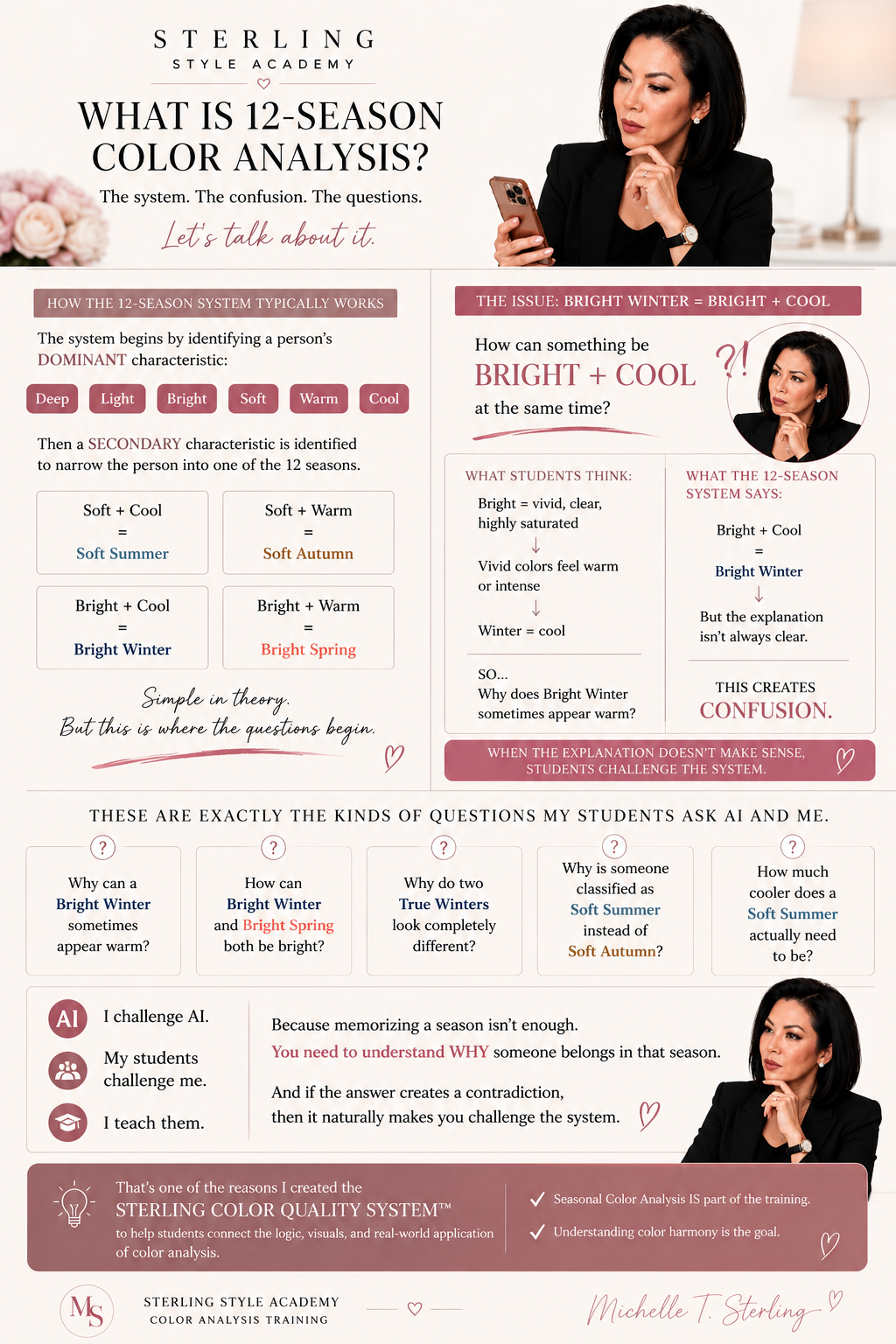
Most 12 Seasonal Color Analysis systems begin by identifying what is believed to be the dominant characteristic of a person’s coloring.
This dominant characteristic is typically described as one of the following:
- Light
- Deep
- Warm
- Cool
- Bright
- Soft
Once the dominant characteristic has been identified, analysts determine a secondary characteristic.
The combination of dominant and secondary characteristics is then used to assign one of the twelve seasons.
What Do Light, Deep, Warm, Cool, Bright, and Soft Mean?
Light
A lighter overall appearance in the hair, eyes, and skin.
Deep
A darker overall appearance in the hair, eyes, and skin.
Warm
Golden, yellow, peach, or warm undertones are most apparent.
Cool
Pink, rosy, blue, or cool undertones are most apparent.
Bright
Coloring appears clearer, more vivid, or able to support higher-intensity colors.
Soft
Coloring appears more muted, blended, or lower in intensity.
What Are the 12 Seasonal Color Analysis Equations?
Many 12 Seasonal Color Analysis systems use a dominant and secondary characteristic model.
Examples include:
- Light + Warm = Light Spring
- Light + Cool = Light Summer
- Deep + Warm = Deep Autumn
- Deep + Cool = Deep Winter
- Bright + Warm = Bright Spring
- Bright + Cool = Bright Winter
- Soft + Warm = Soft Autumn
- Soft + Cool = Soft Summer
- Warm + Bright = Warm Spring
- Warm + Soft = Warm Autumn
- Cool + Bright = Cool Winter
- Cool + Soft = Cool Summer
Soft Autumn vs Soft Summer: What’s the Difference?
Both seasons are considered soft.
The primary difference is temperature.
- Soft Autumn is generally warm and soft.
- Soft Summer is generally cool and soft.
Bright Spring vs Bright Winter: What’s the Difference?
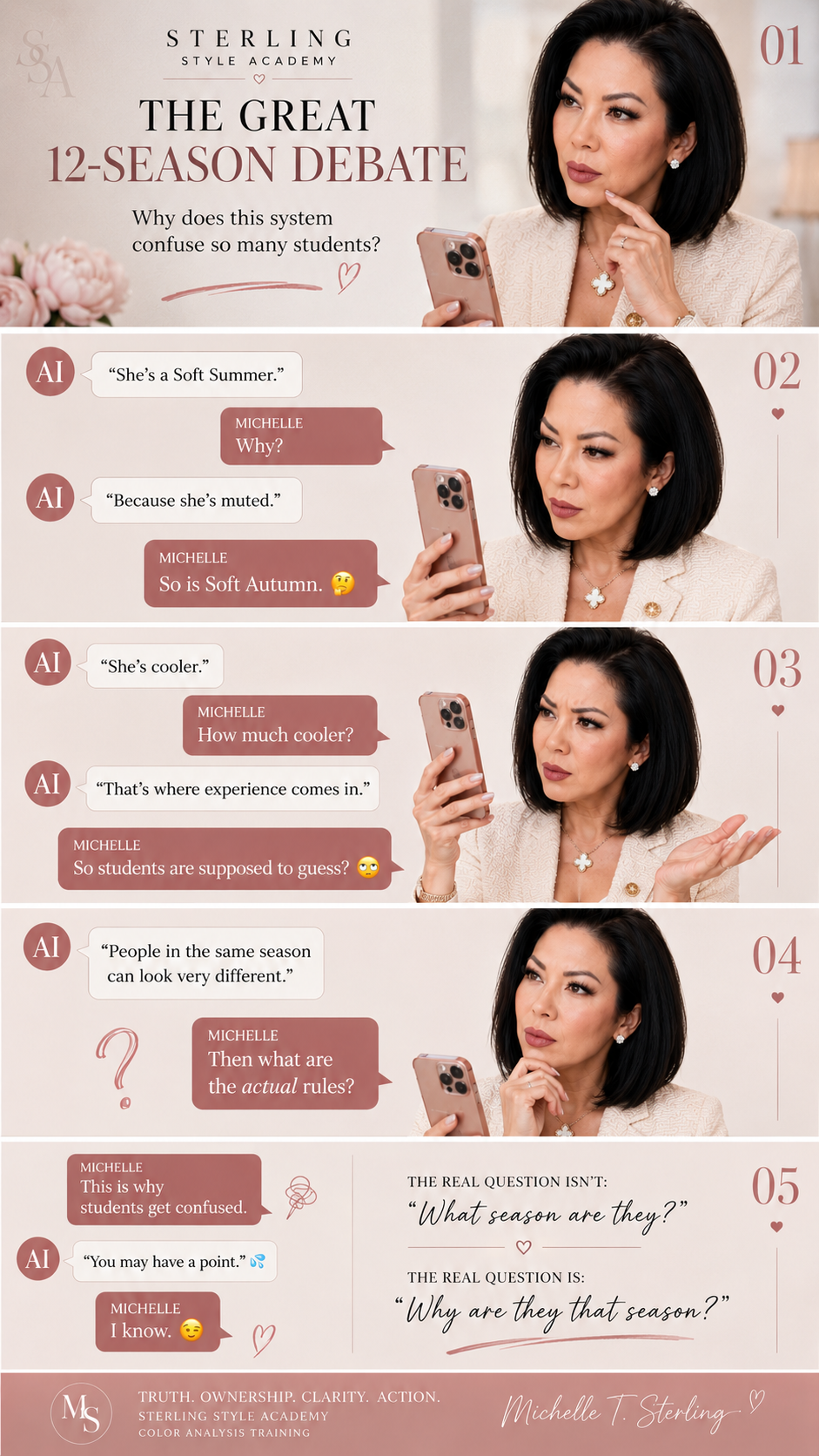
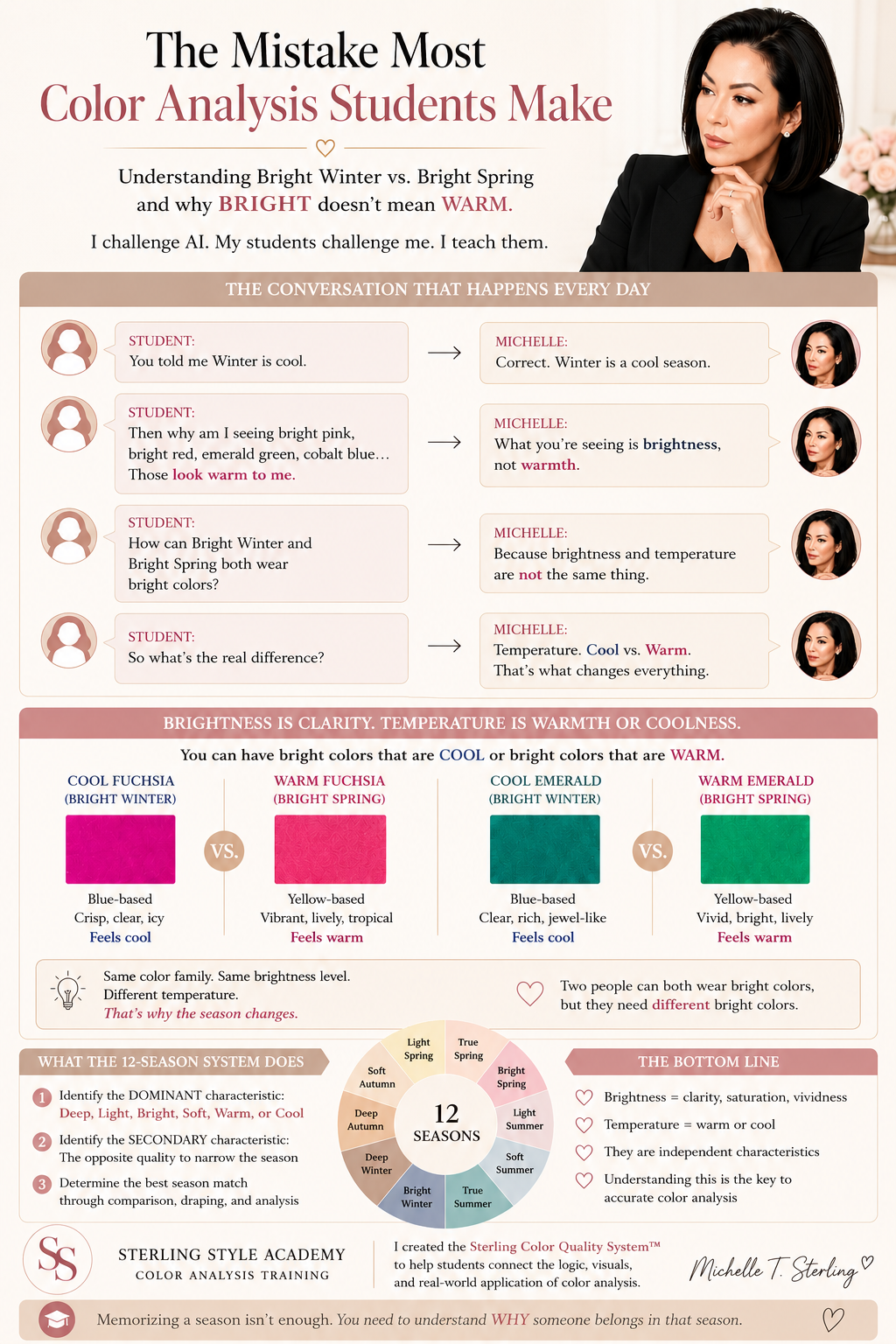
Both seasons are considered bright.
The primary difference is temperature.
- Bright Spring is generally warm and bright.
- Bright Winter is generally cool and bright.
Deep Autumn vs Deep Winter: What’s the Difference?
Both seasons are considered deep.
The primary difference is temperature.
- Deep Autumn is generally warm and deep.
- Deep Winter is generally cool and deep.
Why Do Different Color Analysts Sometimes Disagree?
Although 12 Seasonal Color Analysis follows a structured framework, analysts may prioritize different characteristics during the assessment process.
Some analysts place greater emphasis on undertone. Others focus heavily on draping results. Others evaluate overall visual harmony and contrast.
Because real people often display a mixture of characteristics, it is possible for different analysts to arrive at different seasonal conclusions.
Is 12 Seasonal Color Analysis Accurate?
12 Seasonal Color Analysis remains one of the most widely recognized color analysis systems in the world.
However, it is ultimately a classification framework. Many professional color analysts also evaluate individual color qualities such as:
- Temperature
- Value
- Chroma
- Contrast
- Intensity
to gain a more complete understanding of a person’s coloring.
Why Can 12 Seasonal Color Analysis Become Confusing?
One of the most common challenges with 12 Seasonal Color Analysis is that different analysts may prioritize different characteristics during the assessment process.
Some analysts place greater emphasis on undertone.
Others focus heavily on draping results.
Others evaluate overall visual harmony, contrast, or what they describe as a person’s “dominant characteristic.”
Because real people often display a mixture of characteristics, it is possible for different analysts to arrive at different seasonal conclusions for the same individual.
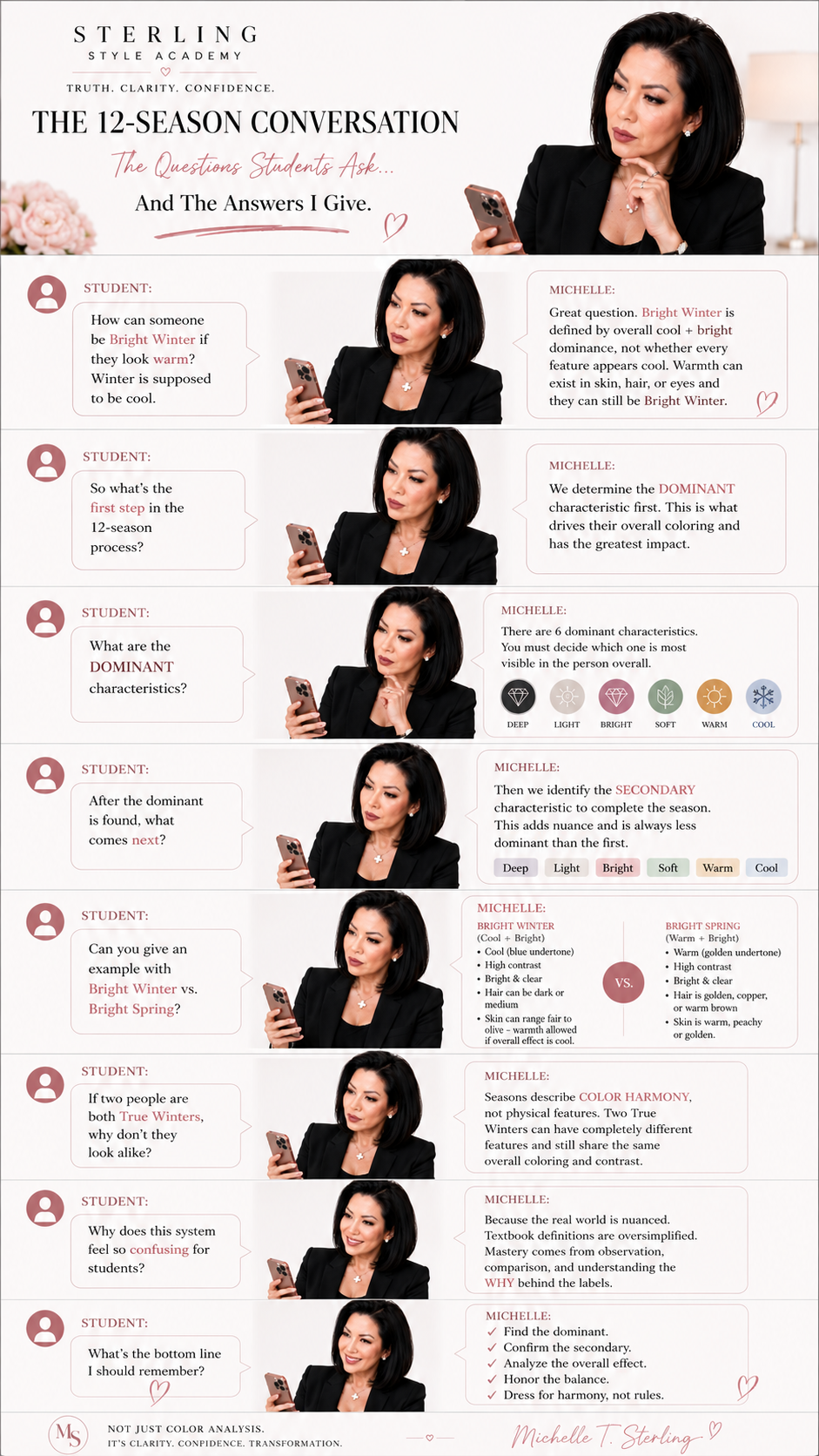
For example
Questions like these can lead to different interpretations depending on the analyst, the system being used, and the characteristics being prioritized.
As a result, clients are often surprised when they receive different seasonal results from different analysts.
This has led many color professionals to ask:
- What happens when a client’s skin appears warm, but their hair appears cool?
- How do you determine whether someone is Soft Autumn or Soft Summer?
- Why might one analyst classify someone as Deep Autumn while another calls them Deep Winter?
- Should undertone take priority over contrast?
- Should draping results outweigh a person’s natural coloring?
- What happens when someone doesn’t fit neatly into a single seasonal category?
These questions have fueled ongoing debate within the color analysis industry for decades.
Why Are Drapes So Important in Seasonal Color Analysis?
Because many people display a combination of characteristics, it is not always obvious which seasonal category provides the best fit.
For this reason, many seasonal color analysts use draping to compare colors directly against the client’s face.
Draping allows the analyst to observe how different colors affect the appearance of the skin, eyes, facial contours, and overall harmony.
In cases where a client appears to fit multiple seasons, draping is often used as the final determining factor.
This is one reason draping plays such a significant role in many seasonal color analysis systems.
The traditional seasonal systems run into problems because people don’t always fit neatly into the theoretical categories.
For example:
- Warm skin + cool hair
- Cool skin + warm eyes
- High contrast but muted coloring
- Olive undertones
- Mixed ethnic backgrounds
Once those situations appear, the analyst can’t rely solely on the seasonal equations.
That’s where draping enters the process.
A seasonal analyst may initially think: Deep Autumn
But then place Deep Autumn drapes beside the face and compare them against Deep Winter drapes.
The drapes become the tie-breaker.
In many seasonal systems, the draping process is considered more important than the initial categorization because it tests the colors directly against the person’s face.
Why the Sterling Color Quality System™ Was Developed
Through working with clients during her first 3 years as a a professional image consultant and personal stylist, Michelle T. Sterling observed that many individuals did not fit neatly into a single seasonal category.
While seasonal color analysis provides a useful reference framework, clients often display a unique combination of characteristics that extend beyond a single season.
This observation led to the development of the Sterling Color Quality System™.
Rather than beginning with a seasonal label, the Sterling Color Quality System™ evaluates individual color qualities independently, including factors such as:
- Temperature
- Value
- Chroma
- Contrast
- Intensity
This allows color recommendations to be based on the actual qualities present in the individual rather than forcing someone into the closest seasonal category.
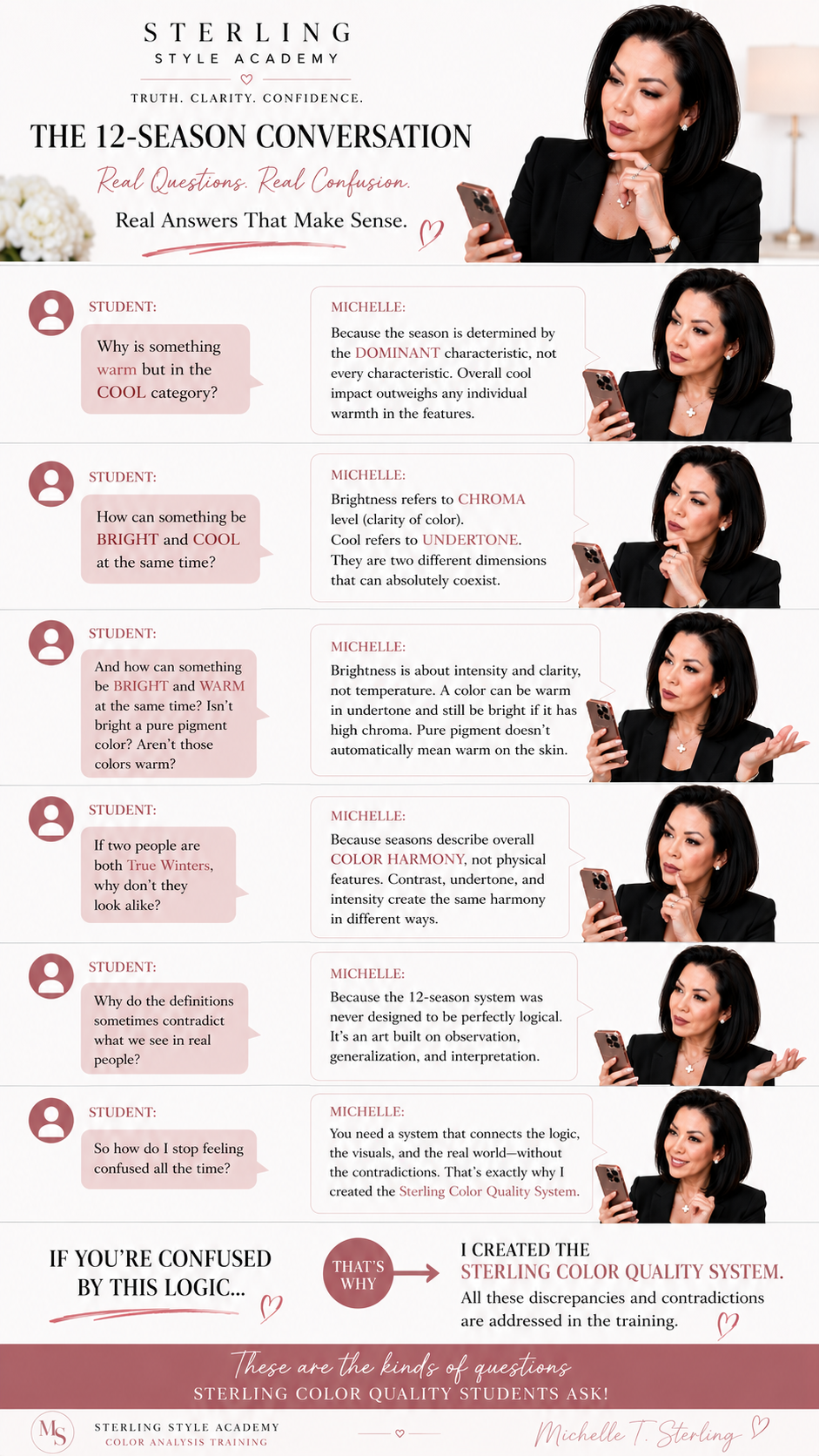
Today, the Sterling Color Quality System™ has been used with clients worldwide and taught to aspiring color analysts, personal stylists, and image consultants seeking a more structured and practical approach to understanding color.
Understanding 12 Seasonal Color Analysis remains valuable because it is one of the most recognized systems in the industry. However, understanding the individual color qualities that create harmony often provides greater clarity when working with real clients.
Frequently Asked Questions About 12 Seasonal Color Analysis
Is 12 Seasonal Color Analysis more accurate than 4 Seasonal Color Analysis?
The 12-season framework was developed to provide more specific color recommendations than the original four-season model. Accuracy depends on the methodology used and the skill of the analyst.
Can two color analysts give different seasonal results?
Yes. Different analysts may prioritize undertone, contrast, draping results, or overall visual harmony differently.
Can olive skin tones fit into multiple seasons?
Some analysts believe olive undertones can make seasonal classification more challenging because olive skin may display both warm and cool characteristics.
Do all professional color analysts use 12 Seasonal Color Analysis?
No. Many professional color analysts use alternative systems that focus on color qualities, tonal analysis, or customized color palettes.
Want structured color analysis training and client-ready tools?
Our 2-Day Color Analysis Training teaches you how to analyze undertones, contrast, and color harmony using a precise, real-world methodology. →View Upcoming In-Person Color Analysis Training Courses
For those who prefer flexibility, you can also explore our Online Color Analysis Certification.
Get Color Analysis Training Online
Want to learn professional color analysis? Explore Sterling Style Academy’s Online Color Analysis Training and learn how undertones, value, contrast, chroma, and intensity work together to create accurate and personalized color recommendations.
About Michelle T. Sterling
Michelle T. Sterling is the founder of Sterling Style Academy and a certified image consultant, personal stylist, color analyst, and educator with more than 20 years of experience working with clients worldwide.
Over the past two decades, Michelle has trained aspiring image consultants, personal stylists, personal shoppers, and color analysts from more than 70 countries through Sterling Style Academy’s online and in-person certification programs.
Through years of working directly with clients, Michelle observed that many individuals did not fit neatly into traditional seasonal color analysis categories. This experience led to the development of the Sterling Color Quality System™, a methodology that evaluates individual color qualities such as temperature, value, chroma, contrast, and intensity rather than relying solely on seasonal classifications.
Today, Michelle continues to teach color analysis, personal styling, and image consulting to students worldwide through Sterling Style Academy’s professional certification programs.
Learn more about Sterling Style Academy’s Online Color Analysis Training.