
How to Find the Right Jeans for Your Body Type: A Personal Stylist’s Guide
Wondering how to find the right jeans for your body type is not simply a matter of choosing the latest denim trend. The rise, leg shape, waistband, fabric, wash and length must work with your individual proportions.
A pair of jeans may look fabulous on someone else and completely wrong on you—not because anything is wrong with your body, but because the cut was not designed to balance your shape.
As a personal stylist and image consultant, I assess how clothing interacts with the entire body. The goal is not to force every woman into the same supposedly “flattering” jean. It is to select denim that fits properly, creates balanced proportions and supports the image you want to project.
Originally Published December 2, 2023 | Updated July 26, 2026
How to Find the Right Jeans: At a Glance
To find the right jeans for your body type:
- Identify where your body carries visual width.
- Choose a rise that fits your torso and waist comfortably.
- Use the leg shape to balance your upper and lower body.
- Make sure the waistband lies flat without digging or gaping.
- Choose denim with enough structure to retain its shape.
- Select a wash that supports the look you want to create.
- Have the length altered when necessary.
- Do not buy jeans solely because a particular cut is trending.
The best jeans are not necessarily the newest or most popular style. They are the jeans that fit your body correctly and work with the tops, shoes and jackets already in your wardrobe.
- Why Body Shape Matters When Choosing Jeans
- The Best Jeans for an Hourglass Body Shape
- The Best Jeans for a Triangle or Pear-Shaped Body
- The Best Jeans for an Apple Body Shape
- The Best Jeans for a Rectangle Body Shape
- The Best Jeans for an Inverted-Triangle Body Shape
- The Best Jeans for an Athletic Body Type
- Can Every Body Type Wear Wide-Leg Jeans?
- What Rise Should You Choose?
- How Should Jeans Fit?
- Choosing Denim Fabric and Stretch
- Choosing the Right Denim Wash
- How to Find Jeans When You Have Gained Weight
- The Best Jeans for Petite Women
- The Best Jeans for Tall Women
- Should You Follow Denim Trends?
- The Most Versatile Pair of Jeans
- Final Advice From a Personal Stylist
- Frequently Asked Questions
- What jeans are the most flattering for every body type?
- Do high-waisted jeans flatter everyone?
- What jeans make your legs look longer?
- What jeans are best for a larger stomach?
- Should jeans be tight when you first buy them?
- Are skinny jeans still flattering?
- Can curvy women wear wide-leg jeans?
- How many pairs of jeans does a woman need?
Why Body Shape Matters When Choosing Jeans
Your body shape is determined by the relationship between your shoulders, bust, waist and hips—not by your clothing size or weight.
Two women can wear the same size and require completely different jeans. One may have wider hips and a defined waist, while another may have straighter proportions or carry more fullness through the middle.
Jeans affect more than your lower body. Their rise changes the apparent length of your torso, while the width of the leg influences the visual relationship between your hips, shoulders and waist.
This is why a professional body-shape analysis considers the entire silhouette rather than reducing the decision to “skinny versus wide-leg jeans.”
The Best Jeans for an Hourglass Body Shape
An hourglass body shape generally has balanced shoulders and hips with a visibly defined waist.
The primary fitting challenge is often finding jeans that accommodate the hips without leaving a large gap at the back of the waistband.
Best jeans for an hourglass figure:
- Contoured-waist jeans
- High-rise or mid-rise jeans
- Straight-leg jeans
- Bootcut jeans
- Flared jeans
- Slim jeans with adequate stretch
A contoured waistband is especially useful because it is shaped to follow the curve between the waist and hips. Look for styles marketed as “curvy fit” when standard jeans fit through the hips but gape at the waist.
Straight, bootcut and flared jeans can all work beautifully because they follow or balance the natural curves of the body.
Very low-rise jeans may visually widen the hips while eliminating waist definition. Oversized jeans that conceal the waist can also make an hourglass figure appear heavier and less proportionate.
Pair your jeans with tops that follow the body or define the waist rather than covering your shape in unnecessary fabric.
The Best Jeans for a Triangle or Pear-Shaped Body
A triangle body shape—often called a pear shape—has more visual width through the hips and thighs than through the shoulders and upper body.
The objective is not to hide your hips. It is to create visual balance between the upper and lower body.
Best jeans for a triangle body shape:
- Straight-leg jeans
- Bootcut jeans
- Flared jeans
- Trouser-style jeans
- Subtle wide-leg jeans
- Mid-rise or high-rise jeans with a contoured waistband
A straight or gently flared leg creates a cleaner line from the hip downward. Bootcut and flared jeans can balance fuller hips by adding controlled width below the knee.
Choose denim that follows the hips without gripping every contour. Jeans that are extremely tight through the thighs and dramatically narrow at the ankles can exaggerate the difference between the upper and lower body.
Large fading, whiskering, cargo pockets and heavy distressing across the hips and thighs also draw attention to the widest area.
Dark or consistent washes generally create a cleaner vertical line, although you do not have to limit yourself to dark denim. Fit and proportion are more important than color alone.
For complete clothing and outfit recommendations, read my guide on how to dress a triangle body shape.
The Best Jeans for an Apple Body Shape
An apple body shape generally carries more visual fullness through the torso and midsection, often with slimmer hips and legs.
The wrong waistband can dig into the stomach, roll down or create an uncomfortable division across the middle. The right pair should provide support without squeezing the body.
Best jeans for an apple body shape:
- Mid-rise jeans
- Supportive high-rise jeans
- Straight-leg jeans
- Bootcut jeans
- Slim-straight jeans
- Subtle wide-leg jeans with a flat front
The precise rise depends on your torso length and where you carry fullness. A mid-rise may be more comfortable for one apple-shaped woman, while another may prefer a smooth high-rise that contains the midsection.
This is why absolute rules such as “all apple shapes must wear high-rise jeans” are unreliable.
Avoid waistbands that end directly across the fullest part of your stomach. Also avoid paper-bag waists, bulky front pleats and excessive detailing around the waistband, as these can add visual volume.
A straight or bootcut leg helps create a long, continuous line. A wider leg may also work when it falls cleanly from the hip, but the jeans should not be so oversized that they add width to the entire body.
For more detailed recommendations on tops, dresses, jackets and accessories, read how to dress an apple-shaped body.
The Best Jeans for a Rectangle Body Shape
A rectangle body shape has relatively similar shoulder, waist and hip measurements, with less obvious waist definition.
You can either celebrate that naturally straight silhouette or use clothing to create the appearance of more curves.
Best jeans for a rectangle body shape:
- High-rise jeans
- Straight-leg jeans
- Slim-straight jeans
- Bootcut jeans
- Flared jeans
- Barrel jeans with controlled volume
- Jeans with strategically positioned back pockets
A high rise can visually define the waist, particularly when worn with a fitted, tucked or cropped top.
Bootcut and flared jeans create additional shape below the knee. Barrel jeans can also introduce curves, but the volume must be controlled. An exaggerated barrel leg paired with an oversized top can overwhelm a rectangle figure and remove any remaining definition.
Back-pocket placement matters. Pockets positioned too low can make the seat appear lower, while well-proportioned pockets placed slightly higher can create a more lifted appearance.
For a complete explanation of how to create shape through clothing, read my ultimate guide to dressing a rectangle body shape.
The Best Jeans for an Inverted-Triangle Body Shape
An inverted-triangle shape has broader shoulders or a fuller upper body in relation to the hips.
The right jeans can add visual weight to the lower body and balance the shoulders.
Best jeans for an inverted-triangle body shape:
- Bootcut jeans
- Flared jeans
- Wide-leg jeans
- Barrel jeans
- Relaxed straight-leg jeans
- Jeans with visible pockets or lower-body detailing
This is one of the body shapes that can benefit from more volume below the waist. Wider legs, lighter washes, patch pockets and certain cargo-inspired details can make the hips and legs appear more proportionate to the upper body.
Be careful with extremely narrow skinny jeans when they are paired with a structured, oversized or voluminous top. That combination can make the shoulders appear even broader and the lower body disproportionately small.
The Best Jeans for an Athletic Body Type
An athletic figure may have a straighter waist, developed thighs or calves and a firmer seat. However, “athletic” is not a single body shape. An athletic woman can also have hourglass, rectangle, inverted-triangle or triangle proportions.
Look for jeans that accommodate your muscular areas without creating excess fabric elsewhere.
Good options include:
- Straight-leg jeans
- Athletic-fit jeans
- Bootcut jeans
- Relaxed jeans with a defined waistband
- Jeans with stretch and strong recovery
Stretch is useful, but too much stretch can cause jeans to lose their structure during the day. Look for denim that moves with your body but returns to its original shape.
When jeans fit your thighs but gape substantially at the waist, try athletic or curvy-fit cuts rather than simply sizing up.
Can Every Body Type Wear Wide-Leg Jeans?
Most body types can wear wide-leg jeans, but not every wide-leg jean will flatter every body.
The width, rise, fabric, length and styling all matter.
A wide leg that falls cleanly from the hip can create a strong vertical line. A pair that is excessively wide, stiff or cropped at an awkward point may make the body appear shorter or broader.
Your top is equally important.
I do not recommend automatically pairing oversized jeans with an oversized top. “Big with big” often eliminates the body’s structure and creates one large, round silhouette. This was the central problem I identified in my analysis of Jennifer Lawrence’s oversized street style.
When the jeans have substantial volume, a fitted, semi-fitted, tucked or strategically cropped top usually creates a more polished proportion.
This is not about requiring every woman to dress tightly. It is about ensuring that the outfit has enough visible structure to look intentional.
What Rise Should You Choose?
The rise is the distance between the crotch seam and the waistband. It determines where the jeans sit and can change how long your torso and legs appear.
High-rise jeans
High-rise jeans can:
- Define the waist
- Visually lengthen the legs
- Support the midsection
- Work well with tucked and cropped tops
However, a very high rise may feel uncomfortable or shorten an already short torso.
Mid-rise jeans
Mid-rise jeans can:
- Sit comfortably below the natural waist
- Work well for many apple shapes
- Suit women who dislike pressure around the upper stomach
- Create balanced proportions on average-length torsos
Low-rise jeans
Low-rise jeans can:
- Visually lengthen a short torso
- Suit certain straight or athletic figures
- Work with longer tops and early-2000s-inspired outfits
However, they provide less support and can visually widen the hips. They also tend to be less practical for women who want secure coverage when sitting or bending.
The correct rise is the one that lies flat, remains comfortable and supports your proportions.
How Should Jeans Fit?
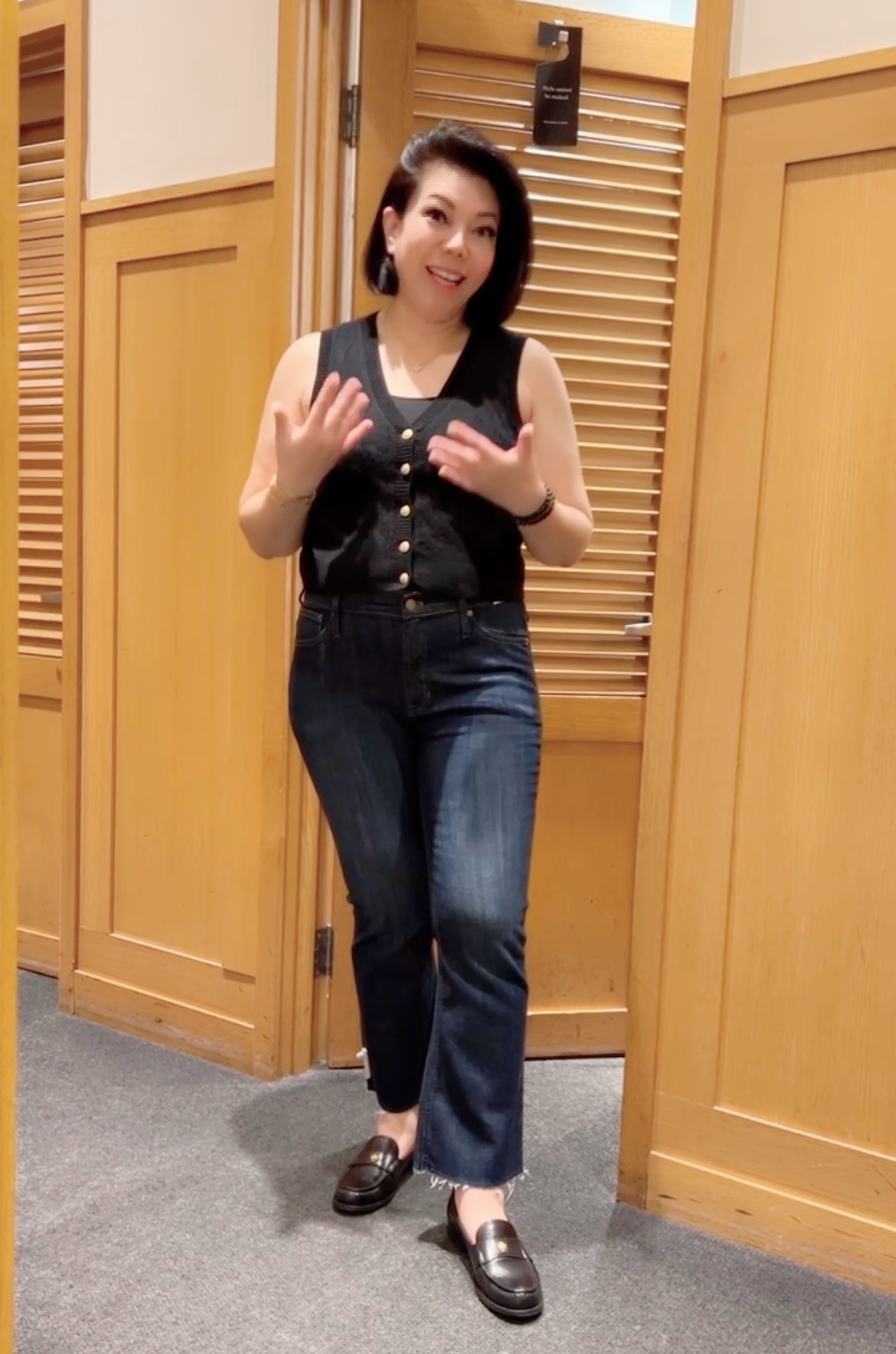
A body-shape recommendation is useless when the jeans do not fit properly.
Check the following areas before buying:
The waistband
The waistband should lie flat against the body. It should not create a large gap at the back, dig deeply into the stomach or slide down as you move.
The crotch
Horizontal pulling lines, bunching or excessive fabric around the crotch usually indicate a problem with the rise, cut or size.
The hips and thighs
The fabric should follow the body without severe pulling. Deep horizontal lines often indicate that the jeans are too tight.
The seat
The jeans should contour the seat without sagging underneath it. Pocket size and placement should also be proportionate to your body.
The knees
The knee of the jean should align with your actual knee. When it sits too high or too low, the entire leg shape can look incorrect.
The hem
The hem should work with the shoes you intend to wear. Full-length wide-leg, bootcut and flared jeans should generally have enough length to create a continuous line without dragging on the floor.
Choosing Denim Fabric and Stretch
Fabric composition affects comfort, appearance and how well the jeans retain their shape.
Rigid denim
Rigid or mostly cotton denim provides structure and tends to hold its shape. It can create a polished appearance but may require a break-in period.
Stretch denim
A small percentage of elastane can improve comfort and mobility. This is especially useful for women with a significant difference between their waist and hip measurements.
However, extremely stretchy denim can cling to every contour, lose its shape and begin to sag after several hours.
The best fabric should provide enough flexibility for movement while still retaining structure.
Do not judge jeans only by how soft they feel in the fitting room. Consider how they are likely to look after several hours of wear.
Choosing the Right Denim Wash
Wash affects where the eye goes.
Dark, uniform washes generally create a cleaner and more polished appearance. They can move easily between casual, smart-casual and certain professional settings.
Light washes appear more casual and can add visual width. Strategic fading may emphasize the thighs, hips or seat depending on its placement.
Distressing, whiskering, patch pockets and embellishment also attract attention. Use them intentionally rather than assuming they are neutral details.
A simple medium or dark wash is usually the most versatile choice when you are purchasing one foundational pair.
How to Find Jeans When You Have Gained Weight
Weight changes can affect more than your clothing size. They may change where your body carries fullness, how defined your waist appears and which rise feels comfortable.
Do not punish yourself by trying to fit into jeans that no longer accommodate your body.
Wearing the correct size will look better than squeezing into a smaller label.
When shopping after gaining weight:
- Reassess your current proportions.
- Try several rises rather than repeating your former preference.
- Look for stretch with good recovery.
- Prioritize a smooth waistband.
- Test the jeans while sitting, walking and bending.
- Consider straight, bootcut or softly wide-leg styles.
- Ignore the number on the tag and evaluate the actual fit.
Your current body deserves clothing that fits it now.
The Best Jeans for Petite Women
Petite refers to height and proportion, not weight or body shape.
Petite women should pay particular attention to:
- Inseam length
- Knee placement
- Pocket size
- Rise depth
- The amount of fabric in wide-leg styles
A petite-specific cut is often better than simply shortening standard jeans because the knee, rise and pocket placement have also been adjusted.
Ankle-length and full-length jeans can both work. The important issue is whether the hem ends at an intentional point rather than bunching heavily at the ankle.
Petite women do not need to avoid wide-leg jeans. They need a wide-leg jean scaled correctly for their frame.
The Best Jeans for Tall Women
Tall women should look for brands offering dedicated tall or long inseams.
The knee break on bootcut, flare and barrel jeans must align with the body correctly. Buying a standard size and hoping the short length appears intentionally cropped rarely produces the same result as a cut designed for a taller frame.
Tall women can wear skinny, straight, bootcut, barrel, flared and wide-leg jeans. Proportion, rather than height alone, determines which style is most flattering.
Should You Follow Denim Trends?
Trends can introduce you to new silhouettes, but they should not override fit.
Skinny jeans do not become universally unflattering because wide-leg jeans are trending. Likewise, barrel jeans do not automatically suit everyone because fashion publications have declared them current.
Try the trend and assess:
- Does it balance your proportions?
- Does it fit properly?
- Can you style it with at least three tops you own?
- Does it work with your shoes?
- Does it support your personal image?
- Will you still want to wear it after the trend fades?
A fashionable jean that does not work with your body or wardrobe is not a smart purchase.
The Most Versatile Pair of Jeans
For many women, the most versatile starting point is:
- A medium- or dark-wash jean
- A mid- or high-rise waistband
- A straight or subtle bootcut leg
- Minimal distressing
- A full or ankle length appropriate to their height
- Denim with structure and a small amount of stretch
This is not the only jean you should own. It is simply a practical foundation that can be worn with sneakers, ballet flats, loafers, boots and heels.

Final Advice From a Personal Stylist
Finding the right jeans for your body type requires more than matching a body-shape label to a denim silhouette.
You must consider your:
- Body proportions
- Torso length
- Waist-to-hip ratio
- Height
- Leg shape
- Preferred shoes
- Existing wardrobe
- Lifestyle
- Personal style
Start with body shape, but finish with the mirror.
The jeans should fit smoothly, balance your proportions and make sense with the complete outfit. Do not allow a trend, size label or generic fashion rule to persuade you to buy jeans that clearly do not work for you.
The right jeans will not require constant pulling, adjusting or explaining. They will fit your body, support your wardrobe and allow you to look polished without unnecessary effort.
Frequently Asked Questions
What jeans are the most flattering for every body type?
There is no single jean that is universally the most flattering. Straight-leg and subtle bootcut jeans are among the most adaptable styles, but the rise, fabric, length and waistband must still suit the individual.
Do high-waisted jeans flatter everyone?
No. High-waisted jeans can define the waist and lengthen the legs, but they may feel uncomfortable or visually shorten a short torso. Some women look and feel better in a mid-rise.
What jeans make your legs look longer?
High-rise jeans, full-length straight legs, bootcut jeans and flares worn with an appropriate shoe can visually lengthen the legs. A continuous wash with minimal horizontal distressing also helps create a longer line.
What jeans are best for a larger stomach?
Look for a smooth mid-rise or supportive high-rise that does not end at the fullest part of the stomach. Straight, bootcut and slim-straight legs are often effective, although the best option depends on the person’s complete proportions.
Should jeans be tight when you first buy them?
Jeans should fit securely, but they should not cause severe pulling, discomfort or restricted movement. Some mostly cotton denim will relax slightly, while very stretchy denim may loosen considerably. Never buy painfully tight jeans based on the assumption that they will eventually fit.
Are skinny jeans still flattering?
Skinny jeans can still flatter certain bodies and outfits. Their usefulness did not disappear because wider denim became fashionable. The question is whether the narrow leg balances your proportions and works with the top and shoes you are wearing.
Can curvy women wear wide-leg jeans?
Yes. Curvy women can wear wide-leg jeans when the waistband fits properly and the leg falls cleanly from the hip. The top should provide enough definition to prevent the outfit from appearing bulky from head to toe.
How many pairs of jeans does a woman need?
There is no required number. A practical wardrobe might include one versatile straight or bootcut pair, one casual or lighter-wash pair and one trend-focused silhouette. Your lifestyle should determine the quantity.
ABOUT MICHELLE T. STERLING
Hello! I’m Michelle
Michelle T. Sterling, Principal Personal Stylist and Chief Image Consultant of Sterling Personal Styling, is an American award-winning, internationally renowned image consultant, personal stylist, online personal shopper, author, and Founder of Sterling Personal Styling and Sterling Style Academy.
With more than 15 years of experience in personal styling and image consulting, Michelle helps clients develop wardrobes and personal images that reflect their lifestyle, proportions, personal coloring, professional goals, and authentic personal style.
Her expertise has been featured in E! News, CNBC, the New York Post, Business Insider, The Wall Street Journal, WWD, HuffPost, CNN, Gulf News, Details Magazine, and Forbes. Explore additional features on Michelle’s Press Page.
Through Sterling Personal Styling, Michelle offers Virtual Personal Styling, Online Personal Styling, Virtual Image Consulting, Online Capsule Wardrobe Services, Online Color Analysis, Online Body Analysis, Online Wardrobe Consulting, In-Person Personal Styling, and In-Person Image Consulting in New York, San Francisco, Washington, DC, Miami and Palm Beach, Dubai, Paris and Monaco, and worldwide online.