
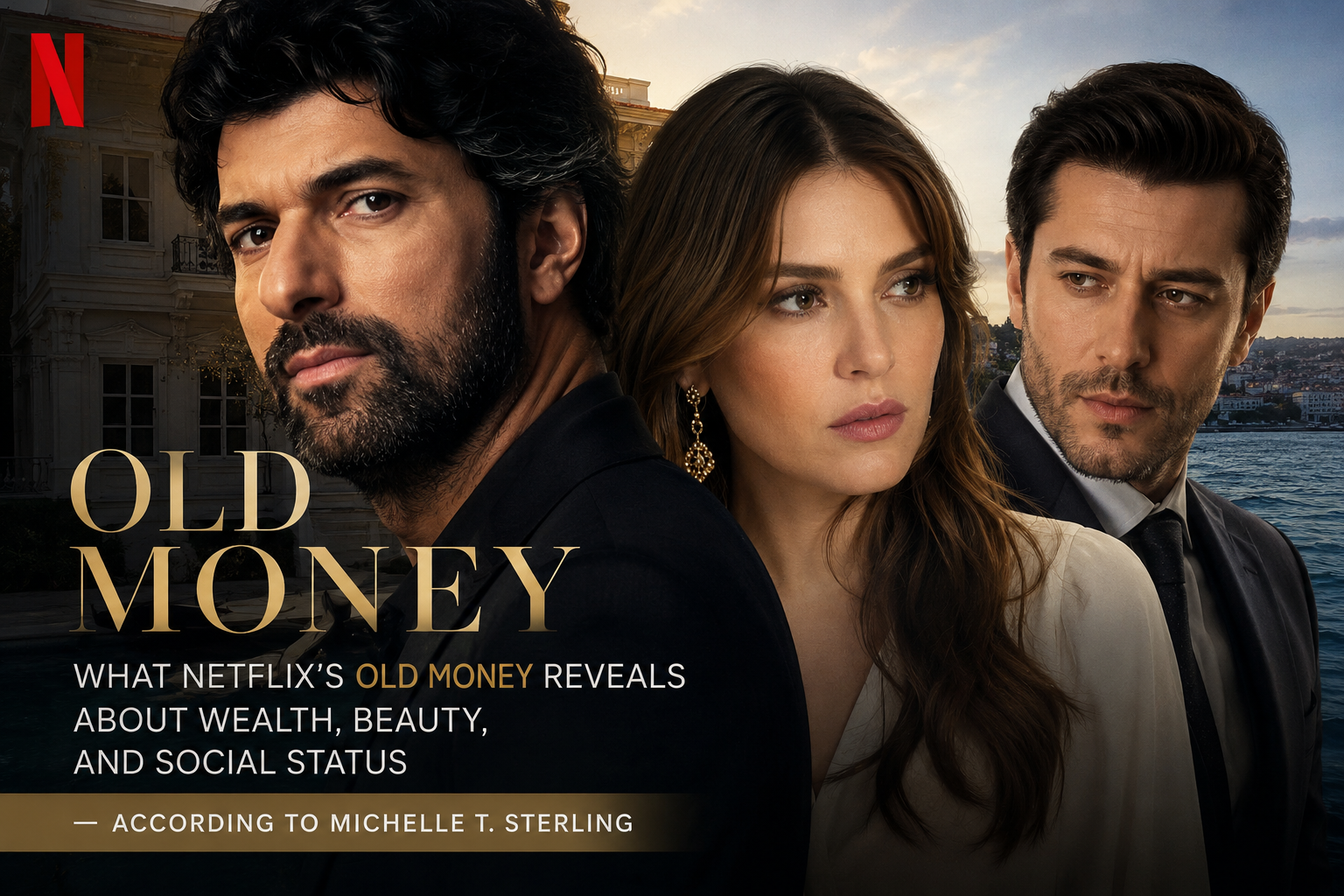
What Netflix’s Old Money Reveals About Wealth, Beauty, and Social Status — According to Michelle T. Sterling
Watching Old Money on Netflix initially made me hesitant because I assumed it would simply be another series glamorizing wealth, yachts, luxury brands and elite lifestyles without much emotional depth. At first glance, Old Moneyappears to revolve around exactly that world: Bosphorus mansions, private schools, powerful families, expensive fashion, mega yachts, elite social circles and the psychology of status.
But the more I watched the series, the more I realized that Old Money is exploring something much more psychologically interesting beneath the aesthetics.
The series centers around Osman, played by Engin Akyürek, a driven self-made billionaire whose obsession with wealth and elite status becomes emotionally intertwined with Nihal, portrayed by Aslı Enver, an intelligent and sophisticated heiress attempting to protect her family’s legacy and identity inside Istanbul’s old-money social world. Complicating the dynamic further is Engin, played by Serkan Altunorak, a polished old-money heir whose long-standing feelings for Nihal represent both romantic longing and the social expectations of the elite world she partially resists.
Underneath all the wealth, Old Money is really examining emotional survival, belonging, class mobility, inherited privilege, beauty culture, social hierarchy and the emotional cost of wealth itself. That is why I think the series resonates beyond Turkey. People everywhere are fascinated by wealth, beauty and social status, even if they don’t openly admit it, because wealth is never just about money.
It is also about identity.
Why Old Money Feels Different From American Luxury Shows
One of the reasons I have become so interested in Turkish dizis is that they approach emotion very differently from much of contemporary American television. Turkish dramas are often willing to take beauty, elegance, longing, romantic obsession, pride and emotional tension completely seriously. They don’t always feel compelled to undercut an emotionally intense moment with irony or sarcasm.
American shows about wealth can be fascinating, but they often view elite culture through cynicism, satire or emotional detachment. Succession is an obvious example, while Gossip Girl approached elite culture through a very different but still distinctly American lens of social performance, competition and scandal.
Turkish dizis allow the audience to remain inside the emotion longer. A look can matter. Silence can matter. The way somebody enters a room can matter. The clothes, grooming, posture and body language are not merely decorative; they become part of the emotional storytelling.
That is one reason Old Money feels so immersive. Beauty is not treated as something intellectually embarrassing or superficial. Neither is romance. Neither is elegance.
And visually, Turkish dramas still place enormous importance on grooming, silhouette, body language, fashion and presentation. In Old Money, image is never accidental. The way characters dress, carry themselves, socialize and perform status is deeply connected to identity.
Why Old Money and Gossip Girl Reflect the Same Fascination With Elite Culture
There is a reason audiences around the world became obsessed with Gossip Girl. Beneath the clothes and Upper East Side fantasy, the series explored elite private schools, social hierarchy, beauty politics, inherited privilege, exclusion, aspiration and the emotional dynamics of wealth.
Old Money explores many of those same themes through a Turkish cultural lens. The difference, to me, is the emotional atmosphere.
American elite culture absolutely still exists, especially in prep schools, Ivy League circles, luxury enclaves and old-money East Coast environments. But contemporary American entertainment frequently portrays those worlds with irony, sarcasm or emotional distance. Turkish dizis are still willing to make luxury feel beautiful, emotionally immersive and aspirational while simultaneously exposing the insecurity and dysfunction underneath it.
That combination is important. The viewer is allowed to be seduced by the Bosphorus mansion while also understanding that the people living inside it are not necessarily emotionally secure.
That contradiction makes Old Money psychologically much more interesting than a simple fantasy about rich people.
Osman Bey and the Psychology of Earned Wealth
One of the most interesting characters in Old Money is Osman Bey because he did not grow up inside privilege. He lost his parents, experienced instability early in life and built his empire from nothing alongside men who became his brothers emotionally rather than biologically.
That background changes the meaning of his wealth. For someone who has experienced profound instability, money can become much more than financial success. It can represent protection, validation, power, emotional safety, survival and proof that the person has escaped powerlessness.
This is why I don’t think Osman’s obsession with the Bosphorus mansion is really about property. The mansion represents entry into a world that once felt unreachable. It represents legitimacy, belonging, status and acceptance.
His attraction to Nihal operates on several levels for the same reason. Yes, she is beautiful, but she also comes from the world he has spent his life trying to enter. She possesses naturally what he has had to acquire deliberately: social fluency, pedigree and an ease within elite culture.
Osman is not merely chasing beauty or money.
He is chasing recognition.
Nihal and the Psychology of Elite Awareness in Old Money
Nihal is fascinating because she understands the elite world without being completely consumed by it. She grew up surrounded by private schools, wealth, social status, beauty culture and privileged social circles, but after losing her mother she eventually leaves Istanbul and studies in Paris, where she has to function more independently.
That experience matters. She learns self-sufficiency and develops a perspective on privilege that she might not have developed had she remained protected inside the same Istanbul social environment her entire life.
When Nihal returns, she is still socially fluent in elite culture. She understands its codes instinctively, but she can also see the performance underneath them: the competition, obsession with appearance, status signaling and emotional emptiness that can exist behind an immaculate exterior.
That duality is what makes her compelling to me. Nihal can be elegant without being completely defined by elegance. She can understand status without worshipping it. She belongs to the world Osman wants access to, yet she has enough distance from it to recognize its limitations.
And I think Osman recognizes that immediately.
Why Osman Bey and Nihal Are Drawn to Each Other
What makes the relationship between Osman and Nihal emotionally compelling is that their attraction is not simply the cliché of the self-made billionaire falling for the beautiful heiress. Both have experienced loss and instability, but they have transformed those experiences in completely different ways.
Osman turns pain outward. He builds, acquires, controls and conquers. His response to vulnerability is power.
Nihal turns pain inward and develops resilience, adaptability, humility and emotional awareness. She understands instability without needing to dominate everything around her in order to feel safe.
That difference creates tension, but there is also recognition between them. She understands elite culture without fully worshipping it, while he desires elite culture and simultaneously resents the fact that people like Nihal were born with access to something he had to fight to obtain.
Underneath the attraction, both characters understand something about instability beneath appearances. That gives their relationship emotional weight.
Why Romantic Miscommunication Is So Important in Turkish Dizis
This is also where Old Money reflects something I have noticed repeatedly in Turkish dizis: people often communicate around their emotions rather than directly through them.
As an American viewer, this can be incredibly frustrating. You want somebody to simply say, What actually happened? How do you feel? What are we doing?
Instead, Turkish romantic drama frequently operates through implication, silence, body language, jealousy, sacrifice, wounded pride and third parties. Someone hears part of a conversation. Someone makes an assumption. Someone withdraws instead of asking a direct question. Two people who obviously love each other can spend episodes emotionally torturing themselves because neither will say the one sentence that would resolve everything.
And yet, this is also part of what makes Turkish dizis so emotionally addictive.
The audience has to read the characters. A glance across a room can communicate what an American series might put into three lines of dialogue. A character’s physical distance, the way he looks at her when she isn’t watching, whether he touches her, whether she turns away, or even who sits beside whom can carry emotional meaning.
Engin’s relationship with Nihal represents this beautifully. He clearly loves her and has idealized her since childhood, yet even his attempts at emotional honesty remain indirect and socially coded. Nihal often seems to understand what he means before he can articulate it himself.
That emotional indirectness creates extraordinary romantic tension, but it also creates jealousy, projection, confusion and completely avoidable suffering. As a storytelling device, it is brilliant. As a relationship strategy, it would be exhausting.
Why Pride Is Almost a Character of Its Own in Turkish Dramas
Pride plays an enormous role in many Turkish dizis, and Old Money is no exception. Characters often seem more willing to suffer privately than risk exposing themselves emotionally.
This is different from simply being emotionally unavailable. In these stories, pride is often connected to family, class, masculinity, femininity, reputation and dignity. Admitting love can feel like surrender. Asking for clarification can feel like weakness. Being rejected can feel like humiliation rather than merely disappointment.
That creates a particular kind of romantic tension that I don’t see portrayed in quite the same way in most contemporary American series.
The frustration for an international viewer is obvious: Just talk to each other.
But if everybody communicated openly and rationally, many Turkish dizis would be over in four episodes.
Why Beauty and Style Matter So Much in Old Money
As an image consultant, this is one of the aspects of Old Money that interests me most. The series understands that status is not communicated only through yachts, private planes, mansions or financial assets. It is communicated through grooming, fitness, elegance, clothing, body language, beauty standards and visual discipline.
Characters constantly project an awareness of image. Their clothes tell us whether they are comfortable with wealth, aspiring toward it, born into it or trying to prove something through it.
This is also where Turkish luxury culture often looks different from contemporary American billionaire culture. In parts of American culture, extreme wealth can now be communicated through deliberate casualness — the T-shirt, sneaker and hoodie aesthetic that says the wearer is powerful enough not to dress traditionally for anybody.
Turkish elite culture, at least as it is portrayed in many dizis, still places considerable value on visible presentation. People dress for dinner. Hair and grooming matter. Men are tailored. Women are polished. The visual world reinforces the emotional world.
That doesn’t mean everyone who looks polished is secure. Quite the opposite. Sometimes immaculate presentation is armor.
And Old Money understands that distinction.
Beauty, Thinness and the Discipline of Belonging
There is another aspect of the series that I think deserves more attention: beauty itself functions as social capital.
Within elite environments, looking polished is rarely just about vanity. Beauty, grooming, fitness and thinness can become part of the unwritten rules of belonging. People learn what someone in their social world is “supposed” to look like, and the pressure to maintain that image can become another form of discipline.
This is something I find particularly interesting as an image consultant because image can empower someone, but it can also become a prison when presentation is being used primarily to satisfy the expectations of a social group.
Nihal understands the visual language of her environment almost instinctively. She doesn’t need to announce that she belongs. Her presentation communicates it before she says anything.
That is very different from conspicuous status signaling.
What Engin Represents: When the “Right” Match Isn’t Necessarily the Right Love
Engin is interesting because, on paper, he represents the socially logical choice. He belongs to Nihal’s world. He understands the codes, history and expectations surrounding her. His feelings for her also have the weight of familiarity and childhood idealization.
But that is precisely why his relationship with Nihal raises another question: how much of love is genuine emotional compatibility, and how much is familiarity, expectation and the comfort of choosing somebody who already belongs to your world?
Elite cultures often encourage relationships that preserve social continuity. The families understand one another. The backgrounds match. Nobody needs to explain the rules.
Osman disrupts that structure.
He brings ambition, unpredictability and emotional intensity into a world built around continuity. Nihal is therefore not simply choosing between two men. Symbolically, she is caught between two different relationships to class, identity and belonging.
That makes the triangle much more interesting than a conventional romantic rivalry.
What Old Money Says About Old Money vs. New Money
The series also complicates the usual stereotypes surrounding inherited and self-made wealth.
Old money is often romanticized as tasteful, discreet and secure, while new money is stereotyped as loud, excessive and desperate for validation. Reality is much more complicated.
Inherited wealth can create extraordinary social confidence because people grow up understanding the codes of elite environments. But it can also create rigidity, entitlement and an intense attachment to hierarchy.
Self-made wealth can produce conspicuous consumption, particularly when someone is still proving that he has arrived. But it can also produce independence because the individual’s identity is based on achievement rather than inherited social approval.
Osman embodies both sides of earned wealth. His accomplishments give him enormous power, but acquiring money has not completely erased the emotional memory of being outside the gates.
That is why the old-money world still matters to him.
Why the Old Money Aesthetic Continues to Fascinate People
People are endlessly fascinated by old-money families, wealth psychology, luxury aesthetics and social hierarchy because these worlds exaggerate universal human behavior.
Everyone understands belonging and exclusion on some level. Everyone understands wanting to be accepted. Wealth simply raises the stakes and makes those dynamics more visually dramatic.
Shows like Old Money allow us to observe those systems from a safe distance. We can admire the fashion, Bosphorus mansions and beautiful settings while simultaneously watching characters struggle with questions that money cannot solve.
Can wealth create emotional security? What happens when status becomes identity? Does inherited privilege make someone more socially secure or simply more afraid of losing position? Why do people romanticize elite culture? And what actually makes someone sophisticated?
Those questions are much more interesting to me than the price of the yacht.
What Old Money Ultimately Reveals About Wealth
The deeper message I take from Old Money is that wealth magnifies identity rather than resolving it.
Money can change someone’s environment, clothing, opportunities and access. It can remove enormous practical difficulties from life. But it cannot automatically create emotional security, self-awareness, confidence or the ability to love.
Osman can acquire almost anything, yet belonging still matters to him. Nihal can be born into privilege and still experience grief, instability and emotional uncertainty. Engin can possess the correct pedigree and still be unable to communicate what he feels.
That is why I don’t see Old Money as simply a show about rich people.
It is a Turkish dizi about human behavior inside systems of beauty, wealth, aspiration, class and emotional longing — wrapped in a visually seductive world that makes us want to keep watching.
And perhaps that is what Turkish dizis do particularly well. They make the exterior beautiful enough to draw you in, and then slowly reveal how complicated the people living inside that beauty actually are.
Related Articles
If you enjoyed this article, you may also like What Netflix’s The Leopard Still Reveals About European Elite Culture — According to Michelle T. Sterling, where I explore aristocracy, inherited wealth and elite social psychology through the lens of nineteenth-century Sicily.
You may also enjoy The Psychology of Modern Elite Culture — According to Michelle T. Sterling and How to Dress Like Old Money: Tips and Tricks to Look Like a Millionaire, where I explore both the psychological and visual sides of status, refinement and old-money culture.
Interestingly, some of the most confident and quietly affluent people rely on consistency rather than trend-chasing. Building a refined personal image usually starts with a strong foundation of timeless essentials, which I explore further in How to Build a Timeless Wardrobe Men Will Wear With Confidence.
For readers interested in refining their own personal image, you can also explore virtual personal styling and virtual image consulting to better understand how visual identity, style psychology and presentation influence perception professionally and socially.
Frequently Asked Questions About Netflix’s Old Money
What is Netflix’s Old Money about?
Old Money is a Turkish Netflix drama exploring wealth, elite culture, social status, beauty, family dynamics, emotional longing and class mobility within Istanbul’s luxury social circles. Beneath its glamorous setting, the series examines how inherited privilege and self-made wealth affect identity, relationships and belonging.
Why is Old Money internationally popular?
The series deals with universal themes including wealth, status, beauty, ambition, emotional insecurity and the desire to belong. Its Turkish dizi storytelling style also combines luxury aesthetics with unusually intense romantic and emotional storytelling.
Why do Turkish dizis feel different from American television?
Turkish dizis frequently allow romantic longing, pride, silence, body language, jealousy and emotional tension to carry substantial parts of the story. American television often uses more direct dialogue, irony or cynicism, while Turkish melodrama is particularly comfortable allowing emotion and romantic tension to unfold slowly.
Why is there so much romantic miscommunication in Turkish dizis?
Miscommunication creates dramatic tension, but it also reflects the importance many Turkish dramas place on pride, implication, family expectations and emotional restraint. Characters frequently communicate through actions, silence and body language rather than stating exactly what they feel.
What does Old Money reveal about elite culture?
The series portrays elite culture as a system involving much more than money. Image, beauty, exclusivity, family history, social fluency, hierarchy and emotional restraint all become ways of communicating status and belonging.
What is the difference between old money and new money in Old Money?
Old money is represented through inherited wealth, established social networks and familiarity with elite cultural codes. Osman represents self-made or new money: enormous financial power earned through ambition and achievement, combined with a more complicated psychological relationship with the elite world he was not born into.
Why are people fascinated by the old-money aesthetic?
The old-money aesthetic represents more than expensive clothing. It suggests elegance, social ease, refinement, confidence, tradition and access to a world in which luxury appears normal rather than performative. That combination makes it particularly compelling in fashion and popular culture.
What role does fashion play in Old Money?
Fashion functions as a social language throughout the series. Clothing, grooming, silhouette and body language help communicate class, confidence, aspiration and whether a character feels naturally comfortable within an elite environment.
About Michelle T. Sterling
Michelle T. Sterling is an American award-winning image consultant, personal stylist, and founder of Sterling Style Academy and Sterling Personal Styling. In addition to writing about personal style and image consulting, Michelle explores topics related to identity, executive presence, social behavior, status psychology, modern culture, and the way visual presentation shapes perception in everyday life.
Her commentary combines real-world styling expertise with observations on human behavior, personal branding, confidence, communication and contemporary culture. Michelle’s insights have been featured in media outlets including the Wall Street Journal, CNN, Forbes, WWD, Gulf News and Business Insider.