
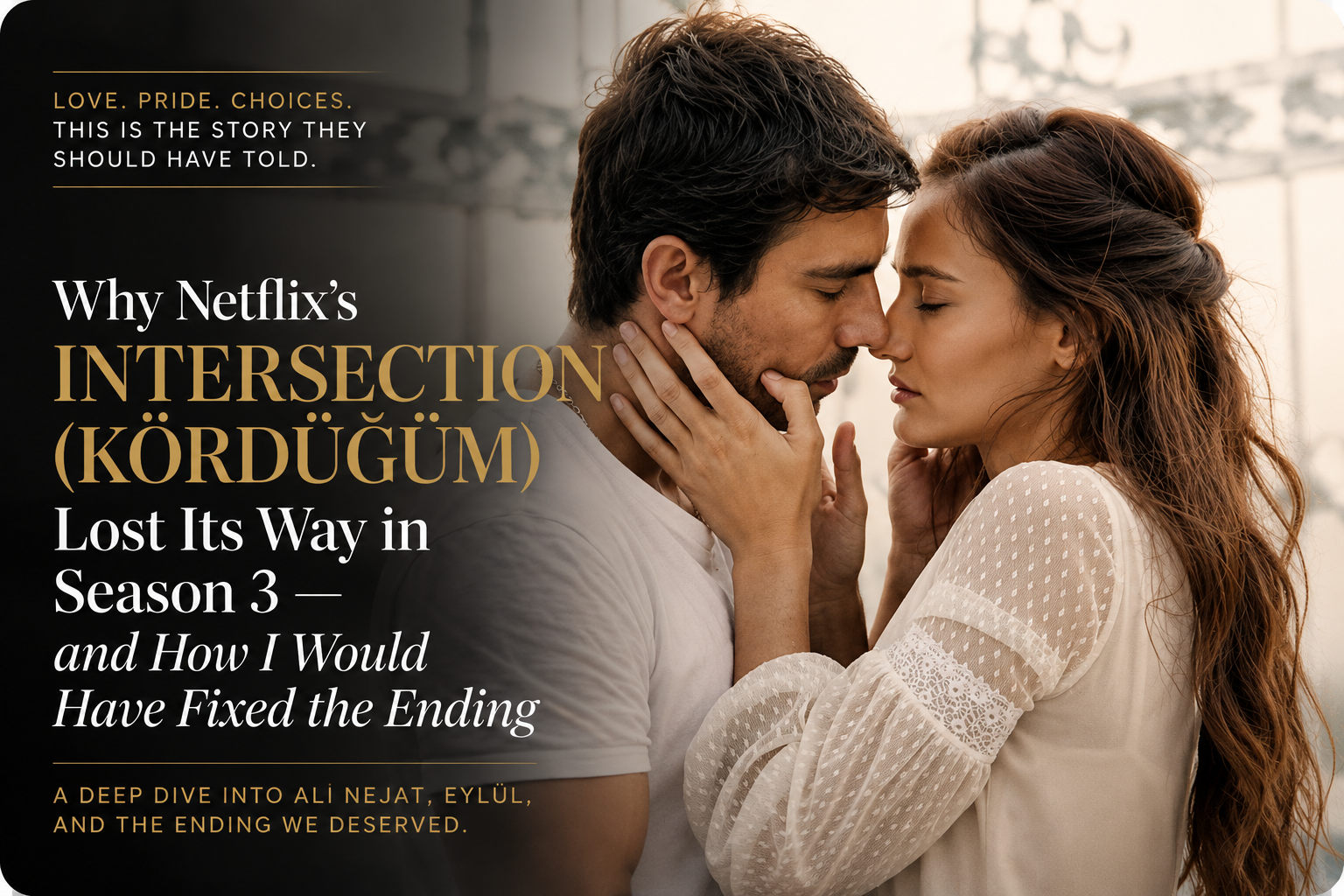
Why Netflix Intersection Season 3 (Kördüğüm) Lost Its Way | How I Would Have Fixed the Ending
I watched every episode of Netflix’s Turkish drama Intersection (Kördüğüm), but if I’m being completely truthful, Seasons 1 and 2 are why I stayed. Netflix Intersection Season 3 (Kördüğüm) Lost Its Way.
At the center of the series is Ali Nejat Karasu, played by İbrahim Çelikkol, a wealthy businessman whose polished exterior initially makes him appear to fit a familiar television archetype: handsome, powerful, emotionally guarded and accustomed to getting what he wants.
Except Ali Nejat was more interesting than that.
His appeal wasn’t simply wealth or appearance. What held my attention was the contradiction within his character. He could be commanding without constantly needing to demonstrate his power. He was educated and sophisticated, but there was also a protectiveness and tenderness underneath the reserve. His relationship with Kaan revealed an entirely different dimension of him, while his relationships with Naz and later Eylül allowed the audience to see how emotionally complicated a seemingly controlled man could actually be.
That is one of the things I increasingly appreciate about a well-written Turkish dizi. The romantic lead is often constructed through contradictions rather than a single personality trait. Strength can coexist with vulnerability. Masculinity can coexist with tenderness. A man can protect someone without the script necessarily treating that protectiveness as weakness.
Intersection understood that beautifully — until it didn’t.
By the time I reached what Netflix presents as Season 3, I felt as though I was watching a different storytelling philosophy take over the same characters. The problem wasn’t that the story became more dramatic. Turkish dizis are melodramatic by nature, and that heightened emotional intensity is part of their appeal.
The problem was that the drama stopped feeling earned.
And what makes the ending particularly frustrating is that I don’t think Intersection needed an entirely different story to work.
The better ending was already sitting inside the story the writers had created.
What Is Netflix’s Intersection (Kördüğüm) About?
Intersection, originally titled Kördüğüm in Turkey, follows businessman Ali Nejat Karasu and the complicated relationships surrounding his family, business interests, past and unexpected role in the life of a young boy named Kaan.
Naz and her husband Umut initially become entangled with Ali Nejat’s world, while the story expands into family secrets, ambition, parenthood, betrayal and romance. Later, Eylül — a woman with an important connection to Ali Nejat’s past — reenters his life.
The series originally aired on Turkish television in 2016. The original Turkish broadcast consisted of 31 episodes, although international streaming platforms divide Turkish series differently, which is why Netflix viewers commonly refer to the later episodes as “Season 3.”
That distinction is useful because the dramatic shift international viewers experience in Season 3 corresponds with a real disruption in the original production. The series returned for a new Turkish broadcast season but struggled to regain its previous audience, and Turkish media reported that declining ratings contributed to its abrupt conclusion.
So the disappointment many international viewers experience today wasn’t simply caused by Netflix dividing the episodes strangely.
Something really did change.
Why I Watched Every Episode of Intersection Seasons 1 and 2
There are Turkish series I enjoy because of the romance. There are others I watch because the locations, fashion or visual atmosphere are beautiful.
Intersection kept me watching because the characters initially felt psychologically layered.
Ali Nejat was particularly compelling because his wealth wasn’t his entire personality. He had presence, manners and authority, but his emotional development was tied to responsibility rather than simply romance.
Kaan was crucial to that transformation.
Watching Ali Nejat discover that he was a father created a much more interesting emotional arc than simply watching another wealthy man fall in love with a beautiful woman. Fatherhood required him to become emotionally available in a way that business never had.
His protectiveness became one of his most attractive qualities as a character. He could solve practical problems because he had money and influence, but Kaan required something that couldn’t be purchased: emotional presence.
That distinction matters.
Why Ali Nejat Worked as a Turkish Dizi Male Lead
Turkish dizis often create powerful male protagonists, but the best ones understand that power alone becomes boring.
Ali Nejat worked because his authority was balanced by emotional restraint, loyalty, generosity and protectiveness. He didn’t need to be loud in order to dominate a room.
That is something Turkish television often does exceptionally well visually. A character’s power can be communicated through posture, tailoring, silence, eye contact, spatial control and the reactions of everyone around him.
As an image consultant, I notice those details immediately.
Ali Nejat’s presentation supported his characterization. He looked like a man accustomed to serious environments. The tailoring, cars, architecture and corporate spaces weren’t simply decorative signs that the production had money. They created a visual language around the character.
But the visual language worked because there was emotional substance underneath it.
Without that, a luxury car is just a prop.
Naz and Ali Nejat: Why Their Relationship Didn’t Need to Continue
I understood the attraction between Naz and Ali Nejat, but I never believed their relationship needed to become the permanent destination of the series.
Naz had her own complicated emotional life before Ali Nejat entered it. Her marriage to Umut deteriorated under enormous pressure, and her growing connection with Ali Nejat developed inside an already unstable situation.
That gave the romance intensity, but intensity isn’t necessarily the same thing as long-term compatibility.
By the end of the earlier story, Naz and Ali Nejat had already gone through enough emotional conflict that allowing them to remain separated would have been completely believable. In fact, the original series itself had already established their breakup before later reversing direction.
This is where I think the writers made their first major mistake.
They didn’t need to reunite Naz and Ali Nejat romantically in order to keep Naz important.
Kaan already gave them a reason to remain connected.
Naz genuinely loved Kaan. That relationship could have continued regardless of whether she remained Ali Nejat’s romantic partner.
That would have been more emotionally mature and, in my opinion, more interesting.
Then Netflix Intersection Season 3 Killed Naz — and I Thought It Had to Be a Joke
When I started the Netflix episodes labeled Season 3 and Naz was killed almost immediately, I genuinely thought I had misunderstood what I was watching.
It felt that abrupt.
The story had put Naz and Ali Nejat back together and moved them toward marriage, despite unresolved feelings surrounding Eylül, only to eliminate Naz almost immediately through a murder storyline.
The official Turkish episode summary itself makes the underlying contradiction obvious: Ali Nejat and Naz are preparing to marry while Ali Nejat remains confused by his unfinished feelings for Eylül.
That should have been the story.
You already have a man preparing to marry one woman while confronting unresolved feelings for a woman from his past.
You don’t need a murder to make that dramatic.
You need a conversation. A choice. And consequences.
Killing Naz certainly created shock, but shock and emotional payoff are not the same thing.
The Difference Between Dizi Melodrama and Narrative Shock
One of the reasons Turkish dizis are so addictive is that they are willing to sustain emotional tension much longer than most American television.
People don’t always say what they mean. Pride interferes. Families interfere. Someone overhears half a conversation. A glance lasts five seconds longer than it should. A character walks away instead of asking the obvious question.
As an American viewer, sometimes I want to yell at the television: Just tell her!
But I also understand why it works.
The audience becomes emotionally involved because we are constantly interpreting what isn’t being said.
That is a tension engine.
The problem comes when a series mistakes escalation for development.
A murder is bigger than a breakup. A kidnapping is bigger than an argument. A conspiracy is bigger than romantic uncertainty.
But “bigger” doesn’t automatically mean better.
If the audience has spent dozens of episodes becoming invested in the emotional architecture of particular relationships, abruptly destroying that architecture for shock can actually reduce tension rather than increase it.
That is what I think happened to Intersection.
Eylül Was Already the More Interesting Season 3 Story
The frustrating part is that the series had already introduced the perfect mechanism for its next chapter: Eylül.
Eylül had history with Ali Nejat.
She also had her own identity, sophistication and presence. She wasn’t simply another woman dropped into the series because the male lead required a new romantic interest.
Most importantly, there was already unfinished emotional business between them.
The official storyline acknowledged Ali Nejat’s unresolved feelings for Eylül even while he was preparing to marry Naz. Scenes also explicitly established Naz’s discomfort with Ali Nejat and Eylül spending time together.
The triangle therefore already existed.
Why destroy it before allowing it to breathe?
The Natural Chemistry Between Ali Nejat and Eylül
What interested me about Ali Nejat and Eylül was that their chemistry didn’t require the writers to manufacture an elaborate reason for them to interact.
They already had one.
The car project gave them a professional connection. Their past gave them emotional history. Barış gave them unresolved grief.
Those three things together are an extraordinarily useful storytelling foundation.
Work + history + unresolved trauma.
That is enough material for an entire slow-burn romantic arc.
They could disagree about the car. They could be forced to spend time together. Memories of Barış could surface. Old resentments could emerge. One could understand something about the other that nobody else does because they were both present during an earlier chapter of their lives.
And somewhere inside all of that, attraction could reappear.
The audience wouldn’t need to be told that Eylül was replacing Naz.
We would simply watch Ali Nejat and Eylül rediscover one another.
Why the Ali Nejat–Eylül Romance Didn’t Feel Earned in Season 3
This is an important distinction because I didn’t object to Ali Nejat ending up with Eylül.
I objected to how the series got there.
There was natural chemistry between the characters, but Season 3 didn’t give that chemistry enough space to develop into an emotionally satisfying relationship.
Naz’s death inevitably changed the context.
Instead of Eylül becoming the woman Ali Nejat consciously chooses after confronting what he wants, she risks feeling like the woman who is available after Naz has been removed from the story.
Those are completely different romantic narratives.
One is choice.
The other is replacement.
And Eylül deserved better than being written as a replacement.
How I Would Have Rewritten Intersection Season 3
I wouldn’t have radically reinvented the show.
I would have used what Seasons 1 and 2 had already built.
1. Keep Naz and Ali Nejat Broken Up
This is the most important change.
Naz and Ali Nejat should not have been pushed back toward marriage merely to create a more shocking tragedy.
Let the breakup stand.
Their relationship mattered. It changed both characters. But not every meaningful relationship has to end in marriage or death.
Sometimes people simply aren’t right for one another.
2. Keep Naz in Kaan’s Life
Naz loved Kaan, and Kaan loved her.
That relationship could have become one of the most emotionally sophisticated parts of Season 3.
Naz could move forward with her own life while maintaining a relationship with Kaan. Ali Nejat would have to learn that ending a romantic relationship doesn’t mean erasing someone from the family structure.
That gives everyone something to navigate emotionally without killing anybody.
3. Let Ali Nejat and Eylül Build the Car Together
This should have been the backbone of the season.
Put them in the same room repeatedly.
Give them a common goal.
Let them disagree professionally.
Let Eylül challenge Ali Nejat in ways other people don’t.
Let Ali Nejat respect her competence.
The romance can remain underneath the professional relationship for a long time.
That is exactly the kind of slow-burn tension Turkish dizis know how to create.
4. Use Barış as the Emotional Bridge
Barış’s death already connects Ali Nejat and Eylül through unresolved history.
Instead of introducing increasingly complicated external threats, I would have brought that emotional history forward.
Let them finally discuss what happened.
Let guilt surface.
Let anger surface.
Let each discover that the other has been carrying something for years.
That gives the actors material with subtextual weight because the romantic connection develops through grief and understanding rather than exposition.
5. Let Ali Nejat Choose Eylül
Eventually, Ali Nejat should realize that what he feels for Eylül isn’t nostalgia.
And Eylül should not immediately accept him.
That’s important.
If their relationship is going to be satisfying, she needs agency. Ali Nejat shouldn’t simply decide he loves her and receive her as the reward at the end of his emotional journey.
Make him prove that he understands what went wrong between them.
Make her decide whether the man standing in front of her is different from the one she knew before.
Then, when they finally come together, the audience has been waiting for it.
That is payoff.
Why This Ending Would Have Preserved the Best Parts of Intersection
My version doesn’t require destroying the existing story.
That’s precisely why I think it works.
Naz remains important.
Kaan doesn’t suffer another devastating maternal loss.
Ali Nejat continues developing as a father.
Eylül retains her own identity.
The car project remains central.
Barış’s death finally receives emotional resolution.
And Ali Nejat’s romantic ending grows naturally from relationships the audience already understands.
You don’t need to keep adding story when the characters already contain the story.
That may be the most important lesson I took from Intersection.
Why Did Kördüğüm End So Abruptly in Turkey?
The original Turkish series did not end because Netflix decided to stop making it. Kördüğüm originally aired on Turkish television, and contemporary Turkish reporting says the returning 2016–2017 broadcast season failed to attract the expected audience.
The departure of Belçim Bilgin, who played Naz, and the addition of new cast members did not reverse the ratings decline. The series subsequently ended after 31 Turkish broadcast episodes.
That context makes Season 3 even more fascinating to revisit.
Because when a television series is struggling, there is an understandable temptation to create a dramatic event big enough to bring viewers back.
But sometimes the answer isn’t a bigger event.
Sometimes the answer is to return to the characters viewers cared about in the first place.
Why Intersection Still Works for International Viewers
Here is the irony: I still watched it.
All of it.
Years after Kördüğüm struggled in its original Turkish broadcast, an international viewer could discover it on Netflix, become invested in Ali Nejat, Kaan, Naz and Eylül, and spend hours inside this story.
That tells us something important about Turkish dizis and their international appeal.
The emotional language travels.
A viewer doesn’t need to grow up in Istanbul to understand a man learning how to become a father. We don’t need the same cultural background to understand jealousy, pride, grief, attraction, family dysfunction or the desire to protect someone.
And the visual world helps carry us across that cultural distance.
The Istanbul locations, beautiful interiors, cars, tailoring and polished characters create aspiration, but aspiration alone would never have kept me watching through three Netflix seasons.
The characters did that.
What Intersection Taught Me About the Mechanics of a Good Turkish Dizi
Watching Intersection reinforced something I’ve noticed across the Turkish series I’ve become interested in: the most effective dizi storytelling doesn’t necessarily depend on constant plot twists.
It depends on emotional architecture.
Give two characters a reason they cannot easily be together.
Give them history.
Give them pride.
Give them something meaningful to lose.
Put them in situations where they must continue interacting.
Then let the audience notice what the characters refuse to say.
That is where the tension lives.
Visual presentation supports it. Beautiful locations support it. Fashion, wealth and production design can make the world irresistible to look at.
But none of those things can replace emotional logic.
When the audience understands why a character behaves a certain way — even when we disagree with the behavior — we remain inside the story.
When characters suddenly behave in ways that primarily serve the next plot twist, we begin to see the machinery.
And once you see the machinery, the spell starts to break.
Intersection Didn’t Need a Different Story — It Needed to Trust the One It Already Had
That is ultimately why I find Intersection so interesting years after its original release.
I don’t think the series failed creatively because its central characters stopped being interesting.
I think the opposite happened.
The characters were more interesting than the ending they were given.
Ali Nejat had already evolved from an emotionally guarded businessman into a protective father capable of much deeper attachment.
Naz had already become an important figure in Kaan’s life without needing to remain Ali Nejat’s romantic destination.
Eylül already had history, chemistry, professional purpose and unresolved emotion with Ali Nejat.
Barış already provided the wound connecting their past to their present.
The car already provided the reason to keep them together.
Everything was there.
My Season 3 would simply have trusted those pieces.
Naz and Ali Nejat remain apart. Naz remains connected to Kaan. Ali Nejat and Eylül build the car. Their unresolved history around Barış gradually forces them to confront what happened between them. Respect turns into intimacy. Old feelings become something new.
And eventually Ali Nejat and Eylül choose each other — not because somebody had to die to clear the path, but because the story finally brought them back to one another.
That, to me, would have been a much more satisfying ending.
And perhaps the greatest compliment I can give Intersection is that nearly a decade after it originally aired, I cared enough about these characters to imagine the ending they should have had.
Frequently Asked Questions About Intersection (Kördüğüm)
Why did Naz leave Intersection?
Naz’s storyline ends at the beginning of the later arc when she is killed after discovering a dangerous secret connected to Ali Nejat’s family. Her departure coincided with actress Belçim Bilgin leaving the series.
Does Ali Nejat end up with Eylül?
The later episodes move Ali Nejat and Eylül toward a romantic conclusion, drawing upon their shared past and previously unresolved feelings. My criticism isn’t that the pairing was wrong; it is that the story did not give their existing chemistry enough time to develop into the ending it could have earned.
Why was Intersection (Kördüğüm) cancelled?
Contemporary Turkish media reported that the series struggled in the 2016–2017 television season and that cast changes failed to improve declining ratings. The original Turkish broadcast ended after 31 episodes.
Why does Netflix show three seasons of Intersection?
Turkish television episodes are substantially longer than standard international television episodes, and streaming platforms can divide imported series differently from their original broadcast structure. As a result, the season and episode organization international viewers encounter may not match the original Turkish broadcast.
Was Intersection successful outside Turkey?
The series subsequently became available to international audiences through Netflix, allowing viewers who never saw the original Turkish broadcast to discover Kördüğüm. Its continued discussion among international viewers years after its original 2016 run demonstrates the long afterlife Turkish dramas can have through global streaming.
Why are Turkish dizis so addictive?
Turkish dramas frequently rely on slow-burn emotional tension, romantic longing, family conflict, pride, miscommunication and highly visual storytelling. Instead of resolving relationships quickly, they often allow emotional conflicts to unfold over extended episodes, encouraging viewers to become deeply invested in the characters.
About Michelle T. Sterling
Michelle T. Sterling is an American award-winning image consultant, personal stylist and founder of Sterling Style Academy and Sterling Personal Styling. In addition to writing about personal style and image consulting, Michelle explores identity, social behavior, status psychology, international culture and the visual language used in film and television.
Her growing interest in Turkish dizis examines not only fashion and visual presentation, but also the emotional and narrative mechanics that have allowed Turkish drama to connect with audiences around the world.