
The Death of Viral Luxury: Why Hype-Chasing Is the New Tacky in 2026
Luxury trend fatigue is real. When people start asking, “Is a Cartier bracelet suddenly tacky? Has the Van Cleef & Arpels Alhambra become too common to be chic? Is carrying a $35 plastic bag inspired by an Hermès Birkin somehow more fashionable than owning the real thing?” it’s time for the death of viral luxury. If you follow fashion coverage and social media closely enough in 2026, these aren’t even ridiculous questions anymore.
Lately, the internet has been trapped in a bizarre luxury paradox. On one side, lifestyle columnists and TikTok trend forecasters are declaring recognizable luxury staples — a classic Rolex, Cartier Love or Juste un Clou bracelets, Van Cleef & Arpels Alhambra jewelry, and even the Hermès Birkin — “tacky,” “overdone” or evidence that someone is trying too hard. On the other side, those same digital fashion conversations are breathlessly celebrating inexpensive novelty pieces such as the viral “Jelly Firkin,” a colorful TPU or plastic bag modeled on the unmistakable silhouette of an Hermès Birkin.
Apparently, owning the original luxury item is now trying too hard, while buying a viral imitation of it is considered ironic and cool.
As an international image consultant and personal stylist who has spent more than two decades working with clients in major fashion and luxury markets including New York, Miami, London and Dubai, I see something very different happening. Luxury itself isn’t becoming tacky. We are experiencing luxury trend fatigue caused by hyper-exposure.And there is an important difference.
When traditional fashion media, social media platforms and trend-driven creators evaluate luxury through a short-term digital lens, decades of craftsmanship, heritage and personal history can get flattened into a momentary internet trend. A recognizable item becomes ubiquitous online, people become tired of seeing it, the algorithm moves on, and suddenly the conclusion becomes: That item is over.
But personal style does not work like an algorithm, and neither does real luxury.
What Is Luxury Trend Fatigue?
Luxury trend fatigue occurs when a luxury item becomes so heavily exposed through social media, influencers, celebrity imagery and digital fashion coverage that consumers begin to feel tired of seeing it — regardless of whether the item’s design, quality or cultural significance has actually changed. Overexposure is not the same thing as obsolescence.
A Cartier bracelet does not lose its craftsmanship because thousands of influencers photograph one. A Rolex does not suddenly cease to be an important piece of watchmaking because a particular model becomes recognizable on Instagram. And an Hermès handbag does not lose the quality of its leatherwork because its silhouette is repeatedly copied.
What changes is the viewer’s perception after repeated exposure. Social media accelerates this process dramatically because the same visual codes can be repeated thousands of times within days. That is why we are seeing increasingly extreme declarations that formerly desirable luxury objects are suddenly “tacky.” The object may not have changed at all; the internet simply became tired of looking at it.
Why Cartier, Van Cleef & Arpels and Rolex Are Suddenly Being Called “Tacky”
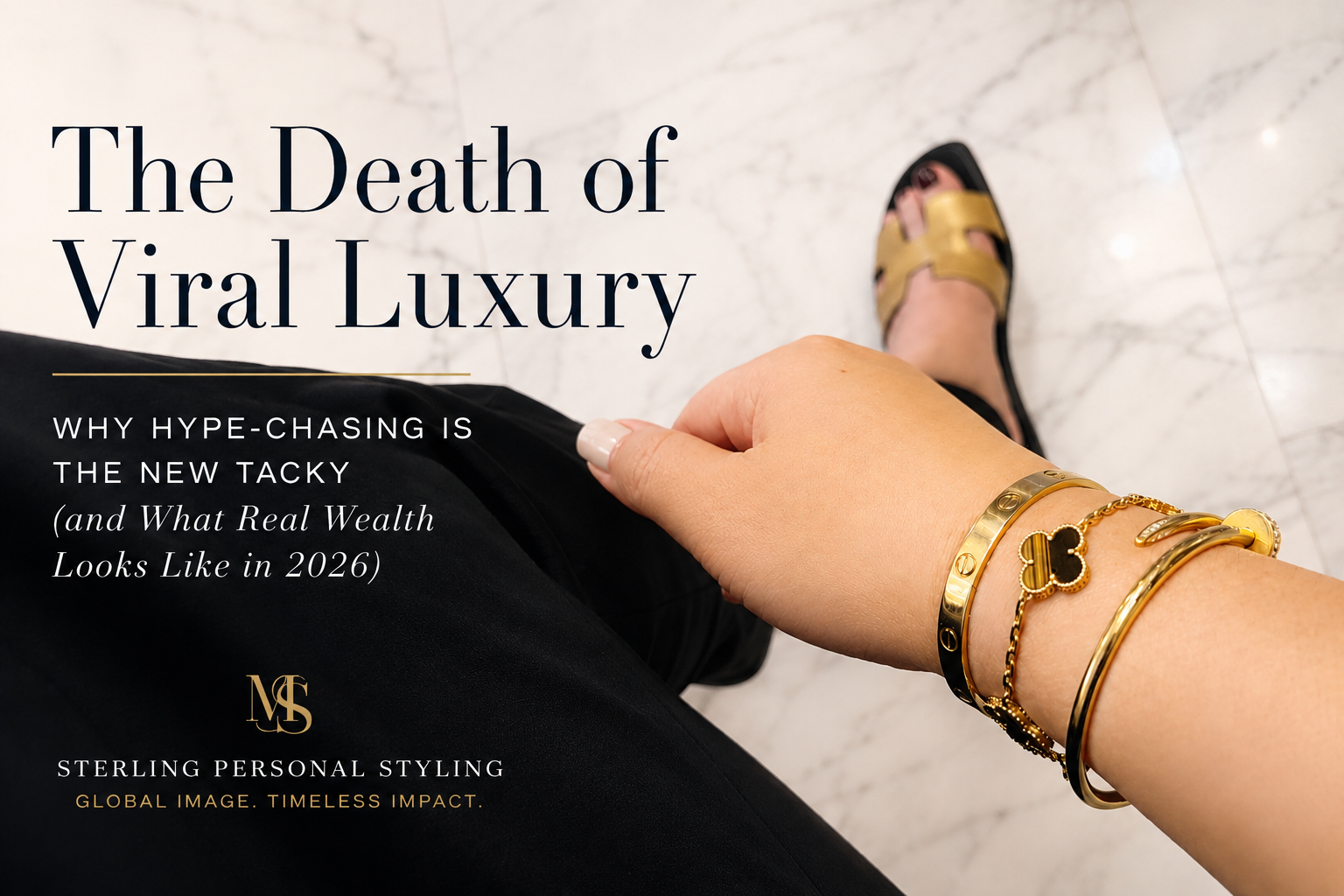
The current backlash against recognizable luxury jewelry reveals one of the biggest misunderstandings in modern fashion commentary. When someone looks at a wrist containing Cartier Love bracelets, a Juste un Clou bracelet, a Van Cleef & Arpels Alhambra motif and a Rolex and immediately declares it “try-hard,” they are judging the objects without understanding the history behind the collection.
There is an enormous difference between hyped consumption and timeless accumulation.
The Luxury Acquisition Gap
| Hype-Driven Consumption | Timeless Luxury Accumulation |
|---|---|
| Multiple status pieces purchased at once | Pieces acquired gradually over many years |
| Buying to reproduce an influencer aesthetic | Buying according to personal taste |
| Motivated by what is trending now | Connected to milestones, memories and history |
| Dependent on social validation | Meaning exists independently of outside approval |
| Can create a rigid “luxury uniform” | Evolves into an individual signature |
| Loses appeal when the algorithm changes | Continues to hold personal significance |
| Communicates “I know what is popular” | Communicates “This is part of who I am” |
If someone rushes out and purchases a Cartier Love bracelet, a Juste un Clou, a Van Cleef Alhambra necklace and a recognizable watch in one afternoon because she saw the exact combination on an influencer, the result can absolutely feel manufactured. It can look like an aesthetic uniform. The problem, however, is not Cartier. The problem is imitation without identity.
Now consider the same jewelry accumulated organically over twenty or thirty years. One bracelet commemorated a professional milestone. Another was purchased during a trip. A watch marked a major birthday. A necklace was inherited. Another piece was simply something the wearer fell in love with years before Instagram existed.
Twenty years later, someone photographs her wrist and dismisses the Cartier/VCA stack as a 2026 influencer cliché — but she didn’t build it in 2026. That’s an important distinction between consumption and collecting. Visually, an outsider might see the same brands, but stylistically these are two completely different wardrobes.
Why a Luxury Jewelry Stack Can Still Be Timeless
Context is everything. Van Cleef & Arpels introduced its Alhambra collection in 1968, while the Cartier Love bracelet dates to 1969. These designs existed decades before Instagram, TikTok and the modern influencer economy.
Calling an established jewelry design “tacky” because it happens to be experiencing another period of mass visibility confuses current exposure with historical relevance. This is particularly important for women who have been purchasing luxury for decades. Someone who began collecting jewelry in the 1990s, 2000s or early 2010s should not be expected to dismantle her personal style because a 2026 TikTok trend cycle suddenly decides her jewelry is overexposed.
That is the opposite of personal style. When fine jewelry becomes intertwined with a person’s life, it becomes part of her visual identity. Personal history is one of the few things an algorithm cannot manufacture.
The $35 Jelly Firkin and the New Anti-Luxury Luxury Trend
Nothing illustrates the current contradiction better than the sudden fascination with the “Jelly Firkin.” The colorful jelly-style handbag borrows heavily from one of the most recognizable handbag silhouettes in the world: the Hermès Birkin.
Versions of these bags have recently circulated online for roughly $35, although products marketed under the Jelly Firkin name are available at a wide range of prices. Some are made from TPU and promoted as playful, lightweight and water-resistant alternatives to traditional leather handbags.
There is nothing inherently wrong with carrying one. Fashion should be fun, and a colorful waterproof bag can make perfect sense for the beach, pool, travel or simply because someone enjoys it. What I question is the larger cultural narrative suggesting that the imitation has somehow made the original undesirable — or that carrying a plastic reinterpretation of an Hermès silhouette demonstrates greater sophistication than owning an authentic Hermès bag.
That argument collapses under its own contradiction. If the Birkin were truly culturally irrelevant, nobody would want to carry a bag designed to look like one. The entire joke depends upon people instantly recognizing the original.
I Owned the Jelly-Bag Trend More Than 20 Years Ago
There is also something amusingly familiar about this trend to me. Jelly Birkin- and Kelly-style bags aren’t a new fashion phenomenon. Similar bags had a documented fashion moment in the early 2000s, more than two decades before today’s Jelly Firkin conversation.
I owned a pink jelly-style Birkin handbag roughly 20 years ago. At the time, I could afford an authentic Birkin, but I didn’t want to spend the money on one. The pink plastic bag was fun, inexpensive and of-the-moment — which is exactly what a novelty fashion piece is supposed to be. I don’t even know where it is today and probably only wore it for a season, but I do remember that the plastic eventually discolored and turned yellow.
Fashion, of course, came back. The plastic didn’t age quite as gracefully.
Perhaps that is the most revealing part of the current Jelly Firkin phenomenon. The plastic Birkin-inspired bag is having another moment more than two decades later. The Hermès Birkin, meanwhile, is still the object being referenced.
Is the Jelly Firkin Really Replacing the Hermès Birkin?
No. It is more accurate to describe the Jelly Firkin as a viral fashion phenomenon built around one of luxury fashion’s most recognizable silhouettes. A novelty bag and an Hermès Birkin satisfy completely different consumer motivations.
One offers novelty, accessibility and participation in an online cultural moment. The other represents luxury leather craftsmanship, scarcity, brand heritage and, for many owners, long-term collecting. The fact that both can exist simultaneously does not mean one has replaced the other.
In fact, the popularity of an inexpensive Birkin-inspired bag demonstrates the continuing cultural power of the Birkin silhouette.
The Viral Luxury Reaction Cycle
| Stage | What Happens |
|---|---|
| 1. Luxury object becomes highly recognizable | A heritage item gains enormous cultural visibility. |
| 2. Social media creates hyper-exposure | Influencers, celebrities and creators repeatedly feature the same item. |
| 3. Audiences experience trend fatigue | Familiarity begins to be interpreted as being “over.” |
| 4. An ironic alternative appears | A dupe, parody or inexpensive reinterpretation becomes the new viral object. |
| 5. The alternative is declared “cooler” | Accessibility and irony are framed as superior taste. |
| 6. Mass adoption follows | The alternative itself becomes ubiquitous. |
| 7. The algorithm moves on | The novelty item eventually experiences the same overexposure. |
| 8. Heritage survives the trend cycle | Established luxury designs remain while the viral conversation shifts elsewhere. |
That final point is the one fashion consumers should remember: virality has a very short memory. Heritage does not.
The Psychology Behind Anti-Luxury Fashion Trends
There is another layer to the fascination with inexpensive luxury lookalikes: accessibility. Traditional luxury has always depended partly upon barriers to entry, including price, scarcity, established client relationships, geography and simple availability.
Social media creates an interesting psychological collision because it gives millions of people visual access to worlds they may not have purchasing access to. Everyone can see the bag, but not everyone can buy the bag. The mass market inevitably responds by recreating the aesthetic at accessible prices.
Again, there is nothing inherently wrong with that. Fashion has always borrowed, translated and democratized ideas. What is new is the speed with which social media can transform that accessibility gap into an ideological statement.
Instead of simply saying, “This is a fun $35 bag,” the internet rewards the more provocative declaration: “This $35 bag is actually cooler than the $20,000 one.” That statement generates conversation, and conversation generates clicks.
Why Fashion Media Keeps Declaring Luxury “Over”
Digital publishing thrives on novelty. “Cartier Continues to Make Beautiful Jewelry” is not a particularly clickable headline. “Your Cartier Bracelet Is Tacky Now” is.
The second statement creates anxiety, curiosity, outrage and debate — four extremely valuable reactions in an attention economy. The same formula applies to handbags, watches, shoes, denim silhouettes and almost every other fashion category.
Something is “dead.” Something else is “back.” A formerly desirable item is suddenly “embarrassing,” while a previously ordinary item becomes a “must-have.” The consumer is continually encouraged to question what she already owns, and once she questions it, she is more likely to buy something else.
That is why I encourage my styling clients to stop asking one of the most common questions in fashion: “Is this still in?” The better question is: “Does this still work for me?” Those are not remotely the same thing.
Is Quiet Luxury Dead in 2026?
No — but the phrase itself has become overused. Quiet luxury was never supposed to mean wearing a specific beige sweater, carrying a particular handbag or buying an entire wardrobe from brands suddenly labeled “quiet.” Once quiet luxury became an identifiable internet aesthetic, it ironically became another form of trend dressing.
True understated luxury is much more personal. It can be exceptional fabric, perfect tailoring, an extraordinary vintage watch, a beautifully constructed handbag with no obvious logo or a piece of jewelry someone has worn for twenty-five years.
It can also be something almost nobody recognizes except the people who share the same experiences. That last category is becoming particularly interesting.
What Does Real Wealth Look Like in 2026?
Modern status is becoming increasingly contextual. The most interesting status objects are not always the most expensive objects; sometimes they are objects that cannot easily be obtained without a particular experience.
Think about an amenity available only to passengers traveling in a premium international airline cabin, a discreet item from a private resort, a tote from a difficult-to-access wellness destination or a small object picked up at an invitation-only event. The financial value may be insignificant compared with a designer handbag, but the experiential barrier can be enormous.
Emirates First Class Pajamas are the epitome of this example. You cannot buy this Hydra Active moisturizing sleepwear or the custom designed super-soft modal fiber sets. That is the ultimate status flex.
Experiential Scarcity Is the New Insider Luxury
An obvious designer logo tells almost everyone what something is. An experiential object may tell almost nobody, but the few people who recognize it understand immediately. It becomes a kind of visual “secret handshake.”
This is not necessarily about showing off wealth. In many cases, it is precisely the opposite: the owner is not relying on strangers to understand the reference. The strongest modern luxury signals increasingly communicate experience, knowledge and access rather than price alone.
Real Wealth Does Not Need Constant Validation
This is also why established luxury consumers are often less responsive to internet declarations about what they should stop wearing. When you have spent decades developing your wardrobe, you are no longer building an identity from scratch every season.
You know which silhouettes work, which colors flatter you and which jewelry feels like you. You understand the difference between something you genuinely love and something you have been persuaded to want. That confidence dramatically changes the relationship between fashion and consumption: you stop asking permission.
How to Build a Timeless Wardrobe That Outlasts Fashion Trends
For executives, entrepreneurs and high-achieving professionals, an effective wardrobe should function as a visual communication system rather than a constantly rotating collection of internet trends. In my work as an international image consultant and personal stylist, I focus on visual architecture, color harmony, proportion, lifestyle alignment and personal brand.
Those principles survive trend cycles because they are built around the individual.
1. Edit Your Wardrobe for Longevity
Stop buying reactionary pieces simply because an algorithm has declared them essential. Before purchasing something, ask yourself: Would I still want this if nobody posted it on social media? If the answer is no, reconsider the purchase.
That does not mean every item needs to last thirty years. Fashion can still be playful, but the foundation of a sophisticated wardrobe should not require constant replacement. Invest strategically in excellent tailoring, beautiful knitwear, strong outerwear, flattering trousers, versatile shoes and accessories that genuinely reflect your personal style.
2. Honor Your Personal History
Never allow a viral headline to convince you that a meaningful possession has suddenly become embarrassing. Your jewelry, watches, vintage accessories and other long-held pieces may represent decades of your life.
That matters more than whether the object appears on a 2026 “tacky luxury” list. A truly personal wardrobe should contain evidence that you have lived.
3. Prioritize Fit Over Branding
Perfect fit remains one of the most powerful luxury signals available at any price point. An accessible pair of trousers tailored beautifully to your body will almost always create a more polished impression than an expensive designer garment that pulls, bunches, drags or distorts your proportions.
People frequently mistake price for polish. They are not the same thing.
4. Understand Your Best Colors
Color is one of the fastest ways to make a wardrobe appear intentional. The correct colors can create visual harmony between your clothing, skin, hair and eyes, while the wrong colors can overwhelm you regardless of how expensive the garment may be.
This is why professional color analysis remains far more useful than simply purchasing whichever color a fashion forecast has declared the color of the year.
5. Develop a Recognizable Personal Signature
The ultimate goal of personal style is not endless novelty; it is recognition. Perhaps you consistently wear beautiful cuffs. Maybe your signature is monochromatic dressing, architectural tailoring, dramatic eyewear, a particular watch, unusual shoes or an extraordinary collection of vintage jewelry.
A signature becomes powerful precisely because you repeat it. Algorithms demand constant change, while personal style becomes stronger through intelligent consistency.
The Difference Between Fashion, Luxury and Personal Style
These three concepts are frequently treated as interchangeable, but they are not.
| Fashion | Luxury | Personal Style |
|---|---|---|
| Responds to cultural change | Emphasizes craftsmanship, heritage, scarcity or experience | Expresses the individual |
| Can change seasonally | Often designed for longevity | Evolves gradually |
| Encourages experimentation | May carry historical or material value | Carries personal meaning |
| Often driven by novelty | Often driven by quality and provenance | Driven by identity |
| Can become viral | Can become a status symbol | Does not require public validation |
The most sophisticated wardrobes understand how to use all three. You can enjoy fashion without becoming controlled by trends, appreciate luxury without dressing like a billboard, and develop a highly recognizable personal style without spending enormous amounts of money.
Is Wearing Recognizable Luxury Tacky in 2026?
No. Recognizable luxury is not inherently tacky. What can appear unsophisticated is using recognizable luxury as a substitute for personal identity.
There is a difference between wearing a Cartier bracelet because it has been part of your life for fifteen years and buying every currently recognizable luxury symbol because you want strangers to understand how much you spent. The objects may be identical, but the intention, styling and context are not.
This is why blanket declarations that an entire luxury brand or iconic design has suddenly become “tacky” are intellectually lazy. Style requires context.
Are Luxury Dupes More Fashionable Than Designer Originals?
Sometimes a dupe can be fun, and sometimes an inexpensive interpretation can even look fantastic. Price alone does not determine style, but neither does irony.
Buying a $35 bag does not automatically make someone more stylish than the woman carrying an Hermès bag — just as owning the Hermès bag does not automatically make its owner stylish. The person creates the style. The object does not.
This is perhaps the biggest lesson being lost in the current luxury debate. Fashion consumers have become so accustomed to discussing products that we have forgotten to discuss people, and personal styling is ultimately about the person.
Frequently Asked Questions About Luxury Trends in 2026
Are Cartier bracelets tacky in 2026?
No. Cartier Love and Juste un Clou bracelets are established fine-jewelry designs and are not inherently tacky. Their increased visibility on social media can create trend fatigue, but how a piece is styled, why it was purchased and how it fits into an individual’s personal style matter more than its current level of online exposure.
Is Van Cleef & Arpels Alhambra out of style?
The Van Cleef & Arpels Alhambra collection dates to 1968 and has existed through numerous fashion cycles. Although the motif has become extremely recognizable and widely imitated, increased visibility does not erase its history as an established fine-jewelry design.
Is the Hermès Birkin out of style in 2026?
The Birkin remains one of the world’s most recognizable luxury handbag designs. Viral criticism of status handbags may reflect changing attitudes toward conspicuous consumption, but a short-term social media backlash should not be confused with the disappearance of the Birkin’s cultural or luxury significance.
What is a Jelly Firkin bag?
The Jelly Firkin is a jelly-style handbag inspired by the recognizable structure of an Hermès Birkin. Versions have circulated online in bright and translucent colors and are commonly made from TPU or similar synthetic materials. Its popularity in 2026 reflects the larger trend toward playful, ironic and accessible reinterpretations of established luxury symbols.
Are jelly Birkin-style bags a new trend?
No. Birkin- and Kelly-inspired jelly bags had a documented fashion moment in the early 2000s. Their reappearance more than two decades later is another example of fashion’s cyclical nature and shows how older novelty trends can be revived for a new generation through social media.
What is luxury trend fatigue?
Luxury trend fatigue happens when consumers become tired of seeing the same luxury products repeatedly across social media, celebrity imagery, influencer content and fashion coverage. The resulting backlash can make an established item appear “outdated” even though the item’s quality, design and craftsmanship have not changed.
What makes a wardrobe look expensive?
Fit, proportion, color harmony, garment condition, fabric quality and intentional coordination generally create a stronger impression of polish than logos alone. Excellent tailoring can make an accessible garment look sophisticated, while poor fit can undermine even an expensive designer piece.
What is timeless personal style?
Timeless personal style is a wardrobe identity based primarily on the individual rather than short-lived trends. It incorporates flattering colors, proportions, silhouettes, lifestyle needs, signature accessories and meaningful pieces that can evolve without requiring the wearer to reinvent herself every season.
The Real Death in Luxury Isn’t the Birkin — It’s Hype-Chasing
The internet will continue creating hyper-speed fashion trends because the digital economy requires new things to click, discuss, buy, reject and replace. Today’s supposedly embarrassing luxury object may become tomorrow’s vintage treasure, while today’s viral $35 novelty may be forgotten by next summer.
And six months after telling you that something is hopelessly dated, the internet may announce that it is “back.” You do not have to participate in that cycle.
True personal style is a system of visual communication. It develops through experience, self-knowledge, consistency and intelligent editing. Luxury can be part of that system, but luxury should never be the system.
Whether you are wearing an heirloom watch, a Cartier bracelet you have owned for twenty years, beautifully tailored trousers from an accessible brand or a silly $35 jelly bag that simply makes you smile, the most important question remains the same: Does it authentically belong to you?
Because the new tacky isn’t Cartier. It isn’t Van Cleef. It isn’t even the Jelly Firkin.
The new tacky is allowing an algorithm to tell you who you are.
Work With Sterling Personal Styling
Want to discover your definitive signature style and build a wardrobe that communicates authority, sophistication and individuality without chasing every new trend?
Sterling Personal Styling provides professional personal styling, color analysis, wardrobe consulting and image development for executives, entrepreneurs and professionals seeking a more intentional approach to personal image.
Build a wardrobe around you — not the algorithm.
ABOUT MICHELLE T. STERLING
Hello! I’m Michelle
Michelle T. Sterling, Principal Personal Stylist and Chief Image Consultant of Sterling Personal Styling, is an American award-winning, internationally renowned image consultant, personal stylist, online personal shopper, author, and Founder of Sterling Personal Styling and Sterling Style Academy.
With more than 15 years of experience in personal styling and image consulting, Michelle helps clients develop wardrobes and personal images that reflect their lifestyle, proportions, personal coloring, professional goals, and authentic personal style.
Her expertise has been featured in E! News, CNBC, the New York Post, Business Insider, The Wall Street Journal, WWD, HuffPost, CNN, Gulf News, Details Magazine, and Forbes. Explore additional features on Michelle’s Press Page.
Through Sterling Personal Styling, Michelle offers Virtual Personal Styling, Online Personal Styling, Virtual Image Consulting, Online Capsule Wardrobe Services, Online Color Analysis, Online Body Analysis, Online Wardrobe Consulting, In-Person Personal Styling, and In-Person Image Consulting in New York, San Francisco, Washington, DC, Miami and Palm Beach, Dubai, Paris and Monaco, and worldwide online.