

Bariş Arduç in Love for Rent vs. Love and Tears: How His Romantic Persona Changed Over 10 Years
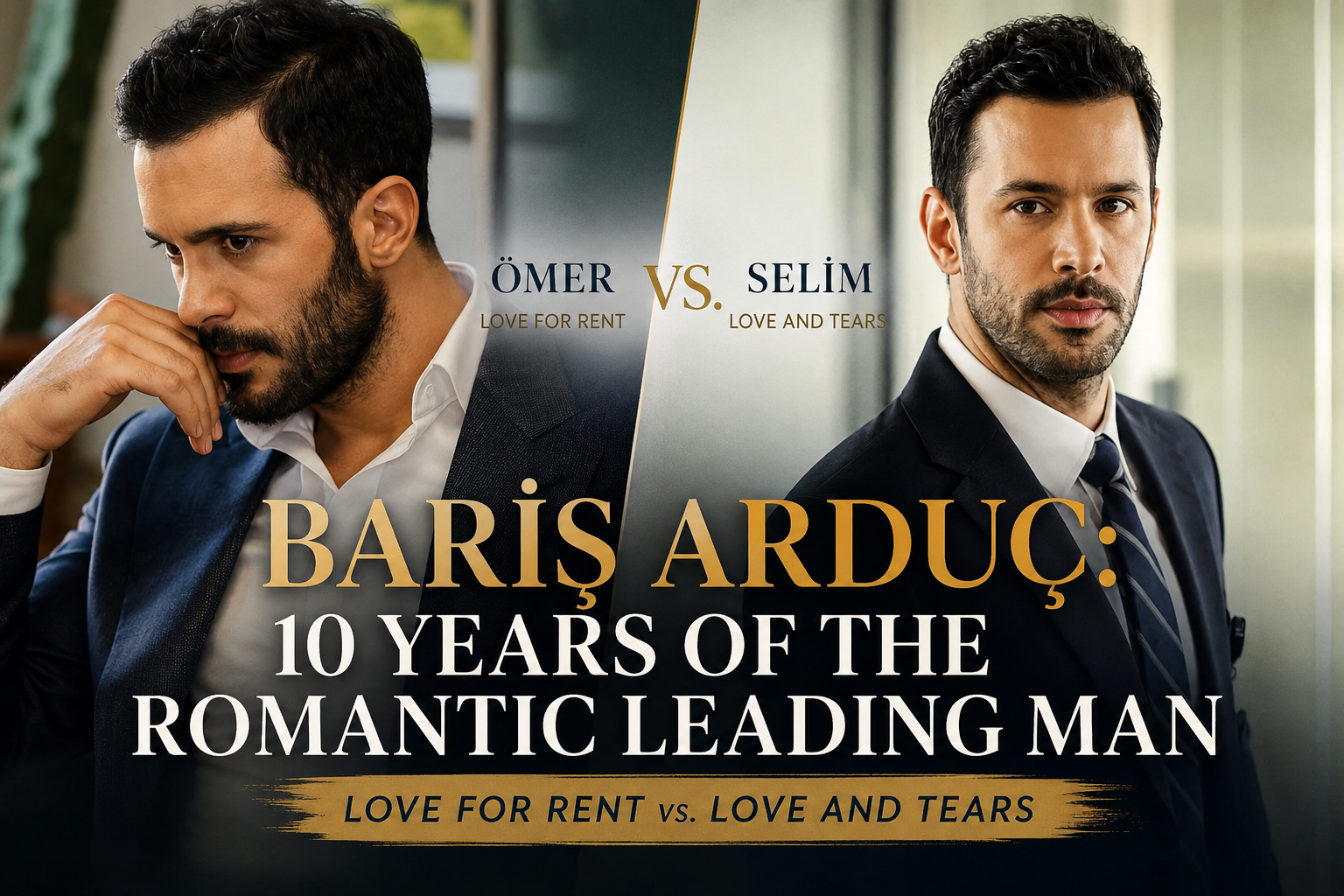
Ten years separate Bariş Arduç’s Ömer İplikçi in Love for Rent (Kiralık Aşk) and his portrayal of Selim in Love and Tears (Aşk ve Gözyaşı). On the surface, the two characters have obvious similarities. Both are handsome, affluent Istanbul men who move comfortably through privileged environments, and both are controlled, masculine and emotionally restrained.
But watching the two performances approximately a decade apart reveals something much more interesting than an actor simply getting older. Ömer and Selim represent two different versions of the emotionally armored Turkish romantic male lead, while also reflecting how romantic storytelling — and the way audiences consume Turkish dramas — has evolved.
Ömer begins Love for Rent as an ice bucket. He is controlled, rigid, self-sufficient and extremely difficult to penetrate emotionally. Defne gradually disrupts that control, and much of the pleasure — and, frankly, the torture — of watching the series comes from waiting for the ice to melt.
Selim begins Love and Tears somewhere very different. He is already married. The great romance has already happened, yet somewhere inside the marriage communication has broken down. His emotional restraint is no longer simply mysterious or seductive; it has become destructive.
That distinction is why I find these two Barış Arduç characters so interesting to compare.
Why Ömer İplikçi Made Bariş Arduç a Star
When Kiralık Aşk premiered in Turkey in 2015, Barış Arduç was not yet the enormous star international Turkish-drama audiences know today. Ömer changed that.
Arduç himself acknowledged during the show’s success that playing the handsome, cool CEO contributed enormously to his sudden popularity. Ömer gave audiences an immediately recognizable romantic fantasy: wealthy, handsome, sophisticated, successful, controlled and seemingly impossible to emotionally penetrate.
Turkish audiences responded enthusiastically. Kiralık Aşk became a major ratings and social-media phenomenon, while the romantic relationship between Ömer and Defne became central to the show’s identity.
But I don’t think audiences fell in love with Ömer because he represented the epitome of male perfection.
He didn’t.
Watching Love for Rent today, particularly through the eyes of an international streaming viewer, Ömer can be incredibly frustrating. His flaws are actually one of the reasons the character remains interesting.
Ömer Was an Ice Bucket Before Defne Ever Hurt Him
It would be easy to interpret Ömer’s emotional coldness as something created by Defne’s eventual deception, but that isn’t really what happens.
Ömer is emotionally frozen when Defne meets him. He is disciplined, controlled, fiercely independent and accustomed to living within an ordered world largely of his own creation. He certainly has feelings and is capable of affection toward the relatively small number of people he trusts, but he is exceptionally good at containing emotion.
Then Defne enters his life.
She doesn’t fit neatly into his environment. She is warm where he is restrained, spontaneous where he is controlled and emotionally expressive in ways he generally is not. Their socioeconomic backgrounds are dramatically different as well, creating another layer of tension between Ömer’s polished, affluent world and Defne’s much more chaotic and relatable reality.
She creates disorder in a man who depends upon control.
And that is precisely why she works.
The Defne Effect: Why Turkey Didn’t Really Fall in Love With Ömer Alone
Looking back at the enormous popularity surrounding Kiralık Aşk, I don’t think the phenomenon can really be explained by Ömer alone. It was Defne and Ömer together — and particularly the possibility created when someone like Defne entered the life of someone like Ömer.
The audience wasn’t necessarily fantasizing about the emotionally inaccessible man standing at the beginning of the story. They were watching to see what that man could become once he genuinely fell in love.
Defne disrupts his routines, challenges his emotional control and forces him to experience feelings that don’t fit neatly into the carefully structured life he has built. The pleasure of the relationship is watching the ice gradually melt.
That is the central romantic fantasy of Love for Rent: the idea that a fiercely self-contained man who does not appear to need anyone can meet one particular woman who reaches the part of him everyone else cannot.
Why Ömer and Defne Could Also Be Torturous to Watch
This is where my reaction to Love for Rent differs somewhat from the mythology surrounding the series. I couldn’t comfortably watch all of Season 1 straight through because, at times, the relationship becomes exhausting and even toxic to watch in its entirety.
The misunderstandings, secrets, wounded pride, interrupted conversations and emotional retreats can continue for what feels like an eternity. Someone misunderstands something, somebody refuses to explain, pride prevents the obvious conversation, and the audience waits another episode — or several — for two people to finally say what they mean.
At the same time, I understand why it works within the traditional mechanics of a Turkish dizi.
A long-form Turkish broadcast series historically had an enormous amount of screen time to fill. Kiralık Aşk ultimately ran for 69 original episodes, with Turkish television episodes running far longer than conventional American network episodes.
That creates a completely different romantic storytelling engine from an eight- or ten-episode international streaming series. You don’t simply create attraction; you create obstruction.
The secret cannot be revealed yet. The misunderstanding cannot be resolved yet. Pride has to interfere. Another romantic possibility appears. Someone walks away just before the conversation that might solve everything.
It can be maddening, but it also produces extraordinary emotional investment.
Ömer’s Real Weakness Wasn’t Coldness — It Was Emotional Maturity
Ömer is intelligent, sophisticated, successful and capable of considerable tenderness, but none of those qualities automatically make someone emotionally mature.
That becomes particularly obvious when he is confronted with deception.
Defne’s secret doesn’t merely injure him romantically. It attacks the structure upon which Ömer has built much of his identity: trust, personal dignity, control and pride. And he doesn’t initially possess particularly sophisticated emotional tools for processing that injury.
He retreats and becomes rigid. His wounded ego becomes part of the conflict.
This is where I actually find Ömer more believable than an idealized “perfect man.” I can imagine many affluent, powerful, alpha-type men in Istanbul — or New York, London, Miami or Dubai — responding badly when they discover that a relationship they believed was authentic began with deception.
Professional power does not necessarily translate into emotional sophistication. I have written about this broader distinction between wealth, security, status and human behavior in The Psychology of Modern Elite Culture — According to Michelle T. Sterling.
Ömer can run a company. That doesn’t mean he knows what to do with a broken heart.
The Ömer I Liked Most Was the Man Who Decided to Get Defne Back
Something important changes later in Ömer’s development. Once he consciously decides that he wants Defne back, he is no longer the ice bucket we met at the beginning.
Love has altered his behavior. Instead of protecting himself entirely through emotional distance, he becomes active. He pursues her, communicates more clearly and allows desire to override some of the rigid self-control that defined his earlier personality.
That is why the emotional reward isn’t simply that Defne eventually “gets” Ömer. It is that Ömer becomes capable of behaving differently because he has experienced Defne.
That is character development, and it helps explain why audiences were willing to tolerate such an extraordinarily prolonged romantic journey. They weren’t simply waiting for a couple to get together; they were waiting for the transformation.
Ten Years Later, Bariş Arduç Gives Us Selim
Approximately a decade later, Aşk ve Gözyaşı, internationally known as Love and Tears, paired Barış Arduç with Hande Erçel in a Turkish adaptation of the South Korean drama Queen of Tears.
This time, Arduç wasn’t playing the mysterious single CEO waiting for a woman to penetrate his emotional defenses.
He was playing Selim, a man whose marriage was already dying.
And initially, I had a problem with him.
Selim felt dry and rigid during those first episodes. I found him significantly more difficult to connect with than the later version of Ömer audiences had learned to love, because Selim’s emotional interior was so deeply hidden that his coldness initially risked looking like indifference.
Eventually, though, the rigidity begins making sense.
Ömer Was Waiting to Fall in Love. Selim Had Forgotten How to Show It.
This is the essential difference between these two men.
Ömer’s emotional armor exists before the relationship. Selim’s emotional armor exists inside the relationship.
That is much sadder.
Selim and Meyra have reached a point where the emotional language between them has almost completely broken down. Instead of communicating hurt, disappointment, fear or longing effectively, Selim withdraws into himself.
He becomes cold. Meyra can only react to the behavior she sees rather than the emotions he refuses or is unable to communicate, and eventually the marriage begins collapsing under the weight of everything neither person is saying properly.
Selim isn’t without feeling.
He is overwhelmed by feeling while presenting the exterior of someone who appears to have almost none.
That is a considerably more mature character problem than Ömer’s.
The Moment Selim Finally Became Interesting to Me
For me, Love and Tears changes when Selim learns that he may actually lose his wife.
Suddenly, emotional distance is no longer safe. The possibility of death destroys the comforting illusion that there will always be another opportunity to repair what has gone wrong.
And this is when Barış becomes much more interesting to watch.
The character who initially appeared dry begins revealing that the emotional emptiness we thought we were seeing wasn’t emptiness at all. It was suppression.
That difference is everything.
The Anniversary Scene That Changed My Interpretation of Selim
The scene I found most devastating comes from the contradiction at the center of their marriage.
Selim has contemplated divorce, yet he prepares a romantic evening at home to celebrate their anniversary. Then Meyra discovers that he had wanted to end the marriage.
And Selim breaks down.
Watching this emotionally rigid man burst into tears and apologize completely reframes the coldness that came before it. The marriage wasn’t deteriorating because he didn’t care.
He cared and couldn’t communicate it.
That is far more tragic, because suddenly the stiffness of the earlier episodes functions differently. The audience realizes we have been watching a man hide behind an emotional facade so effectively that even his own wife can no longer correctly interpret what he feels.
Selim’s Most Formidable Quality Was Loyalty
What impressed me most about Selim wasn’t his wealth, appearance or romantic grand gestures. It was loyalty.
Even while the marriage was breaking down, his loyalty to his wife and her family remained remarkably strong. That matters because loyalty is an action rather than an aesthetic.
A character can repeatedly say “I love you” and still behave selfishly. Selim frequently has difficulty saying what he feels, yet when circumstances become serious, his actions reveal where his allegiance actually lies.
That contradiction — emotionally cold but behaviorally loyal — makes him considerably more interesting than he initially appears. He can be warm and cold almost simultaneously, and that is a very human contradiction.
Ömer and Selim Are Two Versions of the Same Emotional Problem
The ten-year comparison becomes fascinating because neither character actually lacks emotion. Both have trouble managing and communicating it.
| Ömer — Love for Rent | Selim — Love and Tears |
|---|---|
| Emotionally guarded before love | Emotionally guarded inside marriage |
| Control protects independence | Control protects vulnerability |
| Defne disrupts his ordered world | Loss disrupts his emotional withdrawal |
| Deception wounds his pride | Failed communication damages his marriage |
| Love gradually melts the exterior | Mortality cracks the exterior |
| Must learn to trust | Must learn to communicate |
| Romantic possibility drives the story | Romantic recovery drives the story |
Ömer’s emotional defense is appropriate to a younger romantic fantasy: Can the right woman make this inaccessible man fall completely in love?
Selim’s defense belongs to a more mature question: What happens after love, when two people stop telling each other what they actually feel?
That is a much darker — and potentially more sophisticated — problem.
What Changed in Bariş Arduç’s Romantic Screen Persona?
Barış himself is different ten years later. Not merely physically older; his screen presence has matured.
Ömer’s appeal depends partly upon romantic idealization. He is the impossibly handsome, successful and controlled man whose vulnerability must gradually be discovered.
Selim carries considerably more emotional wear. His romantic appeal doesn’t come from perfection; it comes from contradiction.
I also think the early rigidity made Selim harder for viewers to embrace immediately. Ömer is designed to create curiosity: What is underneath this man’s exterior?
Selim can initially produce a much less seductive question: Why is this man behaving so coldly toward his wife?
Those aren’t equally compelling opening propositions. But once Selim’s emotional interior becomes visible, the character becomes significantly more rewarding.
The challenge is that a broadcast audience has to remain with him long enough to see it.
Why Love and Tears Struggled in Turkey
Despite pairing two internationally recognizable stars and adapting the globally successful Queen of Tears, Aşk ve Gözyaşı did not achieve the domestic ratings expected from the production. The series underwent creative changes during its short run and ultimately ended after only seven episodes.
That is an extraordinary contrast with the cultural phenomenon Kiralık Aşk became a decade earlier.
But I’m not convinced that means the underlying emotional story was inherently wrong for an audience. In fact, reports during its Turkish run indicated that the series attracted stronger interest internationally than it was receiving domestically.
That doesn’t particularly surprise me.
Was Love and Tears Better Suited to an International Streaming Audience?
This is where distribution and audience identification become particularly interesting.
Aşk ve Gözyaşı exists inside an extremely affluent, insulated world. There is far less of the immediate working-class identification that Defne provided in Kiralık Aşk.
Defne acts as a bridge. Audiences can experience Ömer’s expensive, highly controlled lifestyle through a woman who doesn’t originate from that environment.
Love and Tears doesn’t provide the same class contrast at the center of its romantic relationship.
Could that have made the characters more difficult for a broad domestic television audience to immediately identify with? I think it is a worthwhile question, particularly when a series is competing for a large terrestrial television audience rather than a self-selecting global streaming audience.
Yet internationally, some of the same characteristics that create distance domestically can become part of the fantasy. Affluent Istanbul interiors, beautiful people, family dynasties and high-end visual production can travel extremely well when the emotional story underneath them is universal.
I explored the relationship between wealth, presentation, social hierarchy and Turkish storytelling from a different angle in What Netflix’s Old Money Reveals About Wealth, Beauty, and Social Status — According to Michelle T. Sterling.
And Love and Tears ultimately has an extremely portable emotional premise: a marriage is dying, the husband thinks divorce may be the answer, and then the possibility of actually losing his wife forces him to confront whether the love disappeared — or whether they simply stopped knowing how to reach one another.
You don’t need to be Turkish to understand that.
The Turkish Dizi Has Changed in Ten Years — Because the Audience Has Too
This may be one of the biggest differences between watching Ömer in 2015 and Selim a decade later.
Kiralık Aşk could make its audience wait. And wait. And wait some more.
The prolonged romantic frustration was part of the broadcast experience. But international streaming has changed our tolerance for narrative delay.
A global viewer accustomed to eight-, ten- or twelve-episode streaming seasons expects character development to happen more efficiently. We still want longing, chemistry, pride, jealousy, emotional restraint and the delicious frustration of two people who clearly love one another refusing to say the obvious thing.
But we don’t necessarily need dozens of episodes to get there.
This question of how traditional dizi mechanics work — and when those mechanics stop working — is something I also explored in Why Netflix’s Intersection Season 3 (Kördüğüm) Lost Its Way — and How I Would Have Fixed the Ending.
In Intersection, the problem wasn’t a lack of emotional potential. The characters already possessed history, chemistry and unresolved tension. The later story simply stopped trusting the emotional architecture it had already built.
That distinction matters here too.
What Streaming Can Learn From the Traditional Turkish Dizi
The answer isn’t to turn Turkish drama into American television. That would destroy much of what makes the format distinctive.
Turkish dizis are extraordinarily effective at emotional subtext. Silence matters. Body language matters. Pride matters. A character’s decision not to touch someone can sometimes communicate as much as a kiss.
The slow burn has value.
But slow burn and narrative stagnation aren’t the same thing.
A contemporary international format can preserve the emotional architecture while compressing repetition. Instead of ten misunderstandings, perhaps you need three exceptional ones. Instead of keeping two characters apart for twenty hours because the episode count requires it, keep them apart until the emotional obstacle has genuinely changed them.
The goal isn’t faster storytelling simply for speed.
It is more concentrated storytelling.
From Ömer to Selim: What Ten Years Really Changed
Ömer and Selim ultimately reveal two stages of the same romantic problem.
Ömer shows us a man who has built emotional walls because those walls make him feel safe. Defne enters and makes that safety impossible. He falls in love, gets hurt, retreats into pride and eventually has to decide whether protecting himself matters more than the woman he loves.
Selim shows us what those emotional walls can look like after the relationship has already been established.
The danger is no longer that he won’t fall in love.
He already did.
The danger is that two people who once loved one another can become so poor at communicating their pain that love begins to look indistinguishable from indifference. Then the possibility of death forces the truth into the open.
That is why, although Ömer is probably the more immediately seductive romantic character, I ultimately found Selim psychologically fascinating once his facade began to crack.
Ömer’s story asks whether love can melt the ice.
Selim’s asks what happens when the ice comes back.
Why Bariş Arduç Works So Well as the Emotionally Restrained Male Lead
There is a reason Barış Arduç can play both characters convincingly.
His screen presence doesn’t require constant dialogue. He can appear emotionally contained while still allowing the audience to sense that something is happening underneath the surface.
That quality was enormously useful for Ömer because viewers needed to believe that Defne was affecting him before Ömer was prepared to acknowledge it himself.
Ten years later, the same quality becomes darker in Selim. We need to believe that his coldness isn’t the whole story.
When the emotion finally surfaces — particularly when that control collapses into grief, fear or tears — the contrast creates the payoff.
The man hasn’t suddenly developed feelings.
He has finally lost the ability to hide them.
That distinction is what makes both performances work for me.
The Evolution Isn’t From Cold to Warm — It’s From Fantasy to Complexity
Looking at Barış Arduç’s two romantic leads approximately a decade apart, I don’t think his screen persona simply became softer or more mature.
It became more complicated.
Ömer represents the romantic fantasy of emotional access: the powerful, self-contained man who lets one extraordinary woman inside.
Selim represents the consequences of emotional inaccessibility: the man who loves deeply but has become so accustomed to protecting himself that the person closest to him can no longer feel that love.
One is about falling in love.
The other is about learning how not to lose it.
And perhaps that is the most interesting evolution of all.
Ten years after Turkey became obsessed with watching Defne melt Ömer İplikçi’s carefully constructed exterior, Barış Arduç returned with a character who asks a much more adult question:
What if the real challenge isn’t getting a guarded man to fall in love — but teaching him how to remain emotionally present once he already has?
That is the Barış Arduç performance I wanted to keep watching.
More Turkish Dizi and Cultural Analysis by Michelle T. Sterling
If you enjoyed this analysis of Barış Arduç as Ömer and Selim, read Why Netflix’s Intersection Season 3 (Kördüğüm) Lost Its Way — and How I Would Have Fixed the Ending for my analysis of Ali Nejat, Eylül and the emotional architecture that could have produced a much stronger final chapter.
You may also enjoy What Netflix’s Old Money Reveals About Wealth, Beauty, and Social Status — According to Michelle T. Sterling, where I explore Turkish dizi storytelling through wealth, class, masculinity, beauty and visual presentation.
For a broader examination of wealth, status, social behavior and the psychological distinction between being rich and feeling secure, read The Psychology of Modern Elite Culture — According to Michelle T. Sterling.
Frequently Asked Questions About Bariş Arduç, Love for Rent and Love and Tears
Who does Bariş Arduç play in Love for Rent?
Barış Arduç plays Ömer İplikçi in Kiralık Aşk (Love for Rent), a successful, wealthy and emotionally guarded shoe designer and businessman who gradually falls in love with Defne Topal, played by Elçin Sangu.
Who does Bariş Arduç play in Love and Tears?
Barış Arduç plays Selim in Aşk ve Gözyaşı (Love and Tears) opposite Hande Erçel as Meyra. The series follows a married couple approaching divorce whose relationship is transformed by life-changing news and is adapted from the South Korean drama Queen of Tears.
Why was Ömer so popular in Turkey?
Ömer combined the fantasy of the handsome, successful and sophisticated CEO with emotional restraint and hidden vulnerability. But the extraordinary chemistry and romantic tension between Ömer and Defne were equally important to the phenomenon. The appeal wasn’t simply who Ömer was when the story began; it was watching what falling in love with Defne gradually allowed him to become.
Why did Aşk ve Gözyaşı end so quickly?
Aşk ve Gözyaşı did not achieve the domestic Turkish ratings expected from the production and ended after seven episodes. The series also underwent creative changes during its short broadcast run, despite considerable attention surrounding its leading actors and source material.
How are Ömer and Selim different?
Both characters are emotionally restrained, but Ömer begins his story guarded and gradually learns to open himself to love. Selim begins inside a failing marriage where emotional withdrawal and poor communication have already caused damage. Ömer’s story is primarily about falling in love; Selim’s is about rediscovering and communicating love before it is too late.
How did Bariş Arduç’s romantic persona change over ten years?
The shift from Ömer to Selim moves from romantic idealization toward greater psychological complexity. Ömer embodies the fantasy of gaining access to an emotionally guarded man, while Selim explores what happens when emotional restraint persists inside an established relationship and begins destroying it.
Why are emotionally restrained male leads so common in Turkish dizis?
Emotional restraint creates an effective slow-burn tension engine because the audience must interpret what a character feels through silence, behavior, body language, jealousy, protectiveness and actions rather than explicit dialogue. The eventual moment when the character finally expresses his emotions becomes more powerful because the audience has waited to see the facade break.
Has streaming changed Turkish dizi storytelling?
International streaming has created greater demand for shorter, more concentrated storytelling than traditional Turkish broadcast television. The challenge is to preserve the emotional intensity, romantic longing, subtext and character development that distinguish Turkish dizis while reducing repetitive obstacles that may feel unnecessarily prolonged to global streaming audiences.
About Michelle T. Sterling
Michelle T. Sterling is an American award-winning image consultant, personal stylist and founder of Sterling Style Academy and Sterling Personal Styling. In addition to writing about personal style and image consulting, Michelle explores visual identity, international culture, social behavior and the way character, wardrobe, status and nonverbal communication intersect on screen.
Her analysis of Turkish dizis focuses particularly on the emotional and visual mechanics that make Turkish drama distinctive — and how those mechanics can evolve for contemporary international audiences.