Here's where most beginners get stuck: what does "certified" even mean in this field? Unlike hairstylists, personal stylists and image consultants don't need a state license to work. That said, certification still matters. It builds the technical skill, client-handling ability, and credibility that separates a hobbyist from someone clients will actually pay.
This guide breaks down the real steps to becoming a certified personal stylist, what programs look like, which skills matter most, and what you can realistically expect to earn.
Key Takeaways
- Certification isn't legally required, but it builds trust, technique, and business skills fast
- Self-paced, live online, and in-person bootcamps fit different budgets and schedules
- Styling skill alone won't build a business; branding and client acquisition matter equally
- Income varies widely by niche and clientele, with strong upside through specialization
- Globally recognized programs can open doors to international clients
What Is a Certified Personal Stylist? (And How It Differs From a Hair Stylist)
A certified personal stylist or image consultant works with clients on wardrobe strategy, color analysis, body shape, and overall personal presentation. A hair stylist, by contrast, focuses on cutting, coloring, and styling hair. The skill set—and the regulation around it—is completely different.
That regulatory gap is the part people find confusing. Cosmetology requires serious state oversight: California mandates 1,000 training hours plus a written exam before anyone can legally work as a licensed cosmetologist, and Texas requires the same 1,000-hour threshold along with both written and practical exams.
Personal styling and image consulting don't work that way. There's no state board, no mandated hour count, no licensing exam. Instead, certification comes from private academies and industry bodies.
The most recognized professional credentials in the field typically require candidates to pass an exam and submit a portfolio review - a voluntary, competency-based credential rather than a government license.
Common Specializations to Choose From
Within personal styling, most professionals settle into one of a few lanes:
- Wardrobe stylist – focuses on closet edits, capsule wardrobes, and outfit coordination
- Image consultant – covers wardrobe plus personal branding, communication, and executive presence
- Personal shopper – specializes in retail navigation, budget management, and in-store or online shopping for clients
- Color analyst – concentrates on undertone, seasonal palettes, and color harmony
Most certification programs blend several of these disciplines rather than isolating just one, which gives graduates flexibility to build a broader practice later.
How to Become a Certified Stylist: Step-by-Step Guide
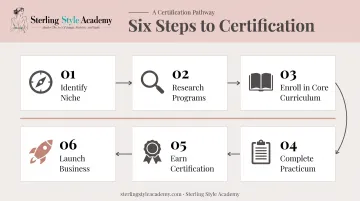
Becoming certified isn't complicated, but skipping steps tends to show up later as gaps in confidence or client results. Here's the realistic path.
- Identify your niche and career goals. Decide early whether you're drawn to wardrobe styling, color analysis, image consulting, or personal shopping. Your answer determines which certification track actually fits you.
- Research certification bodies and programs. Look for industry recognition, curriculum depth, and alumni outcomes. A program's graduates tell you more than its marketing copy does.
- Enroll in a program covering core competencies. This means color theory, body shape analysis, wardrobe curation, client psychology, and personal branding, at minimum.
- Complete hands-on practicum work. Real or mock client sessions build the portfolio and confidence that classroom theory alone can't provide.
- Earn your certification credential. Consider specialized add-ons too, such as a dedicated color analysis system, if you want to expand your service menu later.
- Launch or grow your business. Build a personal brand, start marketing, and put program business tools (branding, outreach, and client-facing resources) to work.
A practical shortcut for step 4: sit on the other side of the table first. Booking Sterling's virtual personal styling or in-person image consulting as the client shows you how a session is paced and where clients hesitate, well before you run one yourself.
Several programs, including Sterling Style Academy, treat the training investment as a tax-deductible business expense because it counts as professional development for a business owner. That isn't tax advice (confirm with an accountant for your situation), but it often changes the math for career-changers weighing tuition against startup costs.
Choosing the Right Certification Program
Not all certification programs are built the same, and the differences show up fast once you're trying to land real clients.
What to Look For
- Industry recognition – Does the curriculum align with recognized professional standards?
- Instructor credentials – Are the trainers working professionals, or just course narrators?
- Curriculum breadth – Does it cover technical skills, client psychology, and business development, or just one of those?
- Post-certification support – Will you get any mentorship, templates, or marketing help after graduation?
Comparing Formats
| Format | Best For | Typical Length |
|---|---|---|
| Self-paced online | Learners who need flexibility around a job or family | Days to several months |
| Live online | Learners who want real-time feedback without travel | Weeks to a few months |
| In-person bootcamp | Learners who want immersive, hands-on practice fast | 1 day to 2 weeks |
Pricing varies widely across the industry. Self-paced online courses can start under $1,000, while live one-on-one online training often runs $2,500–$4,500. For a concrete example of the self-paced tier, Sterling Style Academy runs an online stylist training course you can work through on your own schedule.
In-person intensives range from roughly $1,500 for a single day up to $12,000+ for a two-week mastery-level program, depending on location and depth.
Sterling Style Academy is a useful reference point for what a globally recognized program can look like. Founded by former Certified Image Consultant Michelle T. Sterling, it runs in-person training in Miami, New York, Dubai, Paris, Milan, and Los Angeles, with an alumni network across more than 60 countries.
Its instructor team carries a combined 50 years of industry experience and ranks in the top 2 percentile of the field. Those are the kinds of credentials worth verifying in any program you consider.

Beyond the core certification, specialized add-ons like a dedicated color analysis system let graduates expand their offerings and charge more for niche expertise. Trends also move quickly in this field, so ongoing education still matters—even without formal continuing-education rules like licensed beauty fields require.
Essential Skills for a Successful Certified Stylist
Technical training gets you in the door. What keeps clients coming back is a different set of muscles entirely.
Technical skills form the foundation:
- Color theory and undertone analysis
- Body shape assessment and proportion principles
- Current style trends and how to apply them practically
Soft skills determine whether clients trust you enough to keep booking:
- Active listening to understand what a client actually wants (not just what they say)
- Empathy, especially with clients who feel self-conscious about their bodies
- Clear communication during consultations and follow-ups
This is also where the profession gets harder than newcomers expect. Reading fabric and color is teachable in weeks. Building the rapport that turns a one-time consultation into a five-year client relationship takes longer — usually a mix of practice, feedback, and a fair number of awkward early sessions.
Business skills are non-negotiable since most certified stylists work as entrepreneurs, not employees:
- Pricing and packaging services
- Marketing and client acquisition
- Building a personal brand that photographs well and sells consistently
Programs that skip this third pillar tend to produce graduates who are technically skilled but financially stuck.
Career Outlook, Salary & Growing Your Business
Income in this field swings widely, and that's not a dodge — it genuinely depends on niche, location, and business model. According to Glassdoor's 2026 data, U.S. personal stylists report a median total pay of $73,000, with a typical range of $54,000 to $99,000 based on 591 self-reported salaries. Stylists working in major markets like New York City reported a somewhat higher median, around $82,000.
Take these figures as directional, not gospel — they're aggregator estimates, not a government labor survey, and they don't isolate freelance versus salaried work.
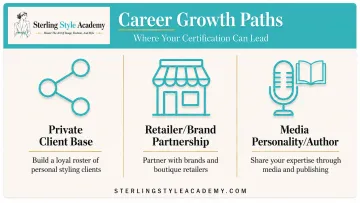
Growth paths in this industry generally fall into a few categories:
- Building a private client base through referrals and word-of-mouth
- Partnering with retailers or brands as a personal shopper or brand consultant
- Becoming a media personality or author, which several established stylists have used to expand well beyond one-on-one client work
Stylists who reinvest in specialized training—advanced color analysis, executive image consulting, or business-launch skills—often gain pricing power generalist credentials alone don't unlock. Niche expertise plus a clear track record tends to justify higher rates faster than years of broad experience. Programs that pair technical certification with practical business tools help new stylists move from training into paid client work with a defined offer and marketing foundation. If you are ready to start, Sterling's online personal stylist training and certification program sets out the full curriculum, formats, and enrollment steps.
Frequently Asked Questions
What qualifications do I need to be a stylist?
No state license is required for personal styling or image consulting. Clients and employers care most about recognized certification and practical training, plus proof you can run a business.
How hard is it to become a stylist?
There's a real learning curve with color theory, body analysis, fabric knowledge, and styling technique. Long-term success still hinges more on consistent practice and client-facing skills than on raw talent.
How much does a stylist get paid a year?
U.S. personal stylists report a median total pay around $73,000, with a typical range of $54,000 to $99,000. Income scales with your niche, reputation, and how you structure the business.
Do I need a license to become a personal stylist or image consultant?
No. Unlike cosmetology or barbering, personal styling and image consulting are unregulated—you don't need a state license to practice. Credentials come from professional certification programs, not a government board.
How long does it take to become a certified stylist?
It depends on format. Self-paced online programs can take days to several months; live online training often runs a few months. In-person bootcamps range from a single day to two weeks.
What's the difference between a personal stylist and an image consultant?
A personal stylist typically focuses on wardrobe and color for an individual client, including body shape. An image consultant usually builds on that with personal branding, communication style, and professional presentation.