
Introduction
You know that friend who looks incredible in mustard yellow but somehow washes out in icy pink? That's not personal taste. It's color science.
Many people keep reaching for rust, olive, and chestnut brown—and still struggle to understand why other shades leave them washed out. Personal color analysis explains it, and the method is surging again. Color analysis is "all over TikTok," as USA Today reported in 2024, with the trend also fueling a personal-color tourism boom in South Korea.
Among the twelve recognized color seasons, Warm Autumn consistently ranks as one of the most searched-for results. This guide covers how to spot one, the traits that define it, the best (and worst) colors to wear, and how to get a definitive answer when DIY checks still leave you unsure.
Key Takeaways
- Warm Autumn combines golden undertones, medium-to-dark value, and muted, low-chroma coloring
- Four factors define every season: undertone, value, chroma, and contrast
- Best colors: rust, olive, mustard, chestnut, warm ivory — avoid icy pastels, true black/white, and neons
- Warm Spring is the "sister season" — bright and clear, versus Autumn's muted richness
- Self-quizzes help you start; a professional analysis clears the gray areas most people miss
What Is Warm Autumn Color Analysis?
Seasonal color analysis sorts people into one of twelve sub-seasons based on four traits: undertone, value, chroma, and contrast. Warm Autumn (often called True Autumn) is the central Autumn season, between Soft Autumn and Dark Autumn.
People use their season to:
- Build a mix-and-match wardrobe with fewer unworn pieces
- Choose foundation, blush, and lipstick shades that suit their undertone
- Pick a flattering hair color instead of guessing at the salon
- Shape a polished, camera-ready professional image
Two paths lead to an answer. Self-guided quizzes ask about your hair, eyes, and skin and generate a season based on your answers.
In-person fabric draping is more hands-on: an analyst holds colored fabrics near your face under neutral light so you can see which tones brighten your skin and which dull it. Quizzes are a useful starting point; draping is what confirms the result.
Why Knowing Your Color Season Matters
Wearing your right colors isn't about vanity. It's about efficiency and confidence.
Once you know your palette, a few things change:
- Skin looks brighter and healthier instead of tired or sallow—the right hues cast flattering light on your face
- Shopping gets faster and cheaper: no more impulse buys that hang in the closet with tags on because they "don't feel right"
- Building a capsule wardrobe becomes simple, since everything in your palette naturally coordinates
- Makeup shopping loses the guesswork: you know your foundation undertone, blush family, and lipstick range before you walk into a store
- Hair color decisions get easier, since you're matching pigment to your existing warm or cool base
For anyone in a client-facing, executive, or on-camera role, this matters even more. A cohesive, well-chosen palette reads as intentional and put-together, which is why color direction is central to most executive image consulting programs.
How to Tell If You're a Warm Autumn
Professional analysts never rely on one clue. They check four dimensions together: undertone, chroma, value, and contrast. Skipping that multi-factor check is the most common DIY mistake. Spotting warmth in your skin and stopping there means you miss chroma and contrast entirely.
Warm Autumn sits on the warm side of the wheel, like Spring, but it's deeper and more muted. Think of it as Spring's richer, dustier cousin — same warmth, far less brightness.
Hair & Eye Signs
- Hair: golden blonde, auburn, medium-to-dark golden brown, warm red, or black with a golden halo visible in sunlight
- Eyes: warm brown, hazel, olive or warm green, amber, golden brown — occasionally a teal-cast blue
Skin Undertone & Contrast
Skin tone ranges from fair to deep, but it always carries a golden, peachy, or bronze undertone.
A quick self-check: hold gold and silver jewelry against your wrist. If gold makes your skin glow while silver looks flat or gray, that's a warmth signal—not a full diagnosis on its own.
On contrast, features tend to blend with low-to-medium difference between hair, skin, and eyes. The overall effect is soft and harmonious rather than sharp or high-contrast.
Warm Autumn vs. Warm Spring (Avoiding the Most Common Mix-Up)
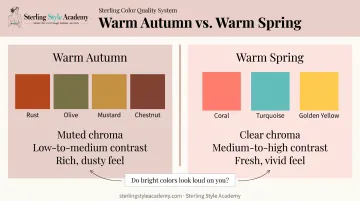
Both seasons share warm undertones, which is exactly why they get confused. The difference is intensity:
| Trait | Warm Autumn | Warm Spring |
|---|---|---|
| Chroma | Muted, dusty | Bright, clear |
| Contrast | Low to medium | Medium to high |
| Palette feel | Rich, earthy | Fresh, vivid |
The simple test: if bright, saturated colors make you look "loud" or costume-like, but muted earth tones make your skin glow, you're a Warm Autumn. If the reverse is true, you're likely a Warm Spring.
The Warm Autumn Color Palette: Best Colors, Makeup & What to Avoid
Warm Autumn colors are rich, earthy, and golden-based. They echo harvest tones and bring out natural warmth in skin, hair, and eyes.
Signature Clothing Colors
- Burnt orange, terracotta, rust, and brick red
- Olive and forest green
- Mustard and golden yellow
- Coffee and chestnut brown
Warm neutrals land best: warm ivory, oyster, cream, and camel. Skip stark white, cool gray, and jet black.
Metals and accessories: gold, copper, bronze, and brass in antiqued or hammered finishes—not polished, mirror-bright versions. Amber and warm green gemstones complete the look.
Makeup Essentials for Warm Autumn
- Eyes: warm-toned browns, bronze, and olive/khaki shades instead of ashy taupe or cool blue-based shadows
- Cheeks and lips: peach, coral, or brick tones rather than icy pink or blue-based reds
- Highlighter: gold or champagne shimmer, never silvery or icy
Colors to Avoid
These shades fight Warm Autumn coloring—either too cool (graying the skin) or too saturated (overwhelming its natural mutedness):
- Icy pastels and blue-based pinks or fuchsias
- True black and stark white
- Neon brights
How Sterling Personal Styling Can Help
DIY quizzes are useful for a first guess. They're just not built to catch the nuance between, say, a Soft Autumn and a Warm Autumn with slightly higher contrast, and that's where most self-analysis goes wrong.
Sterling Personal Styling addresses this with the Sterling Color Quality System™, developed by founder Michelle T. Sterling over more than 20 years of client work. Rather than asking you to check a box and land on a category, the system evaluates undertone, value, chroma, and contrast as four independent variables before building a recommendation.
You get the same rigor professional analysts apply, without the guesswork of a generic quiz. Sessions run virtually worldwide or in person, from photo-based analysis through live consultation paired with a virtual closet review (typically $247–$6,000+ depending on scope).
If you simply want your own palette confirmed, Sterling runs an online color analysis consultation and a full color analysis session with a trained analyst. For beauty professionals — stylists, makeup artists, colorists — looking to add a specialized service, Sterling Style Academy's Color Analysis certification covers the twelve-season foundation alongside the SCQS methodology. You can train through:
- 2-day in-person bootcamps in Miami, New York, Dubai, Paris, Milan, and Los Angeles
- Self-paced online certification, studied on your own schedule
- Live instructor-led programs with direct instructor guidance
Beyond the credential itself, professionals gain access to a global alumni network spanning 60+ countries. As with most industry education, the training investment is typically tax-deductible as a business expense.

Frequently Asked Questions
What are the top colors for warm autumn color analysis?
The best colors are rust, olive, mustard, chestnut brown, and warm ivory. Avoid icy pastels, true black, pure white, and neon brights, which tend to overpower or wash out Warm Autumn coloring.
What's the difference between Warm Autumn and Warm Spring?
Both are warm-based seasons, but Warm Autumn is muted and rich while Warm Spring is bright and clear. Wearing the wrong one either dulls or overwhelms your natural coloring.
Can Warm Autumns wear black?
True black is generally too cool and harsh for this palette. Dark chocolate brown or deep olive green offer the same depth with far more flattering warmth.
What jewelry metals suit a Warm Autumn?
Gold, copper, bronze, and brass all work well, especially in antiqued or matte finishes rather than high-polish, mirror-bright metals.
Is Warm Autumn the same as True Autumn?
Yes. "True Autumn" and "Warm Autumn" refer to the same central sub-season within the Autumn family and are used interchangeably.
How can I be sure I'm really a Warm Autumn and not another season?
Self-quizzes are a helpful starting point, but they often miss the nuance between neighboring seasons. A professional consultation or fabric draping session removes the guesswork and confirms your season clearly.