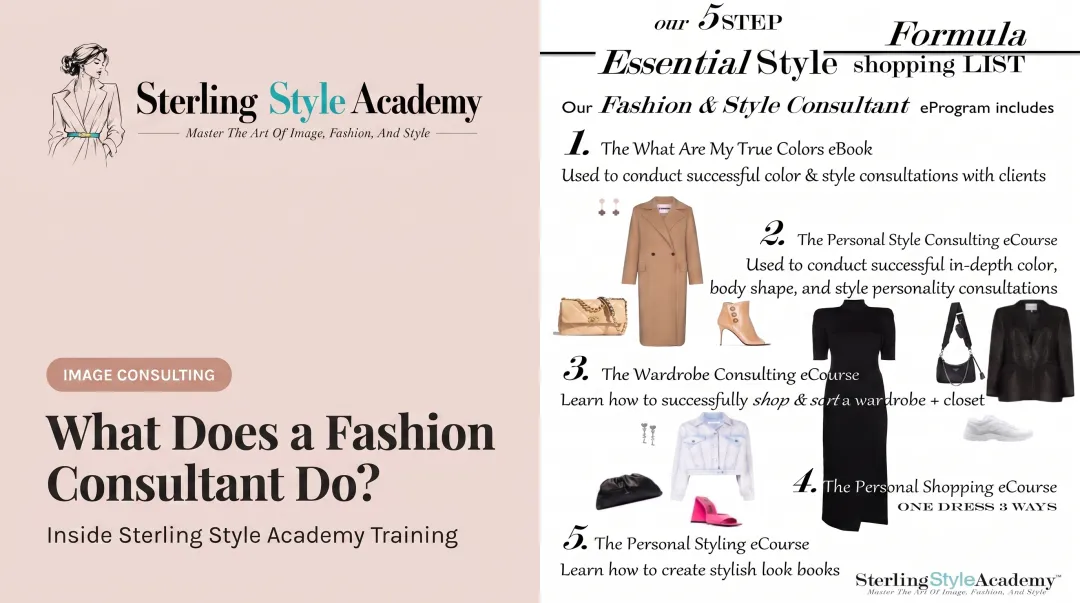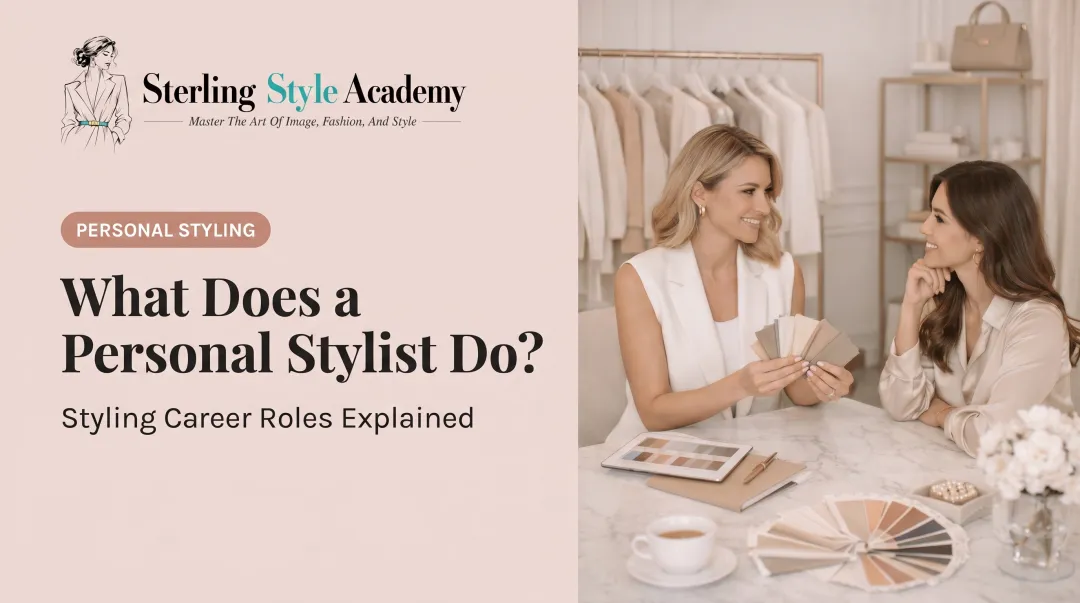
If you've researched this career, you've probably hit a wall of confusing titles: personal stylist, image consultant, style consultant. What's the difference? And more importantly, how do you actually build credibility in a field that anyone can claim to work in?
This guide breaks down the skills, certification paths, and business steps you need to launch a real style consulting career in the US.
Key Takeaways
- Structured training now outperforms informal experience for building client trust
- Pair technical skills (color, proportion) with soft skills (communication, empathy) to keep clients
- Build a sustainable business model—it matters as much as styling talent
- Recognized certification programs fast-track your credibility with new clients
What Is a Style Consultant?
A style consultant advises clients on wardrobe, color, and personal branding to align their appearance with personal or professional goals. It's a broad, umbrella term, and that's exactly why it causes confusion.
Style Consultant vs. Personal Stylist vs. Image Consultant
These titles overlap more than they differ. A personal stylist (also called a style consultant, style coach, or fashion consultant) typically focuses on clothing choices, wardrobe edits, and personal shopping suited to a client's lifestyle.
An image consultant has a broader mandate. The role covers three areas: physical appearance, behavior, and communication skills. That means color analysis, body and facial analysis, wardrobe planning, grooming, etiquette, and executive presence coaching all fall under this title.
Here's the practical distinction: a well-trained image consultant can usually work as a personal stylist, but a personal stylist isn't necessarily trained to handle full image consulting work.
Who hires style consultants?
- Executives building professional presence
- Everyday consumers refreshing their wardrobe
- Brides preparing for their wedding
- Media personalities and public speakers
- Companies running corporate image training
Essential Skills for Style Consultants in 2026
Technical Skills
Clients expect real expertise, not just good taste. That means:
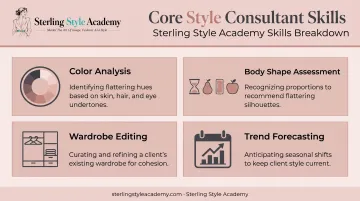
- Color analysis: identifying undertone, temperature, value, chroma, and contrast to build personalized palettes
- Body shape assessment: proportion mapping across categories like hourglass, pear, rectangle, apple, and athletic builds
- Wardrobe editing: closet audits and capsule-building
- Trend forecasting: staying ahead of seasonal shifts without chasing every fad
Interpersonal Skills
Styling is personal, sometimes deeply so. You need:
- Active listening to understand what clients actually want (not just what they say)
- Diplomatic communication for delivering honest feedback
- Quick trust-building when clients feel vulnerable about their appearance
Business Skills
Most style consultants work independently. You'll also need to handle the business side:
- Personal branding and marketing that attracts your ideal clients
- Client acquisition and retention systems that keep bookings steady
- Pricing strategy and financial planning for sustainable income
Step-by-Step Guide to Becoming a Style Consultant in 2026
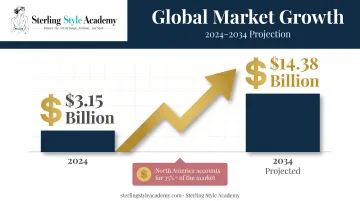
The opportunity is real. The global online personal-styling-services market was valued at $3.15 billion in 2024 and is projected to hit $14.38 billion by 2034. North America alone accounted for more than 35% of that market.
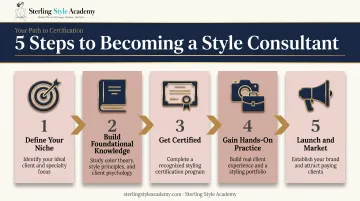
Step 1: Assess Your Strengths and Define Your Niche
Generalists struggle to stand out. Specialists don't. Pick a niche that plays to your strengths and matches local demand:
- Color analysis (seasonal palettes and undertones)
- Executive and leadership image consulting
- Bridal and special-event styling
- Wardrobe editing and capsule building
- Personal shopping for busy professionals A clear niche makes marketing simpler and helps clients find you faster.
Step 2: Build Foundational Knowledge
Before investing in certification, build a base through self-study:
- Fashion history and design principles (color, line, proportion)
- Textiles and fabric behavior
- Industry trends via podcasts, books, and trade publications
Step 3: Get Certified Through a Recognized Program
Self-teaching gets you started. Certification gets you hired faster. Clients want proof of structured training, not just personal taste. Look for programs that cover color theory, body and style analysis, client consultation skills, and business setup. Sterling Style Academy, for example, offers online self-paced and live-instructor certifications plus multi-day intensives in cities such as New York, Miami, and Los Angeles—so you can match format to your schedule and learning style.
Step 4: Gain Hands-On Practice
Practice on friends, family, or pro bono clients before charging full rates. Treat each session like paid work:
- Run full consultations, not casual advice
- Capture before-and-after photos with client permission
- Note what worked, what didn't, and how you'd price it
- Collect written testimonials while the experience is fresh That body of work becomes your portfolio and proof of results. It also helps to see the standard you are aiming at: Sterling's virtual personal styling and online color analysis sessions show how a professional structures the same hour you are practicing.
Step 5: Launch and Market Your Services
Put the basics in place so clients can find and trust you:
- A simple website or landing page with services, niche, and contact path
- Portfolio samples and testimonials from practice clients
- Consistent profiles on Instagram, LinkedIn, or both
- Local networking through chambers, co-working spaces, or bridal and vendor events Start with a few paid offers at introductory rates, then raise prices as demand and reviews grow.
Getting Certified: Why Training Matters in 2026
The style consulting market is crowded. Certification is how you prove you're not just another person with an eye for fashion.
Bootcamps vs. Self-Paced Online Certification
| Format | Best For | Trade-offs |
|---|---|---|
| In-person immersive bootcamps (1–14 days) | Hands-on learners who want direct coaching | Higher upfront cost, fixed travel and dates |
| Self-paced online certification | Career changers balancing other commitments | Requires self-discipline, less live feedback |
In-person programs usually run in small groups with direct feedback on real client scenarios. Self-paced formats trade that immediacy for flexibility so you can study around a current job.
Look for the "Business" Curriculum, Not Just Styling Technique
A program that only teaches styling leaves you stuck when it's time to charge for it. Sterling Style Academy, for example, builds what it calls a "Corporate America" approach into its curriculum: pricing, branding, marketing systems, and client retention, alongside color analysis and body-proportion training.
Sterling's founder, Michelle T. Sterling, built her career in luxury fashion consulting with brands like Giorgio Armani and Cartier. That background shapes the Academy's emphasis on building a real business, not just a hobby.
Its instructor team carries a combined 50 years of industry experience, and its alumni network spans more than 60 countries—including Yuuri Takano, who trained in New York before becoming one of Japan's leading image consultants.
A quick note on cost: Professional development training is often tax-deductible as a business education expense in the US and can offset part of the upfront cost. Confirm eligibility with a tax professional for your situation.
Add-On Certifications for Working Stylists
Already styling clients but want to add a premium service? Color analysis certifications let existing stylists, makeup artists, and hairstylists expand their offering without starting over. These programs typically run a few weeks, stack on top of existing skills, and support higher-fee color services.
Launching and Growing Your Style Consulting Business
Credentials get you in the door. Brand, pricing, referrals, and diversified income keep the practice alive past the first few clients.
Build Your Personal Brand
Your brand is your proof. Prioritize:
- A portfolio site with before/after client transformations
- Consistent visual identity across social platforms
- Client testimonials front and center
Choose Your Pricing Model
Most consultants use one of three approaches:
- Hourly consulting — simple to sell, but income scales only with hours worked
- Package deals — outcome-based bundles (full wardrobe refresh, seasonal edit) priced on results, not time
- Personal shopping commissions — a percentage earned on client purchases
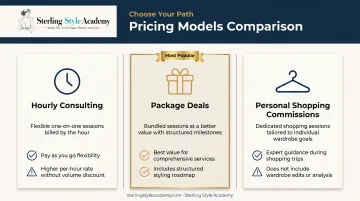
Packages usually win because clients buy a clear result instead of your clock.
Network Strategically
- Partner with boutiques, salons, and photographers for referral pipelines
- Join professional bodies for credibility and referral networks
- Speak at local business and professional networking events
Build for Stability, Not Just Trends
Trend spikes fade. Build a practice that holds up in slow seasons:
- Repeat-client systems and scheduled follow-ups
- Referral partners who send steady leads
- Side income from workshops, corporate seminars, or digital products
Salary Expectations and Career Outlook
Earnings vary widely by niche, location, and experience. A few benchmarks:
- Personal fashion stylists average $37,822/year
- Entry-level pay starts near $32,183; stylists with 8+ years can reach $86,413
- Image consultants average about $47.12/hour, with rates varying widely by market (ZipRecruiter)
- Freelancers set their own rates, which typically rise as reputation and referrals grow
Top earners rarely rely on client sessions alone. Many add speaking, media work, books, or courses on top of consulting.
Outlook is broader than wardrobe work alone. Corporate image consulting, personal branding, and virtual styling continue to open paths for consultants who pick a clear niche and build more than one way to earn. When you are ready to formalize the skills, Sterling's online personal stylist training and certification program covers the full curriculum and enrollment steps.
Frequently Asked Questions
Is 30 too old to become a style consultant?
Not at all. Style consulting welcomes career changers of any age, and life experience often strengthens client relationships rather than hindering them. Many successful consultants started this career in their 30s, 40s, or later.
What is the 3-3-3 rule for fashion?
It's a capsule wardrobe concept: three tops, three bottoms, and three pairs of shoes that all mix and match. Consultants use it to simplify wardrobe editing and teach clients to build versatile closets.
What is the 60/30/10 rule in fashion?
It's a color-proportion guideline: 60% dominant color, 30% secondary color, and 10% accent color in an outfit. Consultants often use it when advising clients on balanced, cohesive color combinations.
Do I need a diploma to become a style consultant?
No formal diploma is legally required. That said, certification builds credibility and client trust faster than self-teaching alone, and it helps you communicate your methodology with confidence.
How long does it take to become a certified style consultant?
Timelines range from a single day for an intensive bootcamp to several months for comprehensive self-paced certification. Most programs fall somewhere between one and two weeks of in-person training or 60+ hours online.
How much can a style consultant earn in their first year?
Earnings depend heavily on niche, location, and how quickly you acquire clients. There's no guaranteed first-year number, but freelance stylists with under a year of experience report averages in the low $40,000s, which can serve as a rough benchmark.