One helps you build a wardrobe that works. The other helps you rebuild how the world reads you, from your handshake to your handbag. Confuse the two, and you might pay for a closet edit when what you actually need is executive presence coaching, or vice versa.
This guide breaks down what each role covers, what they typically cost, and how to decide which one fits your goal, whether you're hiring one or training to become one.
Key Takeaways
- Personal stylists focus on wardrobe and outfits; image consultants cover appearance, behavior, and communication
- Styling work is often project-based; image consulting is typically deeper and ongoing
- Many professionals train in both disciplines to offer complete client services
- Choose a stylist for a fashion refresh, or an image consultant for full personal-brand transformation
Image Consultant vs Personal Stylist: Quick Comparison
| Dimension | Personal Stylist | Image Consultant |
|---|---|---|
| Scope | Clothing, accessories, wardrobe editing, outfit building | Appearance, grooming, etiquette, body language, communication, personal branding |
| Engagement | Project-based (event, season, wardrobe refresh) | Ongoing, transformation-focused |
| Cost Range | Roughly $247–$5,000 for wardrobe/styling packages | $2,500–$6,000+ for executive image programs; some clients invest $15,000 annually |
| Client Type | Individuals wanting event dressing, closet edits, wardrobe refreshes | Executives, entrepreneurs, public figures building professional presence |
| Core Skillset | Fashion knowledge, color and body-shape analysis, trend awareness | Psychology, communication training, etiquette, branding strategy, plus styling fundamentals |
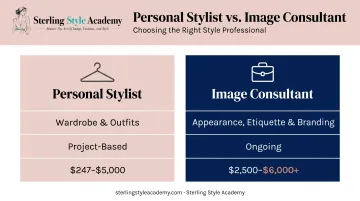
Note: Published pricing varies widely by market. Wardrobe consultants commonly charge $25 to $120 an hour, and full packages in major markets such as New York can run past $1,300. Sterling Personal Styling's own in-person packages run from $2,250 to $6,000+, depending on scope and city.
What is a Personal Stylist?
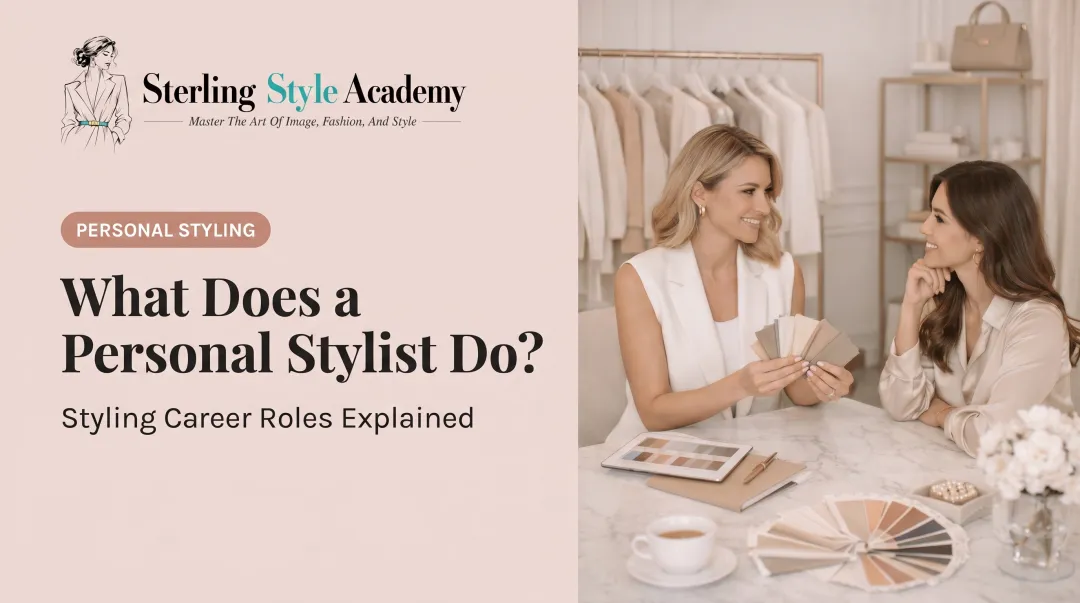
A personal stylist works directly with you to build a wardrobe around your body, lifestyle, and taste—not for a magazine shoot or a runway model. This is what separates personal styling from fashion styling: it's about your closet, not a creative brief.
Core benefits include:
- Wardrobe editing — deciding what stays, what gets tailored, what goes
- Color and body-shape-led outfit building — pieces that actually flatter you
- Trend adaptation — updating your look without chasing every micro-trend
- Occasion dressing — knowing exactly what to wear for the event that matters
Many stylists specialize. Some focus on bridal, others on capsule wardrobes or online personal shopping.
Use Cases of a Personal Stylist
Personal stylists fit naturally into:
- Closet edits and seasonal refreshes
- Event prep (weddings, galas, milestone birthdays)
- Travel packing and capsule-wardrobe building
- Ongoing "personal shopper" relationships for busy professionals
Those needs show up in concrete service formats. Sterling Personal Styling's Capsule Wardrobe Service ($247, or $597 with a fit session) is one example: a digital closet review, curated shopping picks (often 15-22 pieces), and a lookbook that turns scattered clothes into workable outfits.
A related Essential Style Package ($397 for two hours) covers closet editing or wardrobe consultation plus fit and coordination advice. As one client, Susan Riley, put it, shopping stopped feeling "overwhelming" once she had a plan.
The average American woman owns roughly 103 clothing items, per a ClosetMaid survey cited by the New York Times, yet most people wear only about 20% of their closet 80% of the time. That gap—too many pieces, too few outfits—is what a stylist is built to close.

What is an Image Consultant?
An image consultant works on something bigger than an outfit: your entire professional presence. The role centers on helping clients present themselves appropriately, communicate effectively, and act with confidence, covering wardrobe and color analysis along with etiquette, body language, and branding.
Core benefits include:
- Dresses you for the role you want, not just the one you have
- Coaches communication so speech and appearance work together
- Trains etiquette and protocol for cross-cultural or high-visibility roles
- Builds a coherent personal brand across meetings, media, and social platforms
Work often falls into corporate image consulting, protocol training, color analysis, or personal branding coaching, depending on the client’s goals.
Use Cases of an Image Consultant
This role fits executives, entrepreneurs launching a personal brand, professionals in career transitions, and anyone stepping into media appearances. Industries like finance, luxury retail, and entertainment lean on image consulting heavily, since first impressions carry outsized weight there.
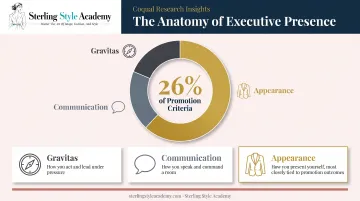
Research from Coqual found that senior leaders say executive presence accounts for 26% of what it takes to earn the next promotion, built on gravitas, communication, and appearance together. That's not proof that a consultant guarantees a promotion, but it does show why appearance rarely stands alone in professional perception.
Sterling Style Academy’s training approach reflects this blended model. Founder Michelle T. Sterling built the curriculum on a "Corporate America" foundation, paired with luxury-retail insight from affiliations with Giorgio Armani and Cartier.
That combined background is why the Academy teaches image, color, etiquette, and business development together, rather than treating wardrobe as the whole job.
Image Consultant vs Personal Stylist: Which Should You Choose?
Weigh these factors before booking anyone:
- Budget: Styling packages start lower; image consulting engagements run higher and longer
- Depth of transformation: Wardrobe-only fix, or a full shift in how you present professionally?
- Timeline: One event coming up, or an ongoing career transition?
- Personal vs. professional goal: A wedding outfit is personal; a promotion push is professional
Choose a personal stylist if: you need event dressing, a wardrobe refresh, or help shopping smarter.
Choose an image consultant if: you're navigating a career move, stepping into a public-facing role, or want confidence and presence to match your ambition.
Many clients need both, and many professionals train across both disciplines. Sterling Style Academy's certification programs teach stylist and consultant skill sets together, so students aren't forced to pick only one path.
Building a Career: Image Consultant or Personal Stylist Training
If you're considering this as a career—not just a service to hire—the training paths overlap more than most people expect.
Personal stylist training options include:
- 5-Day Personal Stylist & Personal Shopper Certification (in-person, major cities)
- Online Image Consultant & Personal Stylist Training (self-paced, roughly 60 hours)
Image consultant training options include:
- 7-Day Image Consultant Training & Personal Stylist Certification (in-person or online)
- 2-Week Image Consultant Training (in-person, hands-on coaching)
Beyond course length, formal credentialing sets a higher bar. A Certified Image Consultant (CIC) pathway typically requires:
- An ethics agreement
- 30 hours of preparation
- Documented client evaluations
- A portfolio review and exam
That is a real professional commitment. Certification still pays off for career switchers:
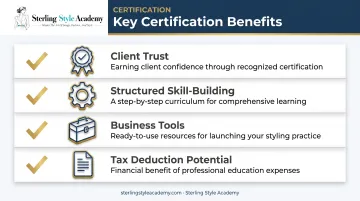
- Builds credibility with clients paying premium rates
- Replaces trial-and-error with structured skill-building
- Includes business tools for pricing, marketing, and client acquisition
- May qualify as a tax-deductible business expense (confirm with your accountant)
Sterling Style Academy's programs follow a structured professional framework, with alumni in 60+ countries. One example: Yuuri Takano trained in New York in 2005 and later helped pioneer Japan's image consulting industry.
Compare formats and timelines on Sterling Style Academy's certification programs—in-person intensives or self-paced online—and choose the path that matches how fast you want to launch.
Conclusion
The right choice comes down to matching the service, or the career path, to your actual goal. Want your closet to finally make sense? Hire a stylist. Want your presence to match your ambition in the boardroom? Bring in an image consultant. Plenty of top professionals do both, and structured training is what makes that combination possible. Sterling Style Academy builds its certification programs around exactly that overlap, so graduates leave equipped to offer wardrobe expertise and full image strategy, whichever a client actually needs.
Frequently Asked Questions
How much does an image consultant cost?
Rates generally range from $50 to $200+ per hour, with many projects requiring 8-12 hours. Sterling's executive packages start around $2,500 for virtual work and $3,000+ for in-person programs, depending on scope.
What does an image consultant do?
An image consultant addresses appearance, grooming, etiquette, communication, and personal branding as one connected strategy, not just clothing choices. The goal is a coherent professional presence.
Is an image consultant worth it?
It depends on your goal. If you're navigating a career transition or public-facing role, the confidence and clarity gained often outweigh the cost, though no consultant can guarantee a promotion or specific career outcome.
Can someone be both a personal stylist and an image consultant?
Yes. Many professionals combine both skill sets through comprehensive training, such as Sterling's 7-Day Image Consultant Training & Personal Stylist Certification, which covers styling, color analysis, and executive presence together.
What's the difference between a personal stylist and a fashion stylist?
Personal stylists work with everyday individuals on personal wardrobes. Fashion stylists typically work on editorial shoots, campaigns, or video, building looks to a creative director's brief.
Do I need certification to become an image consultant or personal stylist?
Certification isn't legally required, but it builds credibility, structured skills, and client trust. Sterling Style Academy programs provide a recognized credential plus practical business training.