
Demand for this kind of guidance isn't slowing down. The U.S. online personal styling services market was valued at $1.01 billion in 2024, growing at a reported 14.23% annual rate. People want help navigating their image, whether that's a closet overhaul or a full brand repositioning.
This article breaks down what a fashion consultant actually does, the skills the job demands, how the role differs from adjacent titles, and how to get trained and certified.
Key Takeaways
- Fashion consultants guide individuals, executives, and brands on image, styling, and market positioning
- The skill stack centers on color analysis, trend fluency, client communication, and business management
- The work overlaps with personal styling but stops short of fashion design (creating garments)
- Formal certification, such as Sterling Style Academy programs, builds client-ready credibility faster than self-teaching
What Does a Fashion Consultant Do?
A fashion consultant's job splits into two distinct tracks: helping individual clients look and feel their best, and helping brands or retailers sharpen their market identity. Some consultants work exclusively in one lane. Many move between both.
The Bureau of Labor Statistics describes image consultants as professionals who make style and clothing suggestions to transform how someone presents themselves, factoring in career, lifestyle, and personal goals. That's the foundation. But the scope can expand well beyond a single wardrobe session.
Personal Client Services
For individual clients, the work usually starts with a conversation, not a closet.
- Wardrobe audits — reviewing existing pieces for fit, relevance, and versatility, then flagging what to keep, tailor, or replace
- Personal shopping — curating new pieces based on the audit, often including fitting and alteration guidance
- Color analysis — identifying which tones flatter a client's skin, hair, and eyes
- Outfit coordination — building complete, wearable looks from existing and new pieces
Sterling Personal Styling, for example, packages these as standalone services or bundles. Virtual capsule wardrobe sessions start around $247, with in-person styling packages scaling by scope.

Many consultants also help clients build a personal brand for LinkedIn, media appearances, or executive visibility. That request is increasingly common as more professionals step into public-facing roles.
Brand and Business Services
On the business side, consultants work with labels and retailers rather than individuals.
Typical responsibilities include:
- Trend analysis and forecasting for upcoming seasons
- Brand identity development and market positioning
- Collection curation and merchandising input
- Sales team training on styling and customer presentation
- Campaign styling for lookbooks or marketing shoots
This side of the role demands commercial thinking as much as aesthetic judgment. A consultant advising a boutique on its spring collection needs to understand margins and customer demographics, not just what's trending on runways.
Skills Needed to Be a Fashion Consultant
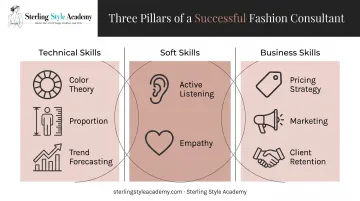
The best consultants blend three skill categories: technical, interpersonal, and business.
Technical skills form the foundation:
- Color theory and seasonal color analysis
- Proportion and silhouette knowledge
- Trend forecasting
- Fabric and garment literacy
Soft skills determine whether clients trust the advice:
- Active listening when clients can't articulate what they want
- Empathy for clients navigating body changes or career shifts
- Translating vague goals ("I want to look more confident") into concrete visual choices
The BLS notes that reading and understanding people is essential to the job, more so than any single technical skill.
Business skills are where many talented stylists fall short:
- Personal branding and marketing
- Client management and retention
- Pricing and packaging services sustainably
Sterling Style Academy founder Michelle T. Sterling is a clear example. She has worked with fashion houses like Giorgio Armani and Cartier.
Her "Corporate America" approach to training treats styling as a business, not only a creative outlet. Color and proportion skill only go so far without the ability to price, market, and retain clients.
Fashion Consultant vs. Related Roles
The terminology overlap here trips up a lot of newcomers. Here's the practical breakdown:
| Role | Primary Focus | Output |
|---|---|---|
| Fashion Consultant | Image, trend direction, brand positioning | Advice, strategy, recommendations |
| Fashion Designer | Garment creation and production | Physical clothing, sketches, patterns |
| Personal Stylist | Individual wardrobe and outfit building | Curated looks, shopping guidance |
| Image Consultant | Full personal presentation, including communication | Wardrobe, behavior, and branding guidance |
Fashion consultant vs. designer is the clearest distinction. The BLS defines fashion designers as professionals who create original clothing and accessories, sketching designs and selecting fabrics. That's product creation. A consultant never touches a sewing machine or pattern block; their output is advice, not garments.
Fashion consultant vs. personal stylist is murkier. Many professionals do both, and job titles often depend on marketing preference rather than a real difference in services. A stylist typically focuses on outfit-building for individuals, while a "fashion consultant" title sometimes signals broader scope, including brand work.
The term "fashion consultant" is increasingly used across editorial, corporate, and creative-director backgrounds. Don't get hung up on titles. Focus on what services someone actually delivers.
How to Become a Fashion Consultant
There's no single path into this career. Three common entry points show up repeatedly:
- Self-taught stylists who build a portfolio through friends, family, and word-of-mouth referrals
- Career changers from retail, fashion buying, or even finance who pivot using transferable skills
- Formally certified consultants who complete a structured training program
Why Certification Matters
Nothing legally requires certification to call yourself a fashion consultant. But formal training solves three problems at once:
- Teaches technical skills systematically
- Signals credibility to clients who've never met you
- Often includes a business-building framework you won't get from YouTube alone
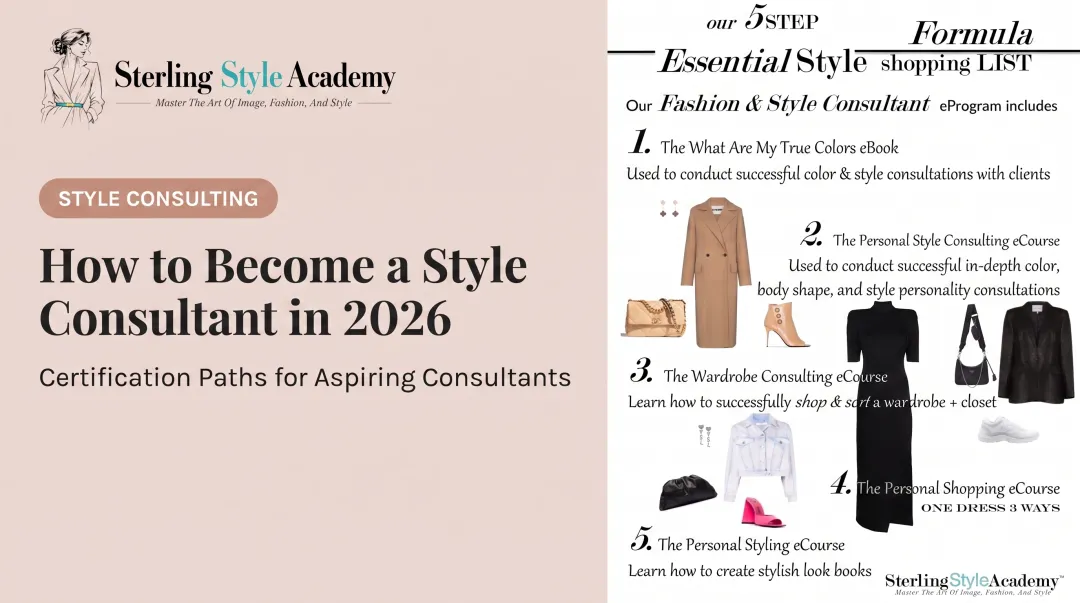
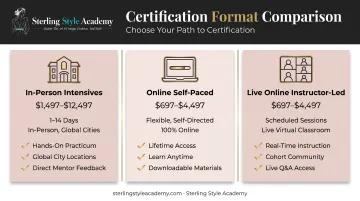
Sterling Style Academy's programs illustrate the range available:
- In-person intensives, from a 1-day stylist training ($1,497) to a 2-week image consultant certification (roughly $7,000), held in cities including New York, Miami, Dubai, and Paris
- Online self-paced options, starting around $697–$997 for stylist and fashion consultant eCertifications
- Live online instructor-led programs, running up to $4,497 with a payment plan available
Programs like these also connect graduates to a global alumni network, in Sterling's case spanning 60+ countries, which can lead to referrals, mentorship, and job opportunities long after graduation.
Build a Portfolio and Pick a Direction
Once trained, specialize. Color analysis, executive image consulting, and bridal styling are common niches. Building a focused portfolio in one area, then expanding, tends to work better than trying to be everything to everyone from day one.
One practical note: training costs are often a tax-deductible business investment for career changers launching a consulting practice, which makes certification more accessible than the sticker price suggests.
Career Outlook and Earning Potential
The U.S. Bureau of Labor Statistics (BLS) doesn't track "fashion consultant" as a distinct occupation, so there's no official growth projection for this title. Earnings figures come from market estimates and platform-reported salary ranges.
Personal stylist salary estimates vary widely depending on the source:
- Glassdoor reports total pay between $54,000 and $99,000 annually, with a median around $73,000
- ZipRecruiter estimates a lower average around $43,800 annually, roughly $21/hour
That gap reflects how much earnings depend on specialization, location, and client type. A generalist stylist serving hourly retail clients earns far less than a consultant running executive image engagements.
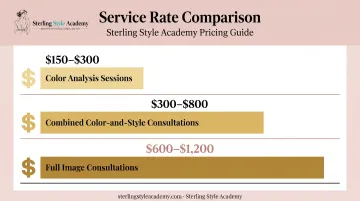
Rate benchmarks by service type:
- Color analysis sessions: $150–$300
- Combined color-and-style consultations: $300–$800
- Full image consultations: $600–$1,200
Consultants who specialize, particularly in color analysis, often build recurring revenue and a premium client base faster than generalists. A focused niche tends to command higher per-session rates than generalist styling work. To build that foundation formally, Sterling's online personal stylist training and certification program sets out the curriculum, formats, and enrollment steps.
Frequently Asked Questions
What is a fashion consultant called?
Fashion consultants are also called image consultants, personal stylists, or style consultants. These titles are used interchangeably; the exact term usually reflects the professional's preference and service focus.
What skills do you need to be a fashion consultant?
Core skills include color analysis, trend awareness, strong communication, and business management. Successful consultants also need empathy and the ability to translate client goals into visual choices.
What is the 3-3-3 rule for fashion?
The 3-3-3 rule is a capsule wardrobe concept: three tops, three bottoms, and three pairs of shoes that mix into dozens of outfits. Consultants use it to simplify client wardrobes and show how far fewer pieces can go.
What is the difference between a fashion consultant and a fashion designer?
A fashion designer creates original garments, sketching designs and selecting fabrics for production. A fashion consultant advises on styling, image, and brand positioning without creating physical clothing.
How much do fashion consultants charge for their services?
Rates vary by specialization, experience, and client type—from around $150 for a color analysis session to over $1,200 for full image consultations. Local market rates and project scope drive where a given consultant lands in that range.
Do I need a certification to become a fashion consultant?
Certification isn't legally required, but it boosts credibility, technical skill, and client trust. Formal training also gives structured business guidance that's harder to piece together on your own.