This guide covers all three dimensions that make up an executive brand: digital presence, communication style, and physical presence. You'll get the frameworks executives actually use, the mistakes that quietly undermine credibility, and where professional guidance accelerates the process.
Key Takeaways
- Treat personal branding as a core career and business asset in 2026
- The strongest executive brands pair digital visibility with real-world executive presence
- Authenticity and consistency beat polish and self-promotion in 2026
- An image consultant helps validate your brand and accelerate the transformation
What Is Executive Personal Branding and Why It Matters in 2026
Executive personal branding is the reputation, visibility, and presence a leader builds. It's how boards, investors, employees, and media perceive a leader before, during, and after direct contact.
Employees notice when leaders show up online. According to Brunswick Group's Connected Leadership research, employees prefer CEOs active on social media over those who aren't by more than a 5:1 margin, and they trust connected leaders at a similar rate. During a crisis, nine out of ten employees and financial readers say it matters that a CEO communicates actively about it.
That preference doesn't disappear once you're hired, promoted, or seated on a board. It's ongoing.
The Business Case for Investing in Your Brand
A strong personal brand does concrete work for a career:
- Recruitment appeal — search firms and boards increasingly screen digital footprint alongside résumés
- Board opportunities — visible, credible leaders get considered for seats they never applied for
- Internal influence — teams follow leaders whose presence feels consistent, not performative
Consider the math on image consulting alone: an executive investing $2,000–$5,000 in professional presence work, paired with a salary move from $100,000 to $120,000 plus bonus, nets a $20,000 gain against a fraction of that in spend. That's illustrative, not a guarantee — but it frames the decision correctly.
Many Sterling Personal Styling clients treat this kind of investment as part of their broader professional development budget, the same way they'd view executive coaching or an MBA elective.
The 7 Pillars of Personal Branding
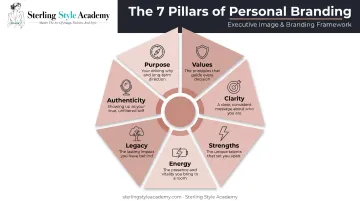
Forbes Coaches Council contributor Jill Hauwiller outlined seven pillars that remain one of the most cited personal branding frameworks: Purpose, Values, Clarity, Strengths, Energy, Legacy, and Authenticity.
Ownership often sits alongside these as a mindset, not a formal eighth pillar.
Here's how each applies to an executive:
- Purpose — the "why" behind your leadership. This becomes the spine of your bio and every mission-driven story you tell.
- Values — what you refuse to compromise on, publicly and privately.
- Clarity — a positioning statement people can repeat back to you accurately.
- Strengths — the recurring problem you're known for solving.
- Energy — what drains you and what restores you. Both show up in every room you enter.
- Legacy — the long-term imprint you're building, not just this quarter's wins.
- Authenticity — showing up as yourself consistently, not a different persona for every room.
Quick example: An executive leading a supply-chain turnaround might combine Purpose ("I fix broken systems before they break companies") with Strengths ("15 years untangling operational chaos") and Legacy ("building teams that outlast my tenure"). That's a three-sentence introduction, not a paragraph.
Building Executive Presence: Beyond the Digital Profile
Your LinkedIn headline means nothing if you show up to the boardroom looking uncertain. Personal branding lives offline too: wardrobe, body language, tone, how you carry yourself under pressure.
Harvard Business Review's 2024 framing of executive presence still comes back to three attributes: gravitas, communication skill, and the "right" appearance. Appearance works as a credibility signal. It either reinforces your digital narrative or undercuts it.
Where Image Consulting Fits
Sterling Personal Styling's executive image consulting builds around:
- Executive image and personal-brand analysis tied to color, proportions, and leadership goals
- Wardrobe architecture and strategy, including outfit formulas and digital wardrobe audits
- Perception and presence strategy for high-stakes settings
- A digital image playbook for repeatable, long-term visual direction
Programs run 8–16 hours in person (available in NYC, Miami, Los Angeles, Paris, and Dubai) or 10–16 hours virtually, worldwide.

The Research Behind Appearance and Trust
Peer-reviewed research backs up why this matters. A 2025 PLOS ONE study on leadership perception found that trustworthiness and perceived age were stronger predictors of leadership attainment than competence or attractiveness. In other words, how composed and credible you look shapes whether people extend trust before you've said a word.
Visual credibility is only half the room. Storytelling, tone, and on-camera presence for interviews and panels usually sit alongside this work, through an image consultant's network or a dedicated executive coach.
The 5 P's and 5 C's Frameworks: Choosing Your Branding Model
Beyond the 7 Pillars, two other models circulate widely: The 5 P's:
- Purpose
- Positioning
- Perception
- Presentation
- Promotion The 5 C's:
- Clarity
- Consistency
- Content
- Communication
- Credibility Both overlap heavily with the 7 Pillars framework. None is more "correct" than the others. What matters is picking one and sticking with it. Mixing frameworks leads to muddled messaging: a bio built on "Purpose and Positioning" language, a LinkedIn summary built on "Clarity and Content" language, and a boardroom introduction that sounds like neither. Choose one lens and run every piece of your brand through it.
The 3-7-27 Rule and Building Consistency Online
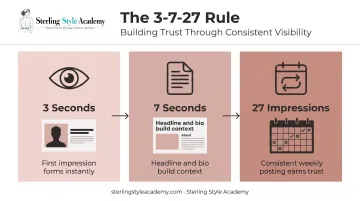
A popular shorthand in branding circles: first impressions form in roughly 3 seconds, sharpen over the next 7, and solidify after around 27 repeated exposures. Treat this as a useful rule of thumb rather than a lab-tested statistic. The underlying logic still holds up.
Here’s how it maps to LinkedIn:
- The 3-second impression — your headline, profile photo, and banner. LinkedIn data shows profiles with a photo get 21 times more views and 9 times more connection requests than those without.
- The 7-second read — your headline copy and the first two lines of your "About" section. Lead with the value you create, not a title stack.
- The 27-impression build — consistent, weekly insight-sharing. One outdated post from six months ago doesn't build trust. A steady rhythm does.
If your photo is five years old and your last post was during a different job, you're resetting the clock every time someone finds you.
Common Mistakes Executives Make With Personal Branding
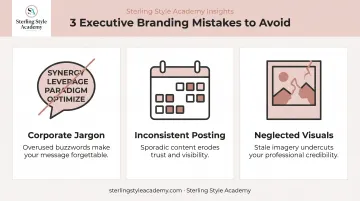
Three mistakes show up repeatedly:
- Leaning on corporate jargon instead of storytelling. "Driving synergies across cross-functional teams" tells a reader nothing memorable. A specific story does.
- Inconsistent posting and visibility. A burst of activity followed by months of silence reads as inauthentic, not busy.
- Neglecting visual elements. An outdated headshot or a wardrobe that doesn't match your current role signals stagnation, even when your work doesn't.
All three trace back to one root cause: treating branding as a one-time project instead of an ongoing practice. That mindset also feeds a broader trust problem. Edelman's 2025 US Trust Barometer found that concern over business leaders exaggerating or misleading has risen 6 points since 2021. Overpolished, inconsistent messaging deepens that suspicion.
Frequently Asked Questions
What are the 7 pillars of personal branding?
Forbes Coaches Council identifies Purpose, Values, Clarity, Strengths, Energy, Legacy, and Authenticity as the seven pillars. Together they cover why you lead, what you stand for, and the imprint you leave behind.
What are the 5 P's of personal branding?
Purpose, Positioning, Perception, Presentation, and Promotion. This model overlaps with the 7 Pillars but frames branding more like a marketing strategy than a leadership philosophy.
What are the five C's of personal branding?
Clarity, Consistency, Content, Communication, and Credibility. It's a practical framework focused on day-to-day execution rather than deeper purpose or legacy.
What is the 3-7-27 rule of branding?
It's shorthand for how first impressions form: roughly 3 seconds for an initial read, 7 seconds to sharpen it, and about 27 repeated impressions before trust solidifies. Treat it as a guiding principle, not a scientific benchmark.
How long does it take to build an executive personal brand?
Visible momentum, like profile traffic or inbound interest, can appear within 60–90 days of consistent effort. Strong, durable brand equity typically builds over 6–12 months.
Should executives hire a professional for personal branding help?
Yes, particularly for the visual and presence side. Sterling's executive image consulting, led by certified image consultant Michelle T. Sterling, helps align in-person credibility with digital narrative through structured, hands-on programs.